Balancing Player Agency With Narrative Structure in Your Campaign
The False Dichotomy
The tabletop RPG community often frames agency and narrative as opposing forces: more player freedom means less story structure, and more structure means less freedom. This is a false dichotomy. The best campaigns have both — players who feel genuinely free to make meaningful choices within a narrative that builds toward something satisfying.
The real tension is not between agency and story. It is between preparation and improvisation. A GM who over-prepares creates a railroad. A GM who under-prepares creates a sandbox with no stakes. The sweet spot is a GM who prepares a narrative framework flexible enough to accommodate any player choice while still providing direction and escalation.
What Player Agency Actually Means
Player agency is not "the players can do anything." It is "the players' choices have meaningful consequences." A player who can go anywhere but whose choices never matter does not have agency — they have an illusion of freedom.
True agency requires:
- Awareness — Players understand the situation and the available options well enough to make informed decisions
- Meaningful options — At least two viable paths forward that lead to genuinely different outcomes
- Consequences — The chosen path affects the story in ways the players can observe
- Persistence — Consequences persist over time and shape future options
A campaign where every path leads to the same destination has no agency. A campaign where choices lead to unpredictable, unrelated outcomes has agency but no story. The goal is choices that lead to different but narratively coherent outcomes.
The Narrative Framework Approach
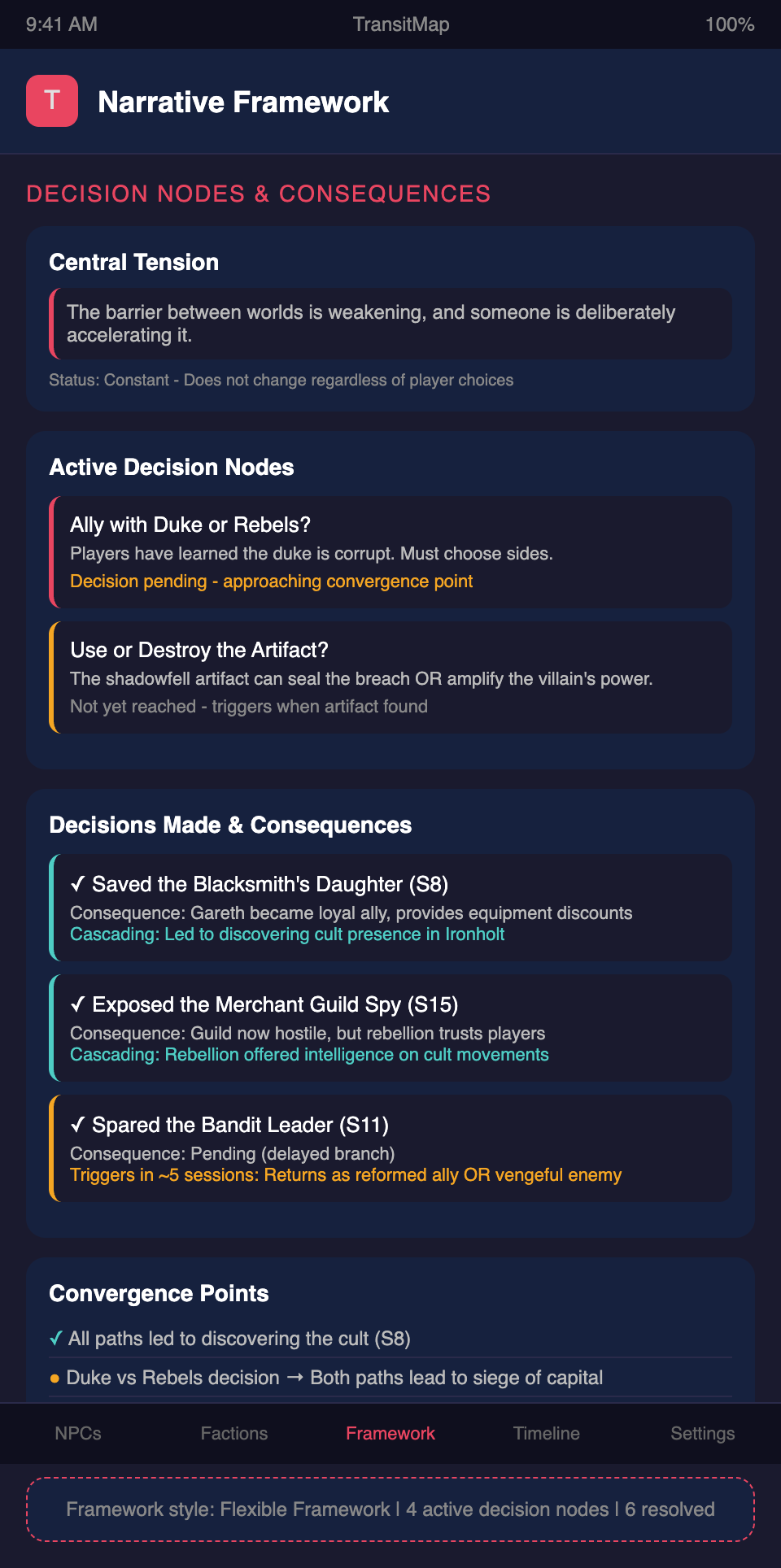
Instead of planning a linear story or an open sandbox, plan a narrative framework — a structure that defines the shape of the story without scripting the content.
A narrative framework includes:
The central tension — The fundamental conflict that drives the campaign. This does not change regardless of player choices — it is the constant that holds the story together. "The barrier between worlds is weakening" is a tension. "The players must collect five crystals to seal the barrier" is a script.
Pressure points — Moments when the central tension escalates. These are not scripted events — they are conditions. "When the players reach level 8 or when three in-game months have passed, the first barrier breach occurs." The trigger is flexible; the escalation is inevitable.
Decision nodes — Points where the players must make a choice that shapes the rest of the campaign. These are designed in advance as situations, not as scenes. "At some point, the players will learn that the duke is working with the enemy. When they learn this, they must decide whether to confront, infiltrate, or expose." How and when they learn it depends on their actions.
Convergence points — Moments where multiple storylines come together regardless of which paths the players have taken. The climax is the ultimate convergence point, but smaller ones should occur throughout the campaign. These ensure the narrative feels cohesive even when players take divergent paths.
Techniques for Preserving Agency Within Structure
Offer choices between destinations, not routes. Instead of "you can go left or right in the dungeon" (which is cosmetic choice), offer "you can ally with the duke or the rebels" (which has lasting consequences). Focus your decision design on outcomes, not paths.
Let consequences be organic. When the players make a choice, trace its logical consequences forward rather than forcing a predetermined result. If they ally with the duke, what does the duke do with their support? What do the rebels do in response? Let the world react authentically.
Prepare situations, not solutions. When you design an encounter or challenge, prepare the problem but not the answer. "The bridge is guarded by a troll" is a situation. The players might fight, sneak, negotiate, bribe, distract, fly over, or find another route. If you decided in advance that they must fight the troll, you have removed agency. If any viable approach works, you have preserved it.
Signal consequences before they happen. Players cannot make meaningful choices if they cannot anticipate consequences. When a decision point approaches, make sure the players understand what is at stake. "If you betray the guild, they will become enemies. Are you sure?" is not railroading — it is informed consent.
Allow failure and its consequences. Agency means the players can fail, and failure changes the story. If the players make a bad strategic decision, let the consequences play out. Protecting players from their own choices is the opposite of agency.
The Railroad Spectrum
It helps to think of campaign structure on a spectrum:
Full railroad — The GM has scripted every scene. Player choices do not affect the outcome. "You will fight the dragon in session 20 no matter what."
Guided narrative — The GM has planned the story's shape but the players determine the details. "You will eventually face the dragon, but when, where, and how is up to you."
Flexible framework — The GM has established a central tension and pressure points. The players determine which storylines to pursue and in what order. "The dragon exists and is a threat. Whether you deal with it is your choice."
Open sandbox — The GM has created a world. There is no predetermined story. "There is a dragon in the mountains. There are also bandits on the road, a political crisis in the capital, and a mysterious plague in the south. What do you do?"
Most successful long campaigns operate in the guided narrative to flexible framework range. Pure railroads frustrate players. Pure sandboxes exhaust GMs and often lack narrative satisfaction.
When Players Refuse the Hook
Sometimes players simply do not engage with your central conflict. They ignore the quest hook, avoid the plot thread, and pursue their own interests. This is not a crisis — it is information.
Before trying to force engagement, ask why they are disengaging:
- The hook is not compelling. The threat does not feel personal or urgent. Solution: make it personal. Threaten something the players care about.
- The players want a different type of game. You prepared political intrigue but they want dungeon crawling. Solution: talk to your players out of character about what they enjoy.
- The players feel railroaded. They sense that their choices do not matter and are testing whether you will force them back on track. Solution: let them go off track and deal with the consequences. The villain advances their plan without opposition. The world gets worse. Now the players have a reason to engage — one they chose.
Tracking Agency and Structure Together
Managing the balance between agency and structure requires tracking both what you have planned and what the players have chosen. Your tracking system should show:
- Active decision points the players have not yet reached
- Decisions already made and their cascading consequences
- The current state of the central tension and upcoming pressure points
- Which storylines the players are actively pursuing versus ignoring
- Convergence points where divergent paths will come together
When you can see the full picture — your framework and the players' path through it — you can make informed decisions about when to guide and when to let go.
Want to see exactly how player choices interact with your campaign's narrative structure? Join the TransitMap waitlist — visualize decision nodes, consequence chains, and convergence points as a transit map where every route the players take leads somewhere meaningful.