Running Political Intrigue in Your D&D Campaign: A Management Guide
Why Political Intrigue Is So Hard to GM
Political intrigue campaigns demand something fundamentally different from dungeon crawls. In a dungeon, the challenge is spatial — navigate rooms, fight monsters, find treasure. In political intrigue, the challenge is informational — who knows what, who is lying, who is allied with whom, and what happens when secrets are revealed.
This informational complexity is what makes political intrigue rewarding for players and exhausting for GMs. You are simultaneously running:
- Multiple NPCs with hidden agendas
- Secret alliances and rivalries the players do not know about
- Information asymmetry — different characters know different things
- Cause and effect chains that operate through conversation rather than combat
- A world that reacts to the players' social actions as dynamically as it reacts to their combat actions
Without tracking systems, this complexity collapses into confusion, contradiction, or the GM just winging it and hoping nobody asks difficult questions.
The Four Pillars of Political Intrigue Management
Pillar 1: Power Mapping
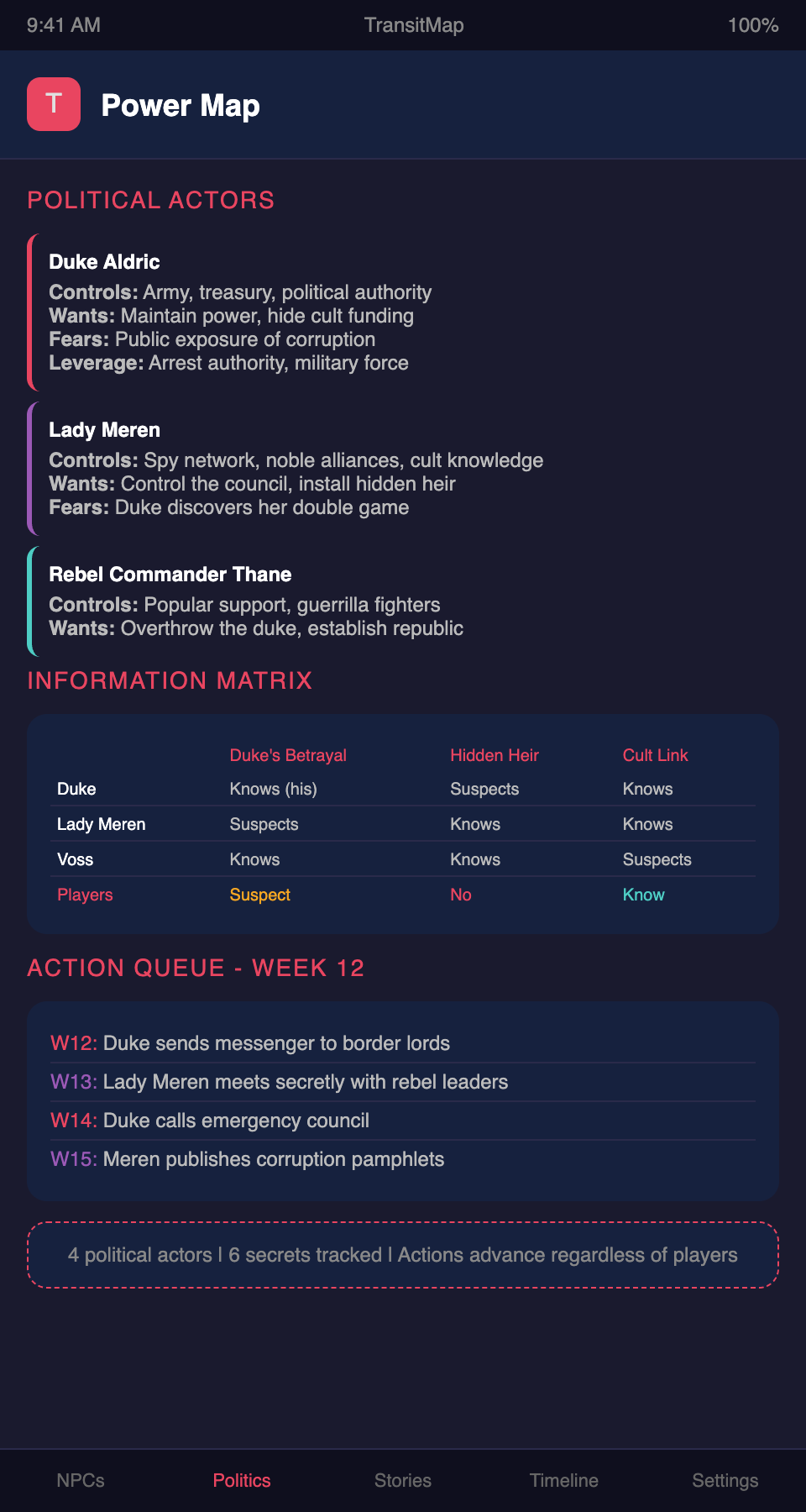
Before your political campaign begins, create a power map — a visual diagram of every significant political actor and their relationships.
For each actor, define:
- What they control — Territory, military, wealth, information, magical resources, popular support
- What they want — Their immediate political goal and their long-term ambition
- What they fear — The outcome they are working to prevent
- Who they trust — And why
- Who they oppose — And why
- Their leverage — What do they have that others want?
Connect actors with labeled relationship lines: allied, hostile, patron/client, secret lovers, rivals, former allies. This map is your reference for every political scene. When the players talk to a noble, you glance at the map to see who that noble is connected to and what they want.
Update the map after every session where political relationships change.
Pillar 2: The Information Layer
Political intrigue runs on information. Track it obsessively.
Create an information matrix — a simple table showing what each major NPC knows about each major secret:
| Duke's Betrayal | Hidden Heir | Cult Involvement | Players' Alliance | |
|---|---|---|---|---|
| Duke Aldric | Knows (it's his) | Suspects | Does not know | Knows |
| Lady Meren | Suspects | Knows | Knows | Does not know |
| Spymaster Voss | Knows | Knows | Suspects | Knows |
| Players | Do not know | Suspect | Know | N/A |
This matrix is invaluable. When the players talk to Lady Meren, you instantly know what she can and cannot reveal. When the duke makes a move, you know what information is driving his decision.
Update the matrix whenever information is shared, discovered, or leaked.
Pillar 3: The Action Queue
Political NPCs do not wait for the players to act. They have their own agendas and their own timelines. Track these with an action queue — a list of what each political actor is doing and when.
- Duke Aldric: Week 1 — Send messenger to border lords. Week 3 — Call emergency council. Week 5 — Attempt to arrest rivals.
- Lady Meren: Week 2 — Meet secretly with rebel leaders. Week 4 — Publish pamphlets revealing the duke's corruption. Week 6 — Rally popular support for the hidden heir.
- Spymaster Voss: Ongoing — Monitor all parties. Report to whoever is paying the most.
The action queue advances regardless of what the players do. If the players are busy with a side quest during Week 3, the duke still calls his emergency council. The players return to find the political landscape has shifted.
This is what makes the political world feel alive — things happen without the players' involvement, and they must react to a changing environment.
Pillar 4: The Consequence Engine
Every political action has consequences. When the players or NPCs take a political action, trace the consequences forward:
Immediate consequences — Who is directly affected? How do they react?
Social consequences — Who hears about this action? How does it change reputations and relationships?
Retaliatory consequences — Who is motivated to respond? What form does their response take?
Systemic consequences — Does this action change the balance of power? Does it open or close options for other actors?
Run this analysis briefly after every significant political event. It does not need to be exhaustive — spend two minutes tracing the most obvious consequences and note them in your tracking system.
Running Political Scenes at the Table
Political scenes require different GM techniques than combat or exploration:
Preparation: For each political scene, know what every NPC present wants, what they know, and what they are willing to reveal. Prepare one secret each NPC is hiding and one piece of information each NPC is trying to learn from the players.
During the scene: Let the players drive the conversation. Your job is to play NPCs honestly — they pursue their goals, protect their secrets, and probe for information. Do not feed the players answers. Let them ask questions, make arguments, and propose deals.
Reading the room: Political scenes live or die on social dynamics. Watch your players' energy. If they are engaged and asking good questions, let the scene run long. If they seem lost, have an NPC make a clear move that forces a reaction.
Ending political scenes: End each political scene with either a deal (the players gained something but gave something in return), a reveal (new information that changes the landscape), or a threat (an NPC makes their opposition clear). Never end a political scene with a shrug and "well, that was a nice conversation."
Common Political Intrigue Mistakes
- Too many secrets — If every NPC has five secrets, the players will never uncover enough to act meaningfully. Give each NPC one or two major secrets and let the players feel like they are making progress.
- Passive NPCs — Political actors who only react to the players feel like quest givers, not power players. NPCs should have their own agendas that advance independently.
- No clear stakes — "The kingdom is politically unstable" is not a hook. "The duke will execute your ally in ten days unless you can prove the duke's corruption to the council" is a hook.
- Punishing player ignorance — If the players walk into a political trap because they lacked information you never made available, that is unfair. Make sure critical information is discoverable through reasonable effort.
- Ignoring combat players — Not every player enjoys pure social play. Give combat-oriented players political roles that use their strengths — bodyguard duty, arena challenges, military consultation.
Drowning in the complexity of your political intrigue campaign? Join the TransitMap waitlist — map every power player, alliance, and secret agenda as lines on a political transit map, and track how every move reshapes the network.