Sandbox Campaign Narrative Structure: Freedom Without Aimlessness
The Sandbox Paradox
The pitch for a sandbox campaign is irresistible: "Go anywhere. Do anything. The world is yours." And then session five arrives and the players stare at you blankly. "So... what should we do?"
This is the sandbox paradox. Total freedom without direction is not liberating — it is paralyzing. Players need goals, stakes, and momentum to feel engaged. But the moment you provide those things, purists will argue you have abandoned the sandbox.
The truth is that the best sandbox campaigns have narrative structure. They just derive that structure from the world and the players' choices rather than from a predetermined plot.
The Difference Between Sandbox and Plotless
A sandbox is not the absence of story. It is the absence of a predetermined story. In a sandbox, stories emerge from the interaction between player choices, world dynamics, and GM-prepared situations. The GM does not write the plot — the GM creates the conditions for plot to happen.
This distinction matters because it tells you what to prepare:
- Do not prepare: A sequence of events the players must experience
- Do prepare: A world with active elements that generate situations whether the players are involved or not
Building an Active Sandbox
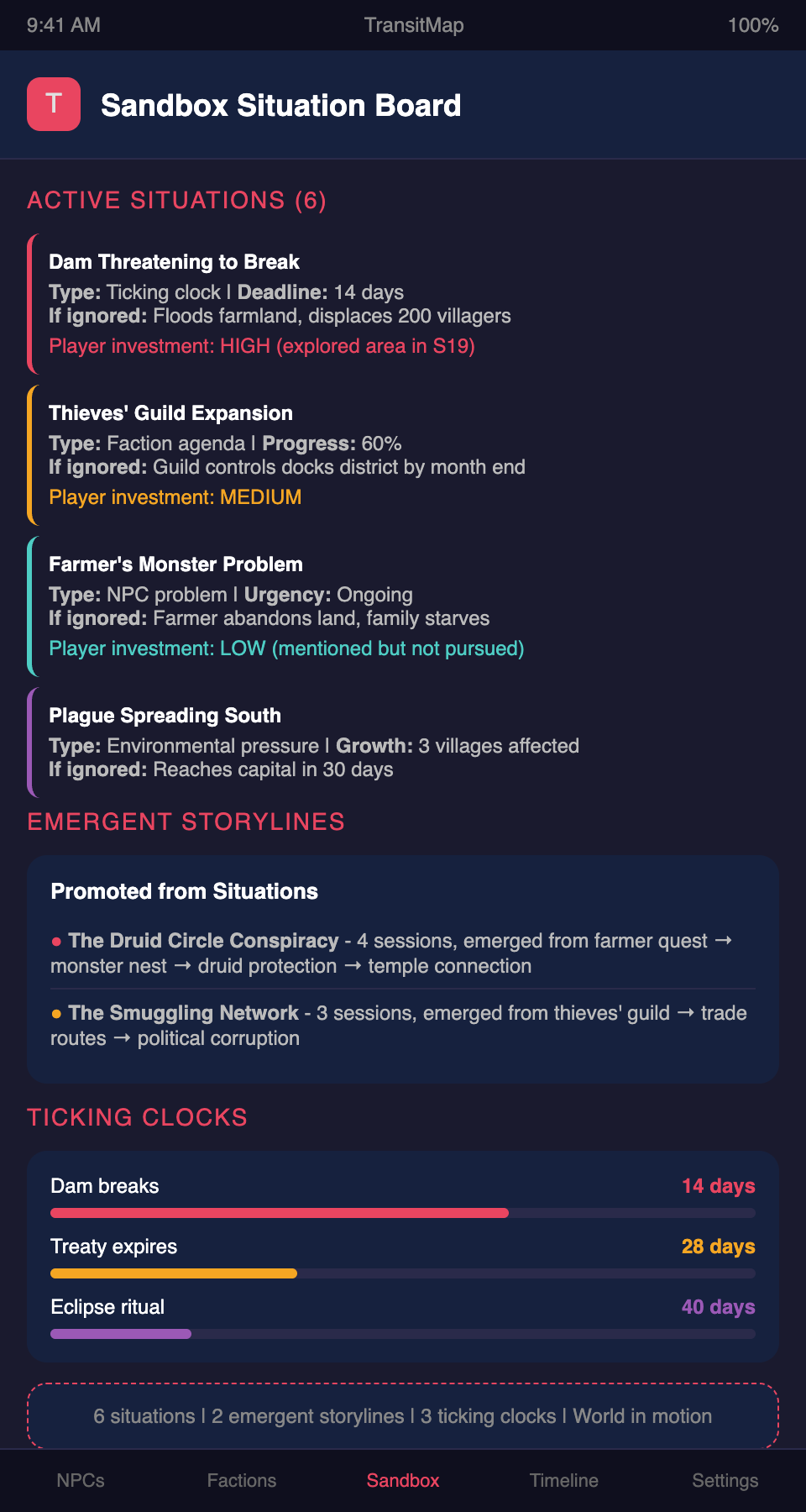
An active sandbox is a world where things are happening independently of the players. These active elements generate the situations, conflicts, and hooks that create emergent narrative.
Factions with agendas — Every faction in your sandbox should have a goal and be actively pursuing it. The thieves' guild is expanding territory. The merchant consortium is monopolizing trade routes. The temple is building a new cathedral. These activities create conflicts and opportunities that the players can choose to engage with or ignore.
NPCs with problems — Scatter NPCs throughout your sandbox who have problems they cannot solve alone. A farmer whose land is being encroached by a monster. A merchant whose shipment is overdue. A noble whose heir has gone missing. These are not quest givers — they are people with problems that exist whether the players help or not.
Environmental pressures — The world itself should create urgency. A harsh winter is coming. A plague is spreading. Bandit activity is increasing on the roads. A volcanic eruption threatens the eastern settlements. These pressures affect everyone in the sandbox and create natural hooks for action.
Ticking clocks — At least two or three elements in your sandbox should have deadlines. The dam will break in two weeks if nobody repairs it. The treaty expires at the end of the month. The eclipse that empowers the ritual happens in forty days. Ticking clocks create urgency without dictating what the players should do.
Emergent Narrative: How Stories Form in Sandboxes
In a sandbox, narrative emerges through a cycle:
- The players encounter a situation — Either by choosing to investigate something or by stumbling into an active element
- The players make a choice — They decide to act, to ignore, to delegate, or to exploit the situation
- Consequences ripple — Their choice affects the world, changing other situations and creating new ones
- New situations emerge — The changed world generates new encounters, new problems, and new opportunities
- Repeat
Over time, these cycles create storylines — connected sequences of choices and consequences that feel like narratives. The players rescued the farmer, which led them to discover the monster nest, which was being protected by the druid circle, which is connected to the temple's new cathedral, which is built on a sacred grove.
Nobody planned this storyline. It emerged from the intersection of active sandbox elements and player choices.
The GM's Role in a Sandbox
Your role in a sandbox is not to tell a story. It is to:
Maintain the world. Keep faction agendas advancing. Keep NPC problems evolving. Keep environmental pressures building. The world should feel like it is in motion whether the players are watching or not.
Present situations clearly. When the players encounter an active element, present the situation with enough clarity for them to make an informed choice. Who is involved? What is at stake? What are the visible options?
Track consequences faithfully. When the players act, trace the consequences honestly. Do not steer consequences toward a predetermined outcome. Let the world react authentically.
Recognize emerging storylines. When a sequence of player choices starts to form a coherent narrative, lean into it. Provide more detail, more NPCs, and more complications for the storylines the players are creating through their choices.
Provide variety. If the players have been doing combat-heavy content, seed social and exploration opportunities. If they have been in cities, create reasons to explore the wilderness. The sandbox should offer diverse experiences.
Preventing Sandbox Stagnation
Sandboxes can stagnate when players run out of motivation. Here are the warning signs and fixes:
Players ask "what should we do?" — Your hooks are not compelling enough. Make the consequences of inaction visible. "If nobody deals with the bandits, the trade route closes and the town starts running out of supplies."
Players repeat the same activities — They have found a comfortable loop (fight monsters, sell loot, repeat) and have no motivation to break it. Introduce a disruption that affects their loop. The loot market crashes. A more dangerous predator moves into their hunting ground.
Players avoid commitment — They start many things and finish nothing because nothing feels important enough. Introduce a ticking clock that forces prioritization. "You can deal with the bandits or the plague, but not both before the winter storms close the mountain passes."
The world feels empty — Not enough active elements. Add more factions, more NPCs with problems, more environmental pressures. A sandbox needs density to feel alive.
Tracking Emergent Storylines
The practical challenge of sandbox GMing is that storylines emerge unpredictably and need to be tracked dynamically. You cannot plan your tracking structure in advance because you do not know what stories will emerge.
A flexible tracking approach:
- Maintain a situation board — A list of every active situation in the sandbox: what it is, who is involved, and what happens next if nobody intervenes
- Promote situations to storylines — When a situation has been engaged by the players across multiple sessions, promote it to a tracked storyline with its own entry showing history, current state, and projected development
- Track player investment — Note which situations the players have chosen to engage with and which they have ignored. This tells you where to invest your prep energy
- Monitor ticking clocks — Keep all deadlines visible so you can advance or resolve them at the appropriate time
When you can see all active situations, emerging storylines, and ticking clocks on a single visual overview, you can run a sandbox that feels alive, responsive, and narratively satisfying — without ever writing a plot.
Want to track emergent storylines in your sandbox campaign as they develop? Join the TransitMap waitlist — map active situations, player-created storylines, and ticking clocks as a living transit network that grows with your campaign.