Session Prep for Complex Homebrew Worlds: A Streamlined System
The Prep Trap That Catches Homebrew GMs
Homebrew world GMs face a unique prep problem. Published module GMs can read ahead in the book. Homebrew GMs have to generate everything — and the more complex their world, the more prep seems to demand.
This creates a trap: you built a complex world because you wanted rich, interconnected storytelling, but now that complexity is eating your prep time alive. You spend three hours before each session reviewing your notes, updating NPC statuses, checking for continuity errors, and trying to anticipate where the players will go — and you still miss things at the table.
The solution is not to simplify your world. The solution is to simplify your prep process with a system that keeps complexity accessible without requiring you to hold it all in your head.
The 45-Minute Prep Framework
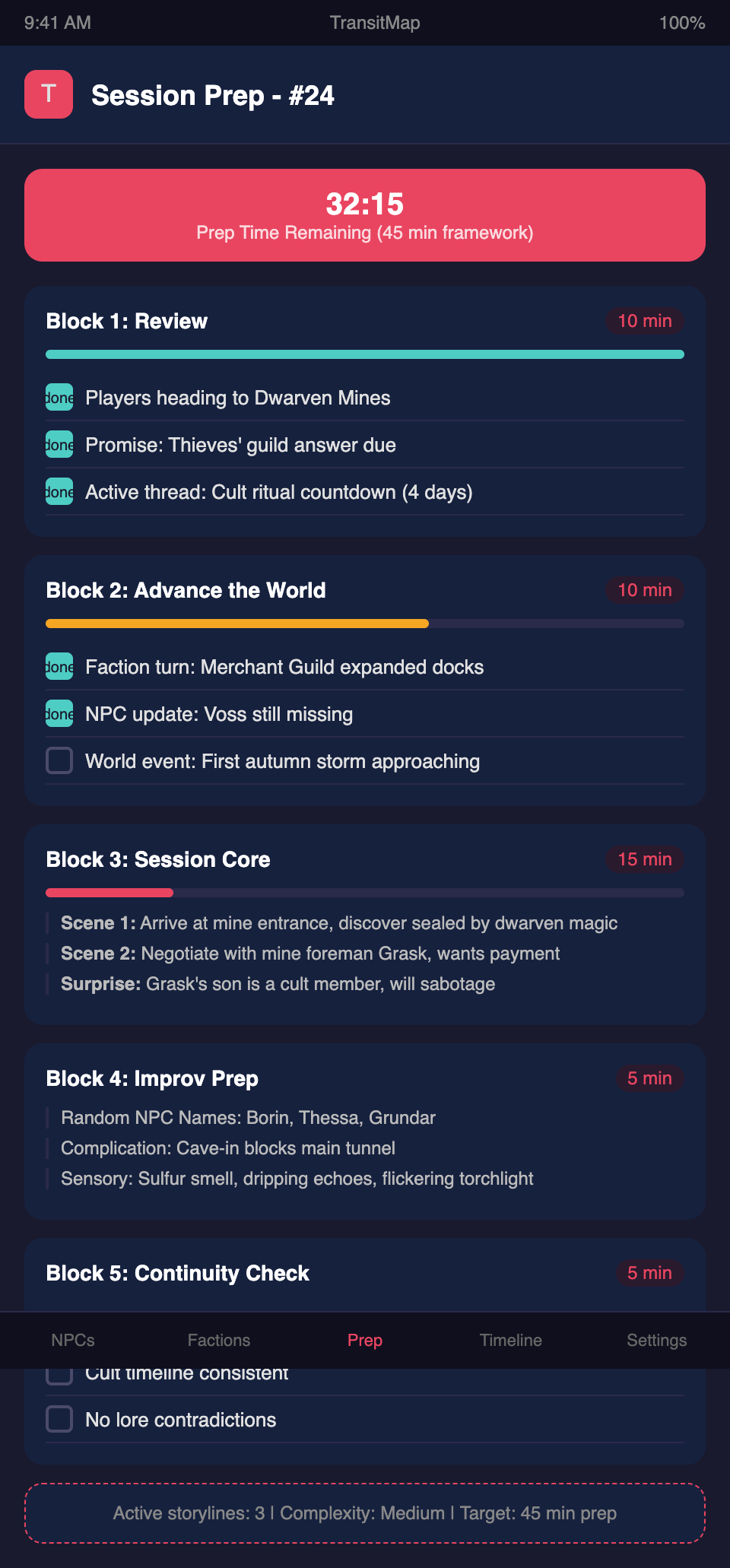
This framework breaks session prep into five focused blocks. Each block has a specific purpose and a hard time limit. The total should not exceed forty-five minutes for a typical session.
Block 1: Review (10 minutes)
Read your notes from the previous session. Focus on three things:
- What did the players decide to do next? This is your starting point. If they said "we're going to the dwarven mines," your session starts at the dwarven mines.
- What promises did you make? Did you tell a player their backstory contact would show up? Did you say the thieves' guild would have an answer by now? These are commitments you need to honor.
- What unresolved threads are active? Which storylines are in motion and might intersect with tonight's session?
Do not re-read old session notes beyond the last one or two. If you need information from session twelve, it should be in your tracking system, not requiring you to re-read session twelve.
Block 2: Advance the World (10 minutes)
Independent of what the players are doing, what has happened in the world since last session?
- Run a quick faction turn if you use one
- Update any NPC operations that are on a timer
- Note any events that would be common knowledge (a storm, a festival, a military movement)
- Identify one thing that has changed in the area the players will be in
This block is what makes your world feel alive. Without it, the world only moves when the players push it.
Block 3: Prepare the Session Core (15 minutes)
Based on where the players are going and what is happening in the world, prepare the one to three scenes that will definitely happen tonight. For each scene, note:
- The situation — What is happening when the players arrive or when this scene triggers?
- The key NPCs present — What do they want in this specific scene? (Not their life goals — their goals for this conversation or encounter.)
- The likely decision point — What choice will the players face? What are the two or three most likely paths forward?
- One surprise — Something the players do not expect. A twist, a complication, a revelation.
Do not script dialogue. Do not write box text. Do not plan more than three scenes. Your players will probably only get through one or two, and improvisation will fill the gaps better than over-preparation.
Block 4: Prepare for Improvisation (5 minutes)
This sounds contradictory, but you can prepare to improvise effectively:
- Three random NPC names appropriate to the area (you will need them when players talk to someone you did not plan for)
- One random encounter or complication that is not connected to any plot (bandits, weather, a broken bridge — something to use if pacing lags)
- Two or three sensory details for the primary location (what does it smell like, what sounds are in the background, what is the light doing)
These are your emergency supplies. You may not use any of them, but having them prevents the dreaded blank-stare pause when players go somewhere unexpected.
Block 5: Check Continuity (5 minutes)
Quickly scan for potential continuity problems:
- Is any NPC scheduled to be in two places at once?
- Did the players learn something in a previous session that contradicts what you are about to present?
- Are there any time-sensitive plot elements that should have resolved by now?
- Does anything you have planned contradict an established fact about your world?
This five-minute check catches the errors that would otherwise break immersion at the table.
What This Framework Does Not Include
Notice what is deliberately excluded from this prep system:
- Detailed maps and tactical battle grids — Draw these only if a combat encounter is virtually certain. Otherwise, sketch them at the table or use theater of the mind.
- Extensive lore writing — Worldbuilding is a separate hobby activity, not session prep. Do it when you enjoy it, not when you are under time pressure.
- Contingency planning for every possible player choice — You cannot predict what players will do. Prepare the situation, not the outcome.
- Re-reading the entire campaign history — If your tracking system is good, you should never need to do this.
Adapting the Framework to Your Campaign's Complexity
Low complexity (1-2 active storylines): You can probably compress blocks 1 and 2 into five minutes each and skip block 5 entirely. Total prep: twenty-five minutes.
Medium complexity (3-5 active storylines): The framework as described. Forty-five minutes.
High complexity (6+ active storylines, multiple factions, extensive NPC cast): Extend block 2 to fifteen minutes and block 5 to ten minutes. Total prep: one hour. If you consistently need more than an hour, you likely have too many active storylines and should resolve or pause some of them.
The Tracking System That Makes This Possible
This prep framework assumes you have a functional tracking system underneath it. Without one, block 1 becomes "spend thirty minutes searching through old notes" and block 5 becomes "pray you do not contradict yourself."
The minimum viable tracking system for a complex homebrew campaign needs:
- A session log — One paragraph per session summarizing what happened, what decisions were made, and what the players said they would do next
- An active storyline tracker — A list of every storyline currently in motion, with its current status and next expected beat
- An NPC quick-reference — Name, current location, current goal, attitude toward the players, for every NPC the players might encounter soon
- A timeline — What day is it in-game? What events are coming up on the calendar?
If you are spending more time maintaining your tracking system than using it during prep, the system is too complex. Strip it down until the maintenance-to-value ratio feels right.
The Most Important Prep Habit
Above any framework or system, the single most impactful prep habit is this: write your session notes immediately after the session, not before the next one.
Ten minutes of note-taking while everything is fresh will save you thirty minutes of reconstruction a week later. Capture what happened, what changed, and what the players committed to doing next. That is it. Future you will be grateful.
Want a tracking system that makes 45-minute prep actually work for complex homebrew worlds? Join the TransitMap waitlist — a visual storyline tracker that keeps every thread, NPC, and timeline event one glance away.