Session Zero Campaign Planning: A Framework for Starting Strong
Why Session Zero Matters More Than Session One
Session one is when the adventure begins. Session zero is when you decide what kind of adventure it will be. Skip it, and you risk discovering incompatible expectations ten sessions in — when the combat-focused player realizes this is a political intrigue campaign, or when the GM learns that nobody cares about the meticulously crafted lore.
A thorough session zero takes two to three hours and covers three domains: social contract, world foundation, and campaign structure.
Domain 1: The Social Contract
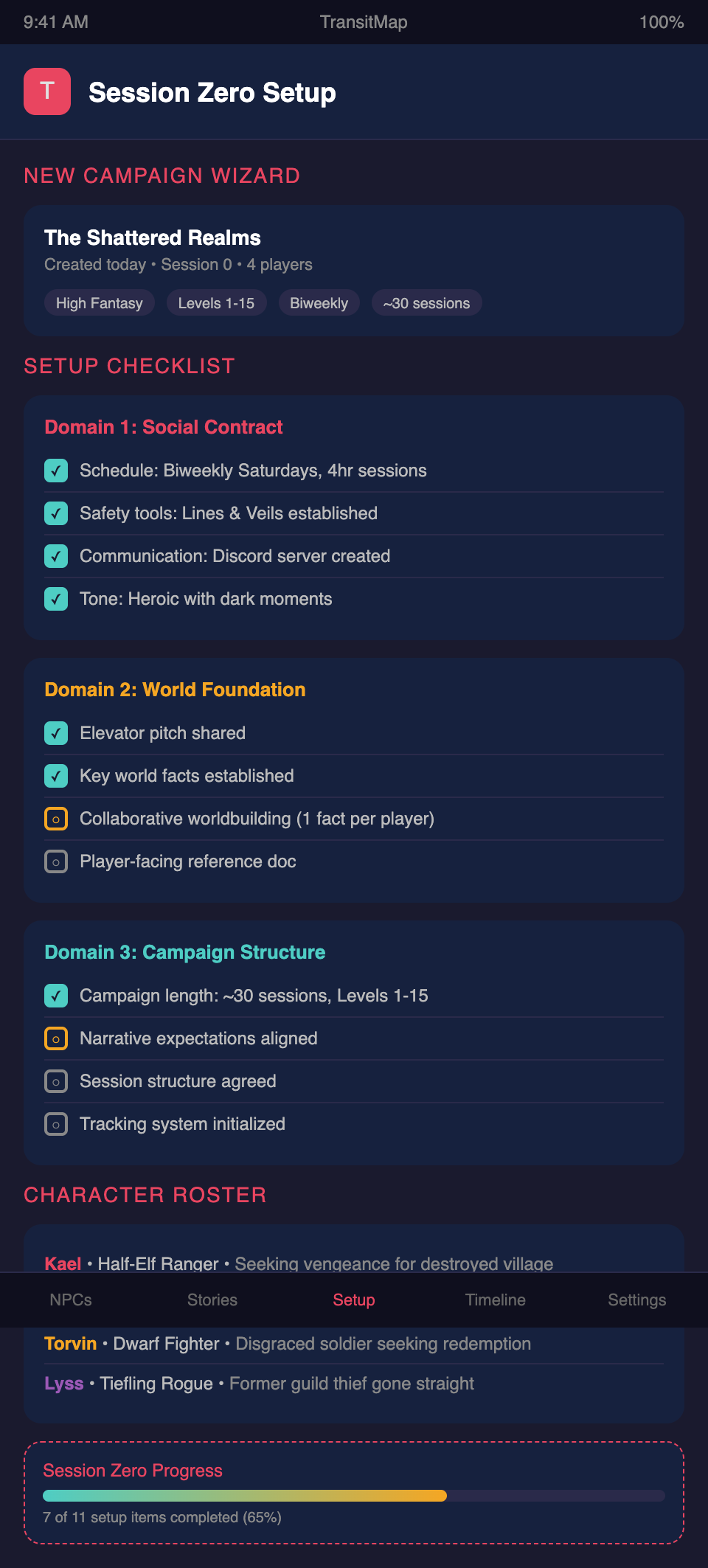
Before you discuss characters or setting, discuss the table itself.
Scheduling and logistics:
- How often will you play? Weekly, biweekly, monthly?
- How long are sessions? Three hours? Five hours?
- What happens when someone cannot make it? Do you play without them? Cancel? Run a one-shot?
- Where do you play? Online or in person? What tools do you use?
Safety and boundaries:
- What topics are off-limits? Discuss content boundaries explicitly. Use a safety tool like Lines and Veils, the X-Card, or Script Change.
- What is the expected tone? Gritty and dark? Heroic and hopeful? Comedic? A mix?
- How is PvP handled? Is it allowed? Under what circumstances?
- How are rules disputes resolved? GM ruling in the moment, discussion after the session?
Communication expectations:
- How do players communicate between sessions? Group chat? Email? Discord?
- How does the GM share information? Handouts? A shared document? A wiki?
- How should players give feedback about the campaign? Directly to the GM? Anonymously? In a group discussion?
These conversations are uncomfortable but essential. Address them now and you prevent conflicts that would otherwise fester for months.
Domain 2: The World Foundation
Establish the setting at a level of detail that allows character creation without overwhelming players.
The elevator pitch: Describe your campaign's world in two to three sentences. "A Renaissance-era continent where magic is regulated by a powerful bureaucracy, and a rebellion is brewing among unlicensed mages." Players need enough context to build characters that fit without reading a setting bible.
The tone and genre: Is this high fantasy with epic battles and world-saving quests? Low fantasy with gritty survival and moral ambiguity? Dark fantasy with horror elements? Urban fantasy set in a single city? Align expectations now.
Key world facts:
- What races and classes are available or restricted?
- How common is magic? Is it feared, celebrated, regulated, or mundane?
- What is the political structure? Kingdoms, city-states, tribal confederations, an empire?
- What is the primary source of conflict in the world?
- What is the technology level?
Keep this brief. Five to ten minutes of world overview is sufficient. Players do not need to know your world's creation myth to make characters. They need to know what daily life looks like and what the big tensions are.
Collaborative worldbuilding. Consider inviting players to contribute to the world. Each player might define one fact about the setting: a city, a tradition, a historical event, an organization. This gives players ownership of the world before the campaign begins and ensures the setting contains elements they care about.
Domain 3: Campaign Structure
Discuss the practical structure of the campaign itself.
Campaign length and scope:
- How long do you expect the campaign to run? Six months? A year? Open-ended?
- What level range are you targeting? 1-10? 1-20? 5-15?
- Is this a single continuous campaign or a series of arcs with possible stopping points?
Narrative expectations:
- How much player agency versus GM-directed plot? Discuss the sandbox-to-railroad spectrum and find the group's preference.
- How important are player backstories? Will they be woven into the main plot?
- What ratio of combat to social to exploration does the group prefer?
- How does the group feel about character death?
Session structure:
- Do sessions start with a recap? Who gives it — the GM or a player?
- Is there a hard stop time?
- How are session breaks handled?
- Do you use milestone leveling or XP?
Character Creation as a Group Activity
Session zero should include character creation as a collaborative process. Players creating characters in isolation produce a party of strangers with no reason to work together. Players creating characters together produce a party with built-in relationships, complementary abilities, and shared history.
Facilitate connections:
- Ask each player to define one relationship with another player character. "We grew up in the same village." "I saved your life once." "We both worked for the same guild."
- Ensure the party has a plausible reason to be together and to stay together. The classic "you all meet in a tavern" works if you follow it with "and here is why you would agree to work together."
Coordinate backstories:
- Share backstory outlines with the group (not the deep secrets, but the broad strokes)
- Look for overlap and connection opportunities
- Verify that backstories are compatible with the world you have established
Balance the party:
- Not mechanically — players should play what they want
- Narratively — if three players have "loner orphan" backstories, encourage at least one to have community ties that anchor the party to the world
The Session Zero Document
After session zero, create a reference document summarizing everything that was decided. This document serves as your campaign's constitution:
- Social contract agreements
- World overview
- Campaign structure decisions
- Character roster with brief descriptions
- Player-established connections
- Any house rules
Share this document with all players. Update it if agreements change. Refer to it when disputes arise.
Setting Up Your Tracking System
Session zero is also when you set up your campaign tracking infrastructure. Based on the campaign's expected complexity, establish:
- Your session log format
- Your NPC tracking approach
- Your storyline tracker
- Your timeline or calendar
- Your world reference document
Do not over-build. Start with the minimum viable tracking system and expand as the campaign's needs become clear. A system you will actually use is better than a comprehensive one you will abandon.
Starting a new campaign and want to build your tracking system from day one? Join the TransitMap waitlist — set up a visual storyline tracker at session zero that grows with your campaign from the first adventure hook to the final climax.