How to Track NPC Storylines Across a Long Campaign Without Losing Your Mind
The NPC Tracking Problem Every Long-Campaign GM Faces
You started your campaign with six important NPCs. Eighteen months later, you have forty-three. The blacksmith your players befriended in session two has appeared in eleven sessions since then, and you cannot remember if he knows about the cult, whether the players told him about the stolen amulet, or if he is supposed to be dead.
This is not a failure of memory. This is a systems problem. Human brains are not built to maintain parallel state tracking for dozens of independent characters across fifty-plus sessions. The GMs who run long campaigns successfully are not the ones with photographic memories — they are the ones with tracking systems that do the remembering for them.
Why Simple NPC Lists Break Down
Most GMs start with a flat list: NPC name, location, brief description, maybe a note about their motivation. This works fine for the first dozen sessions. Then it falls apart for three reasons:
-
Static entries cannot capture change — An NPC list tells you who Gareth the blacksmith is, but not who he is becoming. After the players saved his daughter, did his attitude toward them shift? After the cult burned his shop, did he relocate? A flat list forces you to overwrite old information, losing the history.
-
Relationships are invisible — Gareth is married to Elena, who is secretly working for the merchant guild, which is funding the rebellion that the players are trying to stop. None of these connections are visible in a list sorted alphabetically by name.
-
Dormant NPCs disappear — If Gareth has not appeared in ten sessions, he drops off your mental radar. But he is still in the world, still reacting to events. When the players suddenly return to his town, you need to know what has happened to him in the intervening weeks of game time.
Building an NPC Storyline Tracker That Actually Works
The key insight is that NPCs are not static entries — they are storylines. Each significant NPC has their own arc running in parallel with the main campaign, whether the players are watching or not. Your tracking system needs to reflect this.
Here is a practical framework:
For each NPC, track these five elements:
- Current state — Where are they right now? What are they doing? What do they know?
- Motivation — What do they want, and what are they actively doing to get it?
- Key relationships — Who are they connected to, and how do those connections create plot opportunities?
- History with the party — What have the players done that affects this NPC's attitude and behavior?
- Projected trajectory — If the players never interact with this NPC again, what happens to them over the next few sessions?
That last element is the secret weapon. By projecting forward, you create a living world where NPCs evolve offscreen. When the players return to a town after a long absence, you do not have to improvise — you already know what has changed.
The Transit Line Approach to NPC Tracking
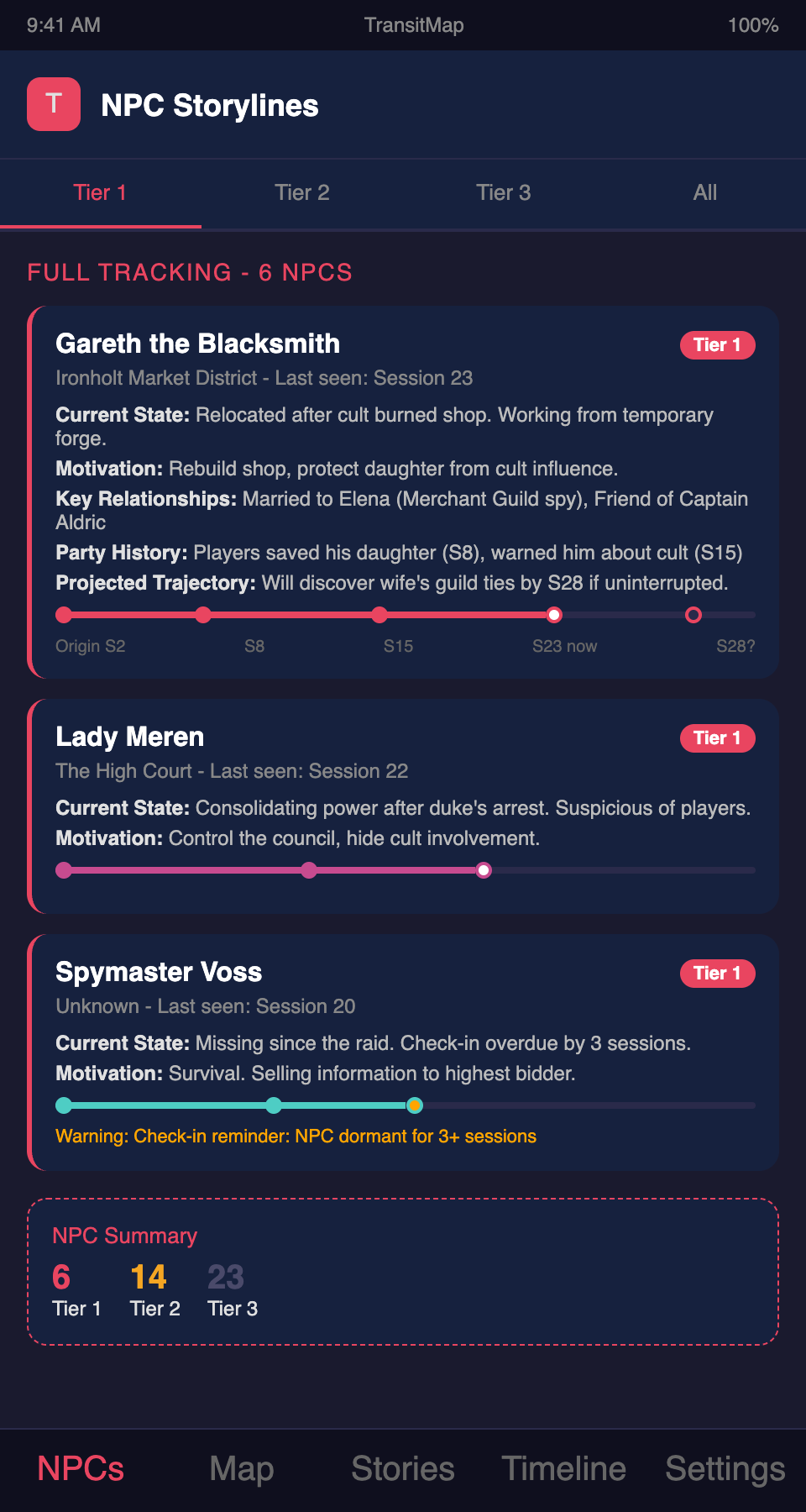
Think of each major NPC's storyline as a transit line on a metro map. The line runs from left to right across your campaign timeline, with stations representing key moments:
- Origin station — Where and when this NPC entered the story
- Interaction stations — Sessions where the players directly engaged with this NPC
- Offscreen stations — Things that happened to this NPC between player interactions
- Junction stations — Points where this NPC's storyline intersects with another NPC's or with the main plot
When you lay out multiple NPC lines in parallel, patterns emerge immediately. You can see which NPCs have been dormant too long and need to resurface. You can spot natural junction points where two NPC storylines should collide. You can identify sections of your campaign where the NPC density is too high (overwhelming) or too low (the world feels empty).
Practical Tips for Maintaining NPC Tracks
Update after every session, not before. Spend ten minutes after each session updating the current state of every NPC who was mentioned, appeared, or would have been affected by events. This is when your memory is freshest.
Use a three-tier system. Not every NPC needs the same level of tracking:
- Tier 1 (full tracking) — Major NPCs with ongoing storylines. Track all five elements. Usually 5-10 characters.
- Tier 2 (light tracking) — Recurring NPCs who matter but are not driving plot. Track current state and key relationships only. Usually 10-20 characters.
- Tier 3 (reference only) — Minor NPCs the players might ask about. Name, location, one-line description. No ongoing tracking needed.
Promote and demote regularly. A Tier 3 NPC that the players suddenly fixate on needs to be promoted to Tier 2 or even Tier 1. A Tier 1 NPC whose storyline has resolved can be demoted. This keeps your active tracking load manageable.
Set "check-in" reminders. Every five sessions, review your Tier 1 NPCs and ask: what has this character been doing offscreen? Update their projected trajectory. This prevents the jarring experience where a major NPC seems frozen in time between appearances.
Common Mistakes That Derail NPC Tracking
- Tracking too many NPCs at full detail — You do not need a five-element breakdown for the innkeeper the players spoke to once. Be ruthless about what gets Tier 1 treatment.
- Forgetting to track NPC knowledge — The most common continuity error in long campaigns is an NPC knowing something they should not, or not knowing something they should. Track what each NPC knows separately from what the players know.
- Letting player favorites stagnate — If the players love an NPC, that NPC needs to keep evolving. A fan-favorite character who never changes becomes wallpaper.
- Not connecting NPC arcs to each other — Isolated NPC storylines are less interesting than interconnected ones. Look for opportunities to tie NPCs together through shared goals, conflicts, or secrets.
Scaling This System for Very Long Campaigns
Campaigns that run for two or more years accumulate enormous NPC casts. At this scale, even a good tracking system can become unwieldy. Two strategies help:
Archive resolved storylines. When an NPC's arc reaches a natural conclusion — they achieved their goal, they died, they left the region — move them out of your active tracker and into an archive. You can retrieve them if needed, but they are no longer cluttering your working view.
Create NPC clusters. Group related NPCs together so you can update them as a unit. The merchant guild NPCs all react to the same economic events. The cult members all advance the same conspiracy. Updating the cluster is faster than updating each individual.
Ready to stop losing NPC threads in your long-running campaign? Join the TransitMap waitlist and get a visual storyline tracker that maps every NPC arc like a transit line — so you always know where each character has been, where they are, and where they are headed.