Maintaining Worldbuilding Continuity Between Sessions
Why Continuity Errors Happen
Continuity errors in homebrew campaigns are not a sign of a bad GM. They are an inevitable consequence of improvising a fictional world in real time across dozens of sessions. No novelist publishes a first draft without an editor catching continuity errors, and they have the luxury of revising before anyone reads it. You are performing live, with no revisions.
The most common continuity errors fall into predictable categories:
- Numerical drift — Dates, distances, prices, and populations shift because you improvised a number once and cannot remember what you said
- NPC contradictions — An NPC's personality, knowledge, or allegiances change because you forgot how you played them previously
- Geographic inconsistency — Locations move, travel times change, or places that should be nearby are suddenly far away
- Lore conflicts — Historical events, magical rules, or cultural details contradict something established earlier
- Timeline errors — Events that should have taken days take hours, or vice versa
The Real Cost of Continuity Errors
Minor continuity errors are harmless. Your players will not care if the innkeeper's name changed from Marta to Martha. But pattern continuity errors erode trust in your world.
When players notice that your world is inconsistent, they stop treating it as real. They stop taking notes because the facts might change. They stop making plans based on established information because that information might not hold. They disengage from the world as a coherent place and start treating it as a series of disconnected scenes.
For players who are deeply invested in the narrative — the ones who take detailed notes, draw maps, and theorize between sessions — continuity errors are especially damaging. These are your most engaged players, and contradictions tell them their engagement is not valued.
Building a World Bible That Actually Gets Used
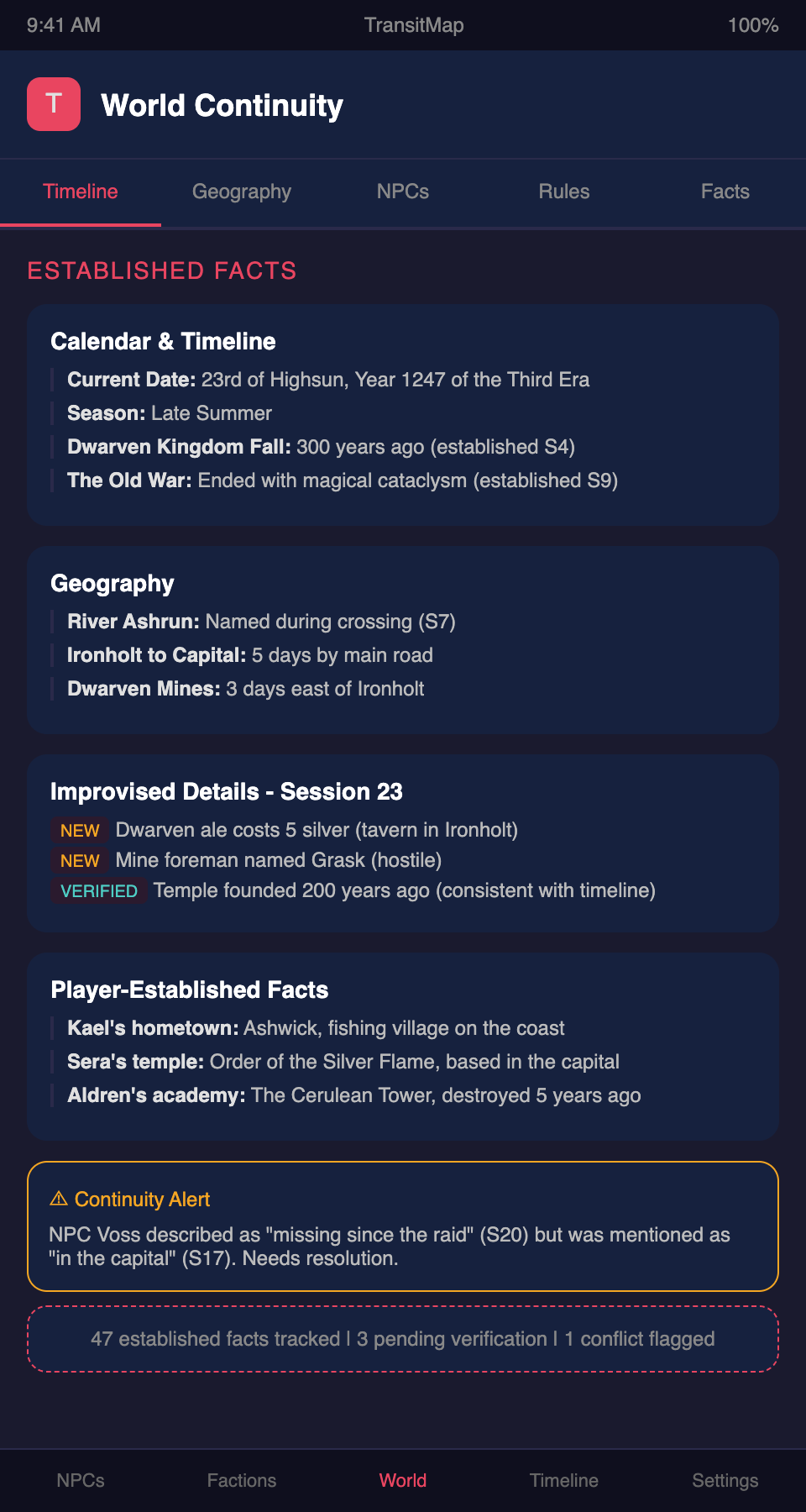
The standard advice is "keep a world bible." The standard problem is that world bibles become enormous reference documents that nobody maintains or consults. Here is how to build one that you will actually use:
Structure it as a reference, not a narrative. Your world bible is not a novel. It is a lookup table. Organize it so you can find a specific fact in under thirty seconds.
Recommended sections:
- Calendar and Timeline — Current in-game date, major historical dates, upcoming scheduled events
- Geography — Region names, travel times between major locations, terrain types. Keep a simple map with distances marked.
- NPCs — Alphabetical list with name, location, role, and one-line description. Link to detailed entries only for major NPCs.
- Factions — Name, goal, leader, relationship to players. Detailed tracking lives in your faction management system.
- Established Rules — How does magic work in your world? What are the laws? What religions exist? Record any ruling or declaration you have made during play.
- Player-Established Facts — Things the players have stated about their characters or the world that you have confirmed as true. This section is critical and often overlooked.
Keep it short. A world bible that is fifty pages long will never be consulted during prep. Aim for a document where every section fits on one screen. Link out to detailed sub-documents for deep dives, but keep the master reference lean.
The Three-Second Rule for In-Session Consistency
During a session, you do not have time to consult a reference document for every detail. Instead, use the three-second rule: before stating any world fact that might be important, take three seconds to ask yourself, "Have I said something about this before?"
If the answer is "I don't know," hedge your statement:
- Instead of "The dwarven kingdom fell 300 years ago," say "The dwarven kingdom fell centuries ago — the exact date is disputed by scholars."
- Instead of "The temple is two days north," say "The temple is roughly two days north by the main road, maybe more through the hills."
- Instead of giving a specific price, say "The merchant quotes a steep price" and determine the exact number after the session when you can check your notes.
Hedging is not weakness. It is strategic ambiguity that prevents future contradictions.
Recording Improvised Details
The most dangerous continuity errors come from details you improvised during play and never recorded. You made up a town name, an NPC's backstory, a historical event, or a magical rule on the spot — and it sounded great at the table, and you forgot it by the next morning.
Build a habit of capturing improvised details immediately after the session. Keep a running list with two columns:
| What I Improvised | Context |
|---|---|
| The river is called the Ashrun | Players asked while crossing it |
| Dwarven ale costs 5 silver | Tavern scene in Ironholt |
| The old war ended with a magical cataclysm | NPC's campfire story |
This list is your continuity insurance policy. Review it during prep, transfer important entries to your world bible, and discard trivial details that will never come up again.
Handling Contradictions When They Happen
Despite your best efforts, contradictions will happen. When a player catches one, you have three options:
Option 1: Retcon transparently. "You're right, I said 300 years last time. Let's go with 300 — that's the official number." This is the simplest solution and most players appreciate the honesty.
Option 2: Make it a feature. "Interesting — the text in the library says 500 years, but the dwarf you spoke to said 300. Maybe someone is lying, or maybe the historical record is unclear." This turns a mistake into a mystery. Use this sparingly, or your players will think everything is a clue.
Option 3: Clarify and move on. "I misspoke — the fall of the kingdom was 300 years ago. The 500-year date refers to the founding of the current dynasty. Sorry for the confusion." Quick, clean, no drama.
The worst option is to insist you never made the error and gaslight your players into doubting their own notes. Never do this.
Using Visual Timelines for Continuity
One of the most effective continuity tools is a visual timeline of your world's history and your campaign's events. A timeline makes certain types of errors immediately obvious:
- If two events are supposed to happen simultaneously but are plotted at different points, you catch it
- If an NPC is supposed to be in two places at once, the timeline reveals it
- If travel times do not add up, the visual spacing makes it clear
- If the pacing of your campaign has stretched or compressed unnaturally, you can see it
The timeline does not need to be elaborate. A horizontal line with dates and events marked on it is sufficient. Update it after each session with new events and any world-history details you established during play.
Continuity as Collaborative Responsibility
Finally, consider making continuity a shared responsibility. Encourage your players to:
- Keep their own notes and flag inconsistencies politely
- Remind you of details their characters would remember
- Correct you in the moment rather than after the session
Players who help maintain continuity are not adversaries — they are collaborators who care about the world as much as you do. Thank them when they catch errors.
Want a visual system that makes worldbuilding continuity effortless? Join the TransitMap waitlist — track every established fact, timeline event, and world detail on a single navigable map that grows with your campaign.