Branching Narrative Design for LARP Events
The Branching Challenge in Live Events
Branching narratives in LARP face a unique constraint: you cannot reload a save file. When players make a choice, that choice is permanent and its consequences are immediate. Every person present witnessed it. You cannot retcon, rewind, or present an alternate path.
This makes branching narratives in LARP simultaneously more impactful and harder to design than in any other medium. The impact is undeniable — a player who changed the course of an event through their decision had a real experience that no other player shared. The design challenge is preparing for multiple outcomes when you can only run one.
The Decision Point Framework
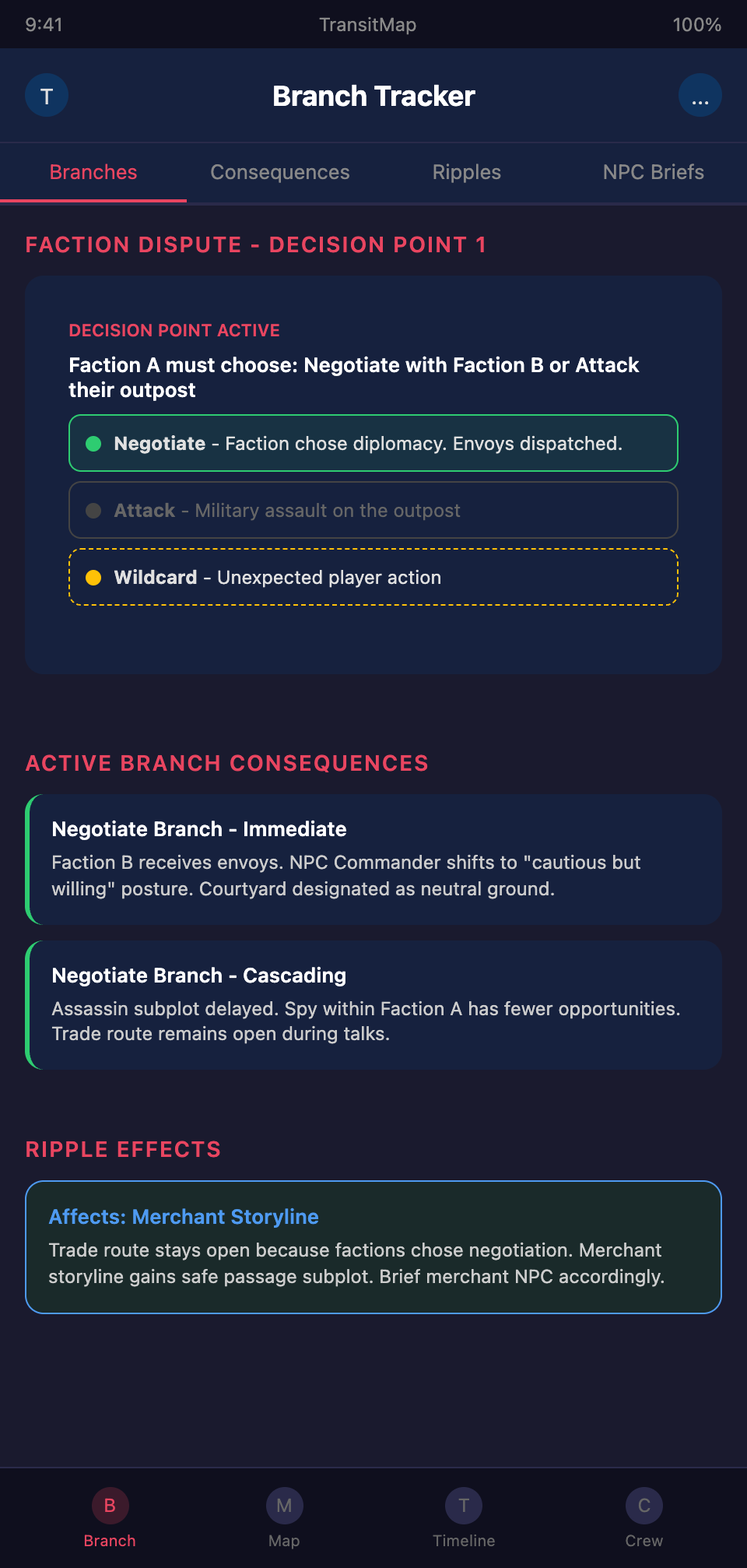
A branching LARP narrative is built on decision points — moments where player choices determine which branch the story follows.
For each decision point, design:
The situation — What circumstances create the choice? This should arise naturally from the storyline, not feel like a GM-presented menu.
The options — What are the two to four viable choices? In LARP, these should not be explicitly listed — players should discover or generate options through play. But you need to anticipate the most likely options to prepare consequences.
The visible stakes — What do players understand they are risking or gaining? Informed choice is meaningful choice. Random choice is just a coin flip.
The consequences — What happens for each likely option? Consequences should be:
- Immediate — Something changes visibly right now
- Cascading — The change affects other parts of the event
- Persistent — The change carries into future events (if campaign LARP)
The irreversibility marker — What makes the choice permanent? In tabletop, the GM can simply declare a choice is final. In LARP, irreversibility must be demonstrated: the building burns down, the NPC dies publicly, the treaty is signed in front of witnesses.
Designing for Three Branches, Not Thirty
The key to manageable branching is bounded divergence — designing storylines that branch meaningfully but do not explode into unmanageable complexity.
The Rule of Three: At any decision point, prepare three branches: the two most likely player choices, plus one wildcard that covers unexpected actions. If players do something completely unanticipated, it usually resembles the wildcard more than it resembles a fourth unique option.
The Convergent Branch: Design branches that diverge at a decision point and reconverge at the next major story beat. The players can choose to negotiate or fight, but both paths lead to the conclusion of the faction dispute — just with different outcomes and different consequences.
The Modular Scene: Instead of scripting separate scenes for each branch, design modular scenes that can be adjusted based on the active branch:
- Core scene — The basic structure that works for any branch (location, NPCs present, general situation)
- Branch modifiers — Specific adjustments for each branch (NPC attitudes, available information, environmental conditions)
- Branch-specific moments — One unique element per branch that makes the chosen path feel distinct
Preparing Your Crew for Branches
Your NPC crew needs to know which branch is active and how it affects their behavior:
Pre-event briefing: For each NPC involved in a branching storyline, provide a brief that covers all possible branches: "If the players chose to negotiate, you are cooperative but wary. If they chose to fight, you are captured and defiant. If they did something unexpected, you are confused and cautious."
Branch signals: Establish a system for communicating which branch has activated. A code word from the line storyteller. A visual signal (a specific colored ribbon worn by the lead NPC). A text message. The method does not matter as long as it is fast, clear, and does not break immersion.
Improvisation authority: NPCs in branching storylines need more improvisation authority than those in linear ones. They may need to react to player choices that fall between your designed branches. Brief them on their character's motivations and let them react authentically.
Tracking Branch State During the Event
As branches activate, you need to track the event's narrative state:
The branch map — A simple diagram showing your storyline's decision points and which branch has been taken at each one. Update this in real time so every storyteller knows the current narrative state.
The consequence log — A running list of consequences that have been triggered by branch choices. These consequences affect NPC behavior, available content, and future event planning.
The ripple tracker — When a branch choice affects other storylines, note the ripple: "Players chose war in the political storyline → the merchant storyline loses its safe trade route → the investigation storyline gains a new refugee informant."
Multi-Branch Events: Parallel Player Paths
For large events, you can design parallel branching — different player groups make different choices simultaneously, each group experiencing a different branch of the same overarching storyline.
Example: The LARP has two major factions. Each faction faces a choice: ally with the crown or join the rebellion. This creates four possible combinations:
- Both factions ally with the crown → United royalist front
- Both factions join the rebellion → United revolutionary front
- Faction A crowns, Faction B rebels → Civil war with clear sides
- Faction B crowns, Faction A rebels → Reversed civil war
You prepare four possible second-half scenarios. Which one activates depends on the choices both factions make independently. Each player experiences the consequence of both their own faction's choice and the other faction's choice.
This is the most complex branching structure in LARP, but it produces the most dynamic and replayable events.
When Branches Fail
Sometimes a branch does not work:
- Players ignore the decision point entirely. Treat this as a choice — inaction has consequences too. Design a "no choice" branch where the situation resolves without player input, usually in the worst possible way for everyone.
- Players find a fourth option you did not anticipate. Fall back on your wildcard branch and adapt. If the wildcard does not fit, improvise based on the NPC's motivations and the situation's logic.
- Both branches trigger simultaneously. This happens when different player groups make contradictory choices at the same decision point. In LARP, the first choice that is physically enacted takes priority. Resolve the contradiction in-game — the two groups are now in conflict about what happened.
Designing branching LARP narratives and need to track which branches are active? Join the TransitMap waitlist — map your storyline branches as diverging and converging transit routes, with real-time branch state tracking for your entire event.