Collaborative Storytelling for LARP Organizers: Sharing Narrative Authority
The Organizer-as-Author Trap
Traditional LARP organizing positions the organizer as the author and the players as the audience. The organizer writes the story, casts the NPCs, designs the plot, and controls the outcome. Players participate but do not shape the narrative at a fundamental level.
This model has limits. A single organizer (or small team) can only create content at a fixed rate. Players consume content faster than organizers can produce it. The result is events where players spend significant time waiting for plot, or events where plot is so tightly scripted that player agency is limited.
Collaborative storytelling dissolves this bottleneck by sharing narrative authority — giving players and crew meaningful power to create, shape, and resolve storylines within an organizer-designed framework.
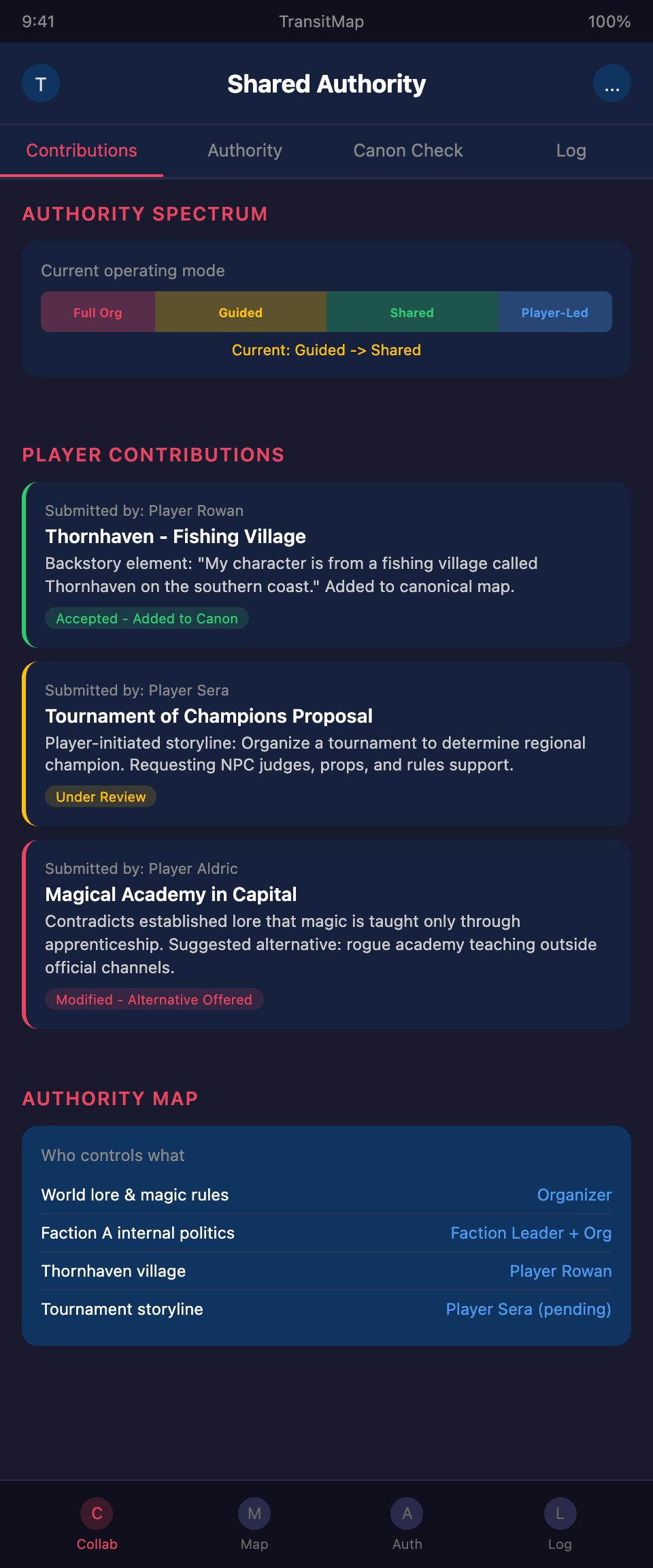
The Authority Spectrum
Narrative authority exists on a spectrum:
Full organizer authority — The organizer controls all narrative elements. Players make choices but the outcomes are predetermined. This is theater, not collaborative storytelling.
Guided authority — The organizer sets the framework (world, factions, conflicts) and controls major plot elements. Players have authority over their characters' decisions and personal storylines. This is the most common LARP model.
Shared authority — Players have authority over significant narrative elements beyond their own characters. They can establish facts about the world, create NPCs, design quest elements, and influence storyline direction. The organizer maintains consistency and adjudicates conflicts.
Player-majority authority — Players drive the majority of narrative content. The organizer provides the world framework, facilitates conflict resolution, and maintains continuity. Content is generated primarily through player interaction and player-created storylines.
Most LARPs benefit from operating in the guided to shared range. Full organizer authority is too limiting. Player-majority authority requires an exceptionally mature and skilled player base.
Mechanisms for Sharing Authority
Player-created backstory elements. Allow players to establish facts about the world through their character backstories — with organizer approval. "My character is from a fishing village called Thornhaven on the southern coast" establishes Thornhaven as a real place in the world. The organizer reviews for consistency and adds it to the canonical map.
Faction self-governance. Give factions authority over their internal politics. Players elect leaders, create laws, establish traditions, and manage internal conflicts without organizer intervention. The organizer only intervenes when internal faction activity contradicts established world facts or when safety concerns arise.
Player-initiated storylines. Create a process for players to propose storylines:
- Player submits a proposal: "I want to organize a tournament to determine the regional champion"
- Organizer reviews for consistency and feasibility
- If approved, the organizer provides logistical support (NPC judges, props, rules adjudication)
- The player runs the storyline with organizer backup
Collaborative world-building sessions. Between events, invite players to contribute to world-building. Each player adds one fact, one location, one tradition, or one piece of history. The organizer curates these contributions into the canonical world document.
Emergent NPC creation. When players interact with background elements ("I want to talk to the blacksmith"), allow the scene to happen without pre-planning. The player and the crew member (or another player) collaboratively create the NPC through the interaction. The organizer canonizes the NPC if they become significant.
The Organizer's Role in Collaborative Storytelling
Sharing authority does not mean abdicating responsibility. The organizer's role shifts from author to:
Facilitator — Creating conditions for player-driven storytelling. Providing frameworks, resources, and opportunities without prescribing outcomes.
Curator — Reviewing player-created content for consistency with the established world. Accepting contributions that fit, negotiating adjustments for those that do not, and declining contributions that contradict canonical facts.
Referee — Adjudicating conflicts between competing narrative claims. When two players establish contradictory facts, the organizer decides which version is canon (or determines that both are partially true).
Amplifier — Elevating player-created content to event-wide significance when it merits attention. A player-created storyline that gains momentum can become a featured event storyline with full organizer support.
Guardian of consistency — The most important ongoing role. With multiple contributors, the risk of contradictions increases. The organizer maintains the canonical record and ensures all contributions are consistent with established facts.
Building a Collaborative Culture
Collaborative storytelling requires a community culture that supports it:
Celebrate player contributions. When a player creates something wonderful — a storyline, an NPC, a piece of lore — acknowledge it. This encourages others to contribute.
Establish clear contribution channels. Players should know how to submit proposals, suggest world elements, and request narrative authority. Without clear channels, only the most assertive players will contribute.
Set expectations for quality. Not every player contribution will be good. Establish quality expectations — internal consistency, compatibility with the world, respect for other players' contributions — and apply them fairly.
Handle rejection gracefully. When a contribution does not fit, explain why and suggest alternatives. "Your proposed magical school contradicts established magical lore, but what if we adapt it to be a rogue academy that teaches magic outside official channels?"
Prevent narrative monopoly. Some players will contribute prolifically, potentially dominating the shared world. Ensure that no single player's contributions outweigh the community's collective input.
Tracking Collaborative Contributions
With multiple narrative authorities, tracking becomes essential:
- Contribution log — Who contributed what, when, and whether it was accepted, modified, or declined
- Canon consistency check — Before accepting any contribution, verify it against the canonical record
- Authority map — Which players have authority over which narrative elements (their backstory, their faction's internal politics, their created locations)
- Conflict resolution record — How competing contributions were resolved, for reference in future conflicts
Building a collaborative LARP storytelling framework? Join the TransitMap waitlist — track contributions from multiple narrative authorities on a shared visual map where every storyline, location, and character is clearly attributed and consistently maintained.