How to Coordinate Multiple LARP Storylines Running Simultaneously
The Simultaneous Storyline Challenge
Tabletop RPGs run storylines sequentially — the GM describes a scene, the players respond, and everything happens in a single narrative stream. LARP does not have that luxury. At any given moment during an event, multiple storylines are unfolding simultaneously across different physical locations with different groups of players.
The guild negotiation is happening in the tavern while the assassination plot is unfolding in the courtyard while the ritual preparation is underway in the woods while the new player is being introduced to their faction in the sleeping quarters. All of these need GM attention. All of them are happening right now.
This is the fundamental coordination challenge of LARP organizing, and it is qualitatively different from anything tabletop GMs face. You cannot pause one storyline while you deal with another. You cannot rewind and adjust. Everything is live, everything is real-time, and everything is happening whether you are watching it or not.
Building a Storyline Operations Framework
Managing simultaneous storylines requires thinking like an operations center, not a storyteller. You need systems for monitoring, dispatching, and adjusting — the same way a transit control room manages multiple trains on multiple lines.
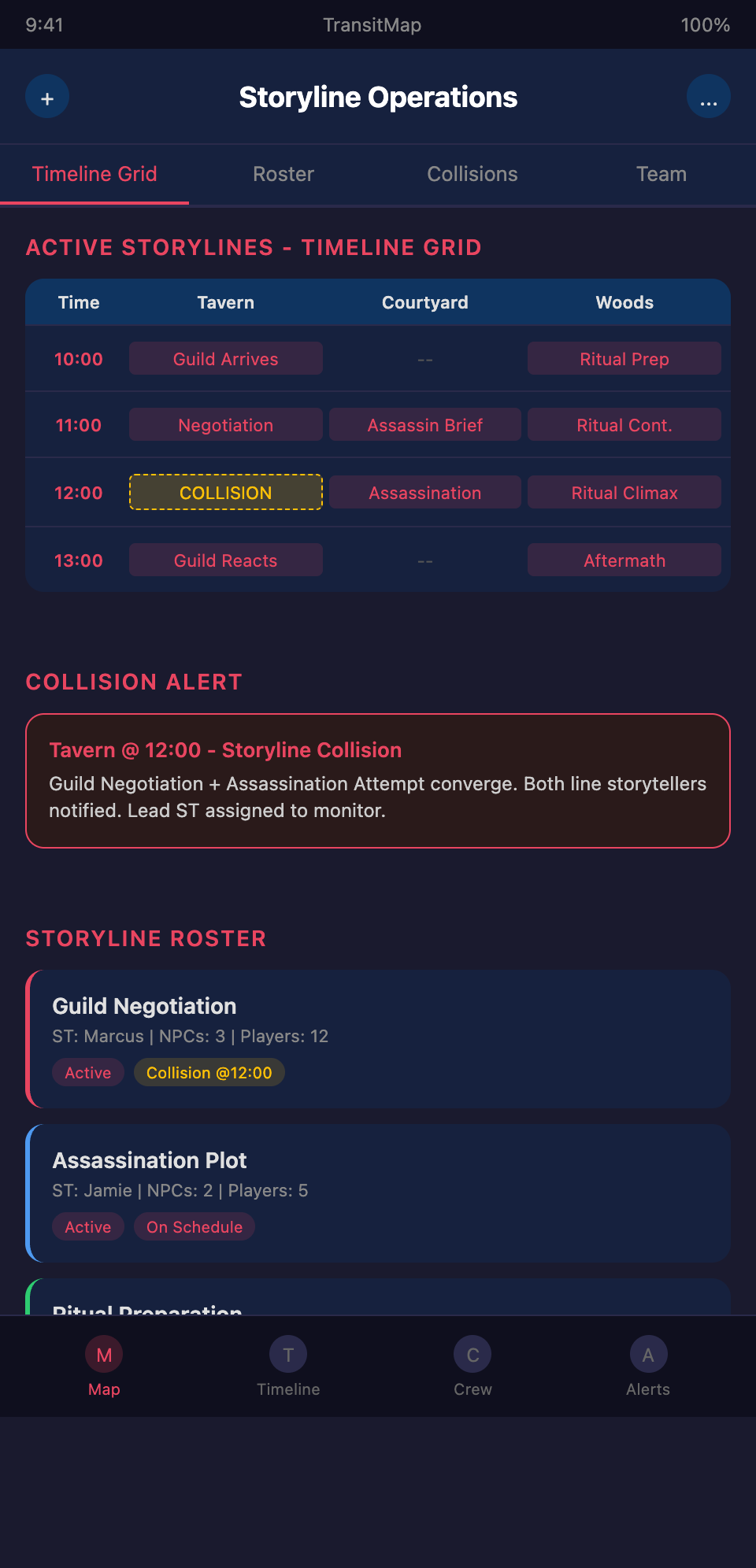
The Storyline Roster
Before your event, create a complete roster of every storyline that will be active:
For each storyline, document:
- Storyline name and brief description
- Key NPCs involved — Which crew members are playing these roles?
- Key player characters involved — Which players are expected to engage with this storyline?
- Physical locations — Where does this storyline take place?
- Timeline — When does this storyline activate? When are its key beats? When should it resolve?
- Dependencies — Does this storyline require another storyline to reach a certain point first?
- Assigned storyteller — Which member of your team is responsible for running this storyline?
This roster is your master reference during the event. Print it. Laminate it. Keep it at your operations point.
The Timeline Grid
Map your storylines against your event timeline on a grid:
| Time | Location A | Location B | Location C |
|---|---|---|---|
| 10:00 | Guild arrives | — | Ritual prep begins |
| 11:00 | Guild negotiation | Assassination briefing | Ritual continues |
| 12:00 | — | Assassination attempt | Ritual climax |
| 13:00 | Guild reacts to assassination | — | Ritual aftermath |
This grid shows you two critical things:
- Where storylines overlap in time and space — These are collision points that need extra coordination
- Where gaps exist — Time-location slots with no planned activity, where players may be idle
The Storyteller Team Structure
You cannot run simultaneous storylines alone. You need a storyteller team with clear roles:
The Lead Storyteller (1 person) — Maintains the big picture. Monitors all storylines from a central position. Makes decisions when storylines collide or when unexpected player actions require a response. Does not run any single storyline directly.
Line Storytellers (1 per major storyline) — Each one is responsible for running their assigned storyline. They know the NPCs, the beats, and the contingencies. They have authority to make minor adjustments within their storyline without consulting the lead.
Floating Storytellers (1-2 people) — Unassigned crew who respond to emergencies: a storyline that needs an extra NPC, a player group that has gone somewhere unexpected, a scene that needs a referee. They are your flexible response capacity.
Communication system — All storytellers need a way to communicate silently during the event. Walkie-talkies with earpieces, a group text channel, or a dedicated messaging app. The lead storyteller needs to be reachable at all times.
Real-Time Storyline Monitoring
During the event, the lead storyteller's job is to maintain situational awareness across all active storylines. This requires:
Regular check-ins. Every thirty to sixty minutes, each line storyteller sends a brief status update: "Guild negotiation progressing. They've agreed to the trade terms but are suspicious of the duke's representative. On schedule."
Collision alerts. When two storylines are about to interact — same location, shared NPC, overlapping player groups — the relevant line storytellers notify each other and the lead. "Assassination team is heading toward the tavern. Guild negotiation is still happening there. How do we want this to play out?"
Player tracking. Key player characters should be loosely tracked — not surveil them, but know which storyline they are currently engaged with. When a player who is critical to storyline B is deep in storyline A, you know storyline B might stall.
Deviation tracking. When a storyline goes off-script, the line storyteller reports the deviation and proposes an adjustment. The lead approves, modifies, or redirects.
Handling Storyline Collisions
The most exciting and most dangerous moments in a LARP are storyline collisions — when two or more plotlines converge at the same time and place.
Planned collisions are your most dramatic event moments. The assassination happens during the guild negotiation. The ritual's climax coincides with the battle. These should be choreographed:
- Both line storytellers coordinate in advance
- NPCs know what to expect and how to react
- Contingencies are prepared for likely player responses
- The lead storyteller is present or nearby to make real-time calls
Unplanned collisions happen when players take storylines to unexpected places. The assassination target flees into the ritual space. A faction meeting gets interrupted by a player pursuing a completely different plotline.
For unplanned collisions:
- Do not fight it. The collision is happening. Let it happen.
- Communicate immediately. Both line storytellers need to know what is happening.
- Decide who leads. One storyline takes priority in the moment — usually the one with more players engaged or higher stakes.
- Adapt the subordinate storyline. The storyline that did not take priority adjusts. The assassination is delayed. The ritual is disrupted. Build the collision into both storylines' narratives.
Post-Event Storyline Reconciliation
After the event, reconcile what actually happened with what was planned:
- For each storyline: What beats were hit? Which were missed? How did the storyline resolve?
- For collisions: What unexpected interactions occurred? How did they affect each storyline?
- For player actions: Which player choices significantly altered storyline trajectories?
- For continuity: What is now canonically true in your game world as a result of this event?
This reconciliation is essential if your LARP runs ongoing campaigns. What happened at this event becomes the starting point for the next one.
Running a multi-storyline LARP and need a coordination system that keeps every plotline visible? Join the TransitMap waitlist — manage simultaneous storylines as parallel transit lines with collision points, timing, and crew assignments all mapped in one view.