Cross-Faction Storyline Coordination in LARP
The Faction Silo Problem
Well-designed LARP factions can accidentally become walled gardens. Players within a faction interact constantly with each other but rarely with members of other factions. The faction's internal storyline consumes all available player attention, and cross-faction interaction only happens during scheduled confrontations.
This creates several problems:
- The world feels small — Players only experience their faction's perspective
- Faction dynamics stagnate — Without cross-faction interaction, the same internal politics repeat each event
- New relationships do not form — Players never meet characters outside their faction, limiting the social web
- The event fragments — Instead of one event, you are running several small events in the same location
Cross-faction storylines solve this by creating narrative reasons for players from different factions to interact — cooperate, compete, negotiate, deceive, and build relationships that transcend faction boundaries.
Types of Cross-Faction Storylines
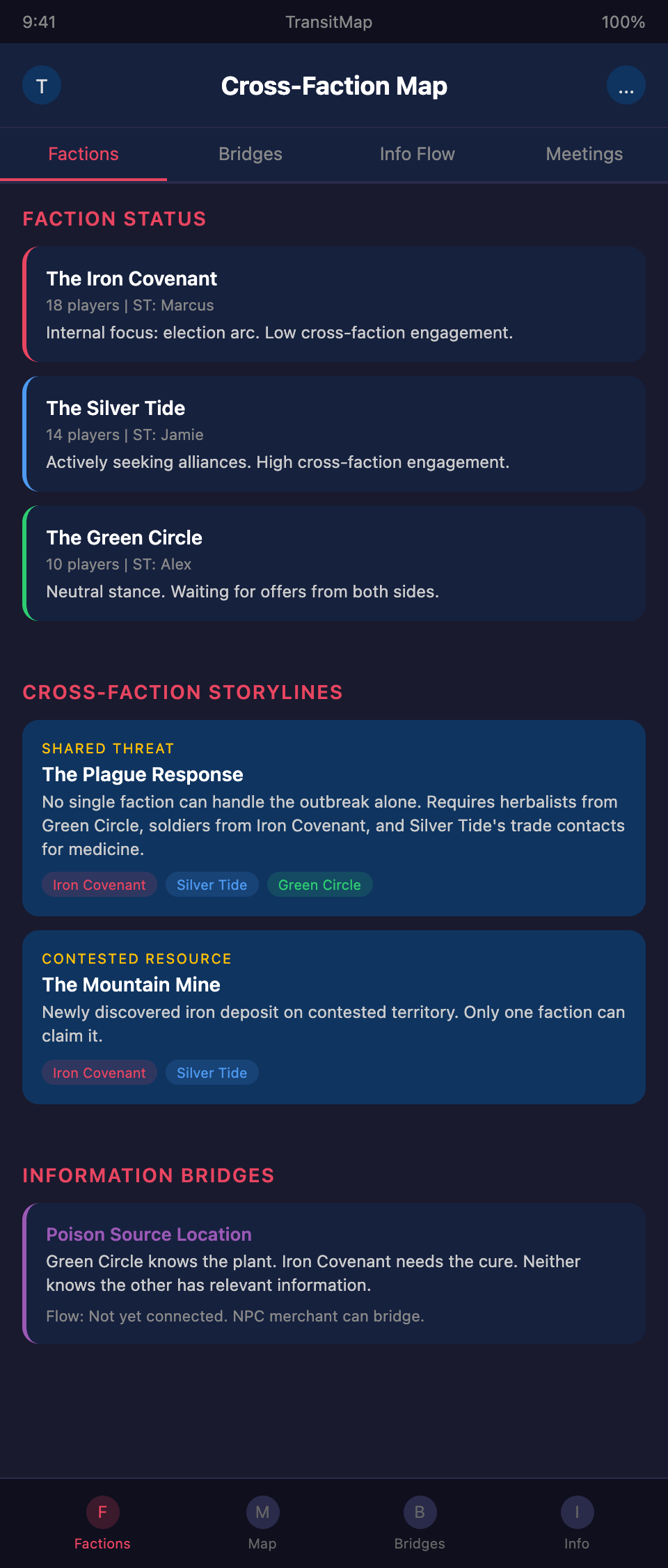
The Shared Threat. An external danger that affects all factions equally and cannot be handled by any single faction alone. A plague, an invasion, a magical catastrophe. The shared threat forces cooperation and reveals which factions prioritize the common good versus their own advantage.
The Contested Resource. Something that multiple factions want and only one can have. Unlike faction conflict (which is general), a contested resource is specific and creates a focused interaction point. The location of a mine. The allegiance of a neutral NPC. Control of a trade route.
The Cross-Faction Relationship. Two characters from different factions develop a personal relationship — friendship, romance, mentorship, rivalry — that creates tension between personal loyalty and faction loyalty. These storylines are usually player-initiated, but organizers can seed them by designing character connections during creation.
The Information Bridge. A piece of information that one faction has and another faction needs. The faction with the information may not know its significance. The faction that needs it may not know who has it. The investigation process creates cross-faction interaction.
The Neutral Actor. An NPC or player character who is not aligned with any faction and whose actions affect multiple factions. A traveling judge, an independent merchant, a mercenary company. Neutral actors serve as interaction catalysts and mediators.
Designing Cross-Faction Content
Create natural meeting points. Design locations and events where cross-faction interaction is expected:
- The market square where all factions trade
- The tavern where everyone gathers for meals
- The council chamber where faction representatives meet
- The neutral temple where characters seek counsel
These spaces should be physically central and designed to encourage mixing.
Design quests that require cross-faction cooperation. A quest that requires skills, resources, or information from multiple factions forces players to negotiate, share, and trust across faction lines. The key: make the cooperation necessary but the terms negotiable. How much does each faction contribute? Who gets the reward? These negotiations are the real content.
Create information asymmetry across factions. Give each faction a piece of a larger puzzle. No faction can solve the puzzle alone. The process of assembling the full picture — with all the trust issues and information-trading that implies — generates rich cross-faction narrative.
Introduce cross-faction NPCs. NPCs who have relationships with multiple factions serve as bridges. The merchant who trades with everyone. The spy who works for the highest bidder. The diplomat who is trying to broker peace. These NPCs can steer cross-faction interaction by introducing factions to each other and facilitating (or sabotaging) cooperation.
Coordination Between Line Storytellers
Cross-faction storylines require coordination between the line storytellers responsible for each involved faction:
Joint planning sessions. Storytellers whose factions are involved in a cross-faction storyline must plan together. They need to agree on:
- The storyline's core premise and intended outcomes
- Which faction-specific beats intersect with the cross-faction storyline
- How information flows between factions and when
- What happens if one faction resolves their part before the other
- Which NPCs are shared and who controls them
Communication during the event. When cross-faction scenes are happening, all involved storytellers need to monitor. A cross-faction negotiation that goes wrong might require immediate response from multiple storytellers simultaneously.
Post-event reconciliation. Cross-faction storyline outcomes must be reconciled into a single canon that both factions accept. If the two factions remember the negotiation differently, the storytellers must agree on what actually happened.
Preventing Cross-Faction Problems
Forced interaction resentment. Players who are forced into cross-faction scenes they do not want can become resentful. Design cross-faction content as opportunities, not obligations. Players should choose to engage because the storyline offers something their faction wants, not because the organizer requires it.
Information leakage. Cross-faction storylines require information discipline. A player who learns a faction secret through a cross-faction interaction should not immediately share it with their entire faction — but they probably will. Design your information flow with the assumption that any shared information will spread quickly.
Spotlight imbalance. Cross-faction storylines can accidentally give one faction more screen time or more agency than others. Design each faction's role in the cross-faction storyline to be equally important — different contributions, but equivalent significance.
Tone clashes. Different factions may have different tones — one is serious political drama, another is adventure comedy. Cross-faction scenes need a negotiated tone that respects both factions' established atmospheres.
Tracking Cross-Faction Storylines
Cross-faction storylines are the most complex to track because they involve multiple tracking systems:
- The cross-faction storyline tracker (owned by the lead storyteller)
- Each involved faction's internal tracking (owned by line storytellers)
- Shared NPC tracking (jointly owned)
- Information flow tracking (who knows what across faction boundaries)
A visual map that shows cross-faction connections — storylines that bridge between faction zones — immediately reveals the integration level of your event. If your map shows factions as isolated clusters with no bridges, you need more cross-faction content.
Designing cross-faction storylines for your LARP? Join the TransitMap waitlist — map storylines that cross faction boundaries as connecting transit routes, with shared NPCs, information flow, and coordination points all visible on one map.