Handling Unexpected Player Actions at LARP Events
The Certainty of Surprise
In LARP, unexpected player actions are not exceptional — they are the norm. With twenty, fifty, or a hundred autonomous players making independent decisions in real time, every event will produce actions that no organizer anticipated.
The player who befriends the monster instead of fighting it. The spy who defects to the enemy faction during a public ceremony. The entire faction that decides to leave the kingdom rather than fight the war. The player who gives the quest macguffin to the villain instead of using it against them.
These moments are simultaneously the greatest strength of LARP as a medium and the greatest challenge of LARP as an organized activity. They cannot be prevented. They can only be prepared for — not with specific contingencies for every possible action, but with a mindset and a toolkit that turns surprises into story.
The First Response: Do Not Undo
The cardinal rule of handling unexpected player actions in LARP: do not reverse, retcon, or negate what just happened. The player acted. Other players witnessed it. It is now part of the shared narrative.
Negating player actions destroys the fundamental promise of LARP — that your choices matter. Even when a player's action is catastrophic for your planned storyline, reversing it teaches every player at the event that their actions are cosmetic. The damage from negation is worse than the damage from any surprise.
Exceptions exist for safety violations, rules violations, and out-of-game misconduct. But within the bounds of legitimate play, player actions stand.
The Triage Framework
When a surprising player action occurs, triage it:
Category 1: Flavor surprises. The player's action is unexpected but does not affect the storyline's core structure. The spy approached the target differently than expected. The negotiator used an unconventional argument. The warrior challenged the villain to a duel instead of attacking.
Response: Adapt NPC reactions and let the scene play out. No structural changes needed.
Category 2: Path surprises. The player's action bypasses planned content but the storyline can still reach its intended destination through an alternate route. The players skipped the investigation and went straight to the suspect. The faction chose to negotiate when you expected them to fight.
Response: Skip the bypassed content. Adjust the remaining storyline to connect the new path to the intended destination. Brief affected NPCs on the change.
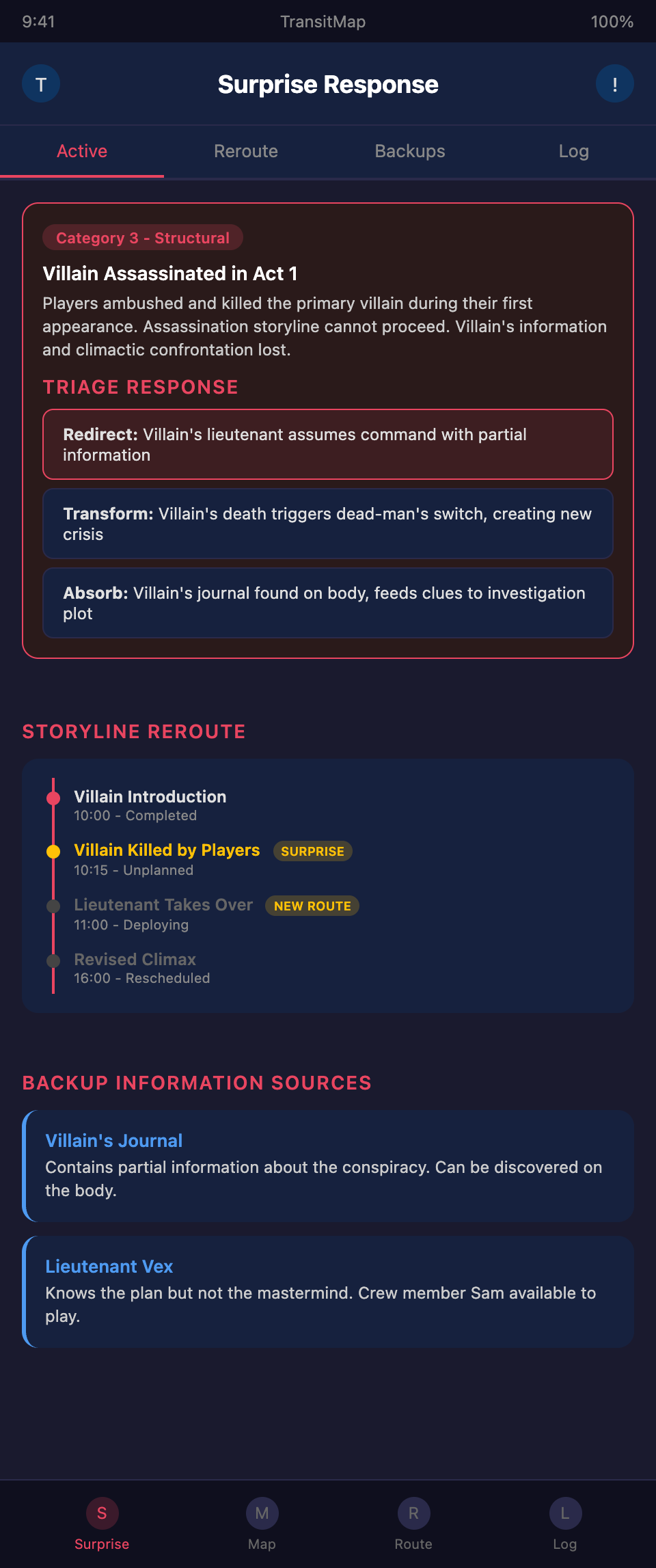
Category 3: Structural surprises. The player's action fundamentally alters the storyline. The villain is dead. The macguffin is destroyed. The alliance that was supposed to be the climax has already happened. The storyline cannot proceed as planned.
Response: Stop. Assess. Redesign. This requires the real-time redesign process: freeze your reaction, assess the impact, choose between redirect/transform/absorb, communicate, and execute.
Building a Surprise-Resilient Event
You cannot prevent surprises, but you can design events that absorb them gracefully:
Modular storylines. Design storylines as chains of modular scenes rather than fixed sequences. If one scene is invalidated by player action, the remaining scenes can be rearranged or modified without redesigning the entire storyline.
Motivation-based NPCs. NPCs briefed with motivations ("you want to protect your family") handle surprises better than NPCs briefed with scripts ("say this line and then leave"). A motivation-based NPC can react authentically to anything a player does.
Redundant plot infrastructure. Critical story elements should exist in multiple forms. If the villain is the only character who knows the secret, the villain's death kills the secret. If the villain, the villain's journal, and the villain's lieutenant all know the secret, the secret survives the villain's death.
Flexible timelines. Events scheduled for specific times are vulnerable to surprises that disrupt the timeline. Build buffer time into your schedule. If the climactic battle is scheduled for 4 PM and a surprise at 2 PM changes everything, you have two hours to adapt.
Common Surprise Categories and Prepared Responses
Based on hundreds of LARP events, certain surprises are predictable in category if not in specifics:
"They killed the important NPC." Always have a backup information source. The NPC's journal. A subordinate who knows partial information. A letter the NPC sent before dying. The information survives the character.
"They allied with the enemy." Let the alliance happen. The "enemy" NPC has their own agenda and will eventually reveal that alliance has costs. The other players who expected this group to be allies now have a new problem to deal with.
"They ignored the plot entirely." The plot does not wait for them. The threat escalates. The deadline passes. The consequences of inaction manifest visibly. Eventually, the plot comes to them.
"They solved it immediately." Congratulate them. Then add a complication. The mystery is solved, but the culprit has allies. The dungeon is conquered, but what was sealed inside is now free. Success should create new challenges.
"They did something the rules don't cover." Make a ruling in the moment that serves the story. Note the ruling for future reference. After the event, review the ruling and decide if it should become precedent.
Empowering Your Team to Handle Surprises
You cannot be everywhere during a LARP event. Your line storytellers and crew need the authority and the tools to handle surprises independently:
Authority levels. Define what each team member can decide without checking with you:
- All crew: respond to Category 1 surprises autonomously
- Line storytellers: respond to Category 2 surprises autonomously, escalate Category 3
- Lead storyteller: handle Category 3 surprises
The "yes, and" principle. Train your team in improvisational thinking. When a player does something unexpected, the default response is "yes, and" — accept what happened and add to it. "Yes, you killed the duke. And now his guards are surrounding you and demanding you drop your weapons."
Quick-consult protocol. For surprises that need escalation, establish a fast communication method. A text message with a code: "Situation: [what happened]. My proposed response: [option]. Approve? Y/N." The lead storyteller responds in under two minutes.
Post-surprise debriefs. After the event, review every significant surprise and how it was handled. What worked? What could have been handled better? This builds institutional knowledge for future events.
Want a system that helps you anticipate and respond to player surprises? Join the TransitMap waitlist — track your storylines as flexible transit routes that can be rerouted in real time, with alternative paths always visible when the unexpected happens.