Integrating Combat and Narrative in LARP Events
The Combat-Narrative Disconnect
Many LARP events have a combat problem: fights happen in a narrative vacuum. Players batter each other with foam swords for thirty minutes, someone wins, and then... the political intrigue continues as if nothing happened. The combat and the narrative are running on separate tracks.
This disconnect wastes combat's dramatic potential. A well-integrated battle can be the most memorable moment of an event — the culmination of political maneuvering, the resolution of a faction conflict, the physical manifestation of a narrative crisis. A disconnected battle is just exercise.
Making Combat Narratively Necessary
Combat should happen because the story demands it, not because the schedule says "battle at 3 PM." Design combat encounters that emerge from narrative situations:
Escalation combat. A political negotiation fails. Diplomacy is exhausted. Violence becomes the final option. The players who spent hours negotiating now fight because they could not find a peaceful resolution. This combat has weight because the players tried to avoid it.
Revelation combat. The battle reveals something hidden. The traitor reveals themselves by fighting for the wrong side. The mysterious artifact activates during combat. The NPC who appeared harmless turns out to be a deadly combatant. The fight is the vehicle for the reveal.
Consequence combat. The battle's outcome determines a narrative consequence. If the defenders hold the gate, the town is saved. If the attackers breach the wall, the refugees must flee. The stakes are clear and the outcome matters.
Character combat. A personal conflict between two characters reaches its physical climax. A duel of honor. A confrontation between former allies. A fight where the relationship between the combatants matters more than the tactical outcome.
Pre-Combat Narrative Setup
The thirty minutes before a battle are as important as the battle itself:
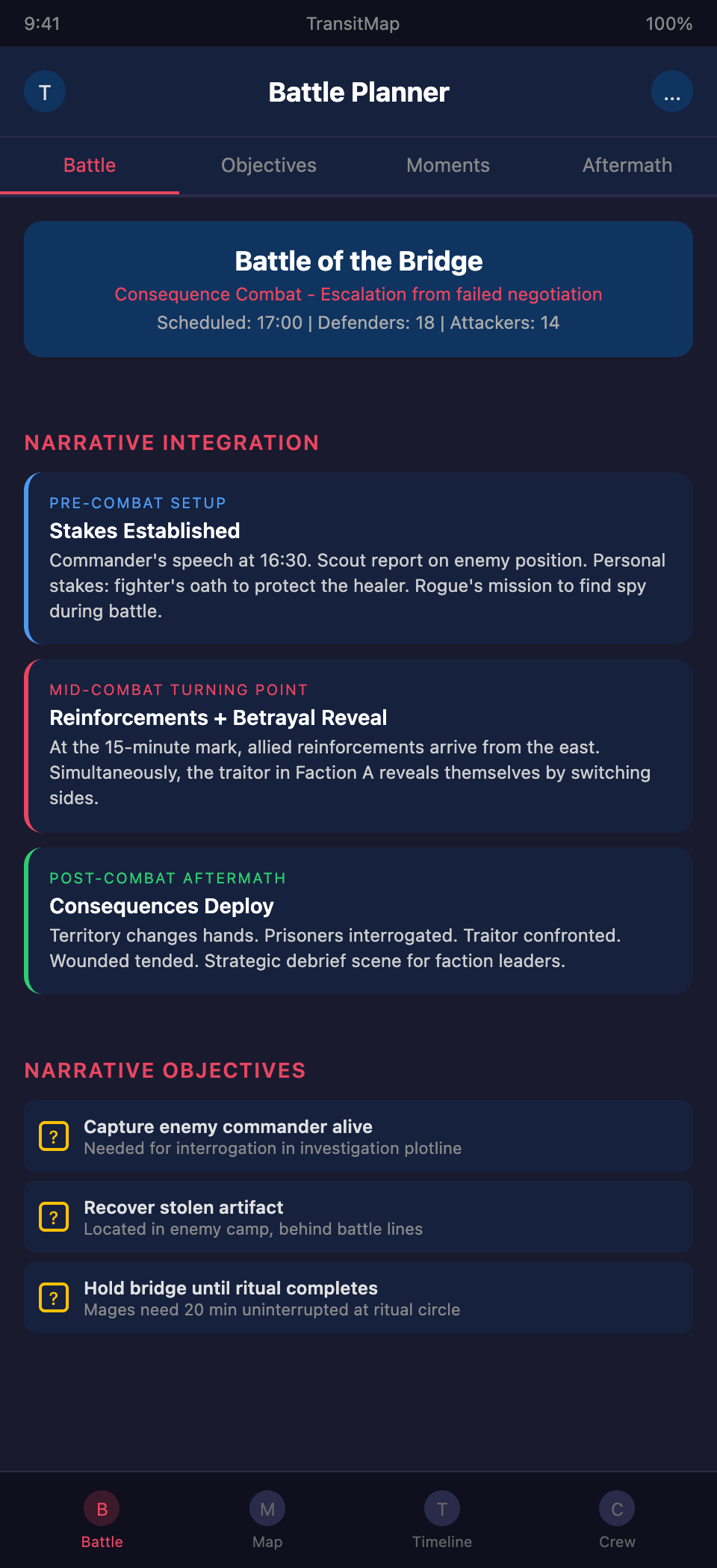
Establish what is at stake. Before the first sword is drawn, every participant should understand what they are fighting for. An NPC commander gives a speech. A scout reports what the enemy is doing. The war council decides the strategy. Make the stakes personal: "If we lose this bridge, the healer's village is defenseless."
Create personal stakes within the battle. Not every combatant needs a personal stake, but key players should have one. The fighter who promised to protect the healer. The rogue who is looking for the spy who will try to sabotage the defense. The mage who needs to reach the ritual circle during the battle.
Set narrative objectives. Beyond "defeat the enemy," give players specific objectives that serve the storyline:
- Capture the enemy commander alive for interrogation
- Recover the stolen artifact from the enemy camp
- Hold the position until the ritual is complete
- Protect the non-combatant NPCs during the evacuation
These objectives ensure the battle produces narrative outcomes beyond win/lose.
During Combat: Narrative Moments
Embed narrative moments within the combat itself:
Turning points. Midway through the battle, something changes — reinforcements arrive, a betrayal is revealed, the artifact activates, the weather shifts. This creates a dramatic arc within the combat rather than a continuous melee.
NPC behavior. Enemy NPCs should behave like characters, not targets. The enemy commander taunts the players. The enemy soldiers surrender when outmatched. The monster shows unexpected behavior that hints at its true nature. NPCs with personality transform combat from a mechanics exercise into a narrative scene.
Character moments. Create space within combat for character moments. The mentor falls and the student must fight alone. The pacifist character makes their first kill. The coward finds their courage. These moments do not require special mechanics — they emerge naturally when combat is designed with narrative awareness.
Environmental storytelling. The battlefield itself tells a story. Combat in the ruins of a destroyed village has different weight than combat in an open field. Combat in a sacred grove feels different from combat in a dungeon. Choose locations that reinforce the narrative context.
Post-Combat Narrative Follow-Through
The most important narrative work happens after the last sword is lowered:
Immediate aftermath. What happens in the five minutes after combat ends? The victors celebrate or collapse. The defeated surrender or flee. The wounded are tended. The dead are mourned. These moments are some of the most powerful in LARP — do not rush past them to get to the next plot beat.
Consequences. Within the hour after combat, the narrative consequences should become visible:
- Territory changes hands
- Prisoners are interrogated
- The retrieved artifact is examined
- The traitor is confronted
- Casualties are counted and mourned
Relationship impact. Combat changes relationships. Allies who fought side by side are bonded. Characters who were expected to fight but did not are questioned. The enemy who showed mercy is reassessed. Track these relationship shifts — they drive the next phase of the narrative.
Strategic debrief. Characters who led the battle should have an opportunity to debrief in character. What worked? What went wrong? Who distinguished themselves? This is both a pacing tool (a calm scene after high intensity) and a narrative device (it surfaces character reactions and generates new plotlines).
Common Combat-Narrative Integration Mistakes
- Combat as schedule filler — Inserting a battle because the event needs action, not because the story needs a fight
- Consequence-free combat — The battle ends and nothing changes. The same political situation continues. Nobody died permanently. No territory changed hands.
- Missing aftermath — Jumping straight from the battle to the next plot beat without giving players time to process what just happened
- PvP without narrative setup — Player-versus-player combat that feels like a grudge match rather than a story moment. PvP should emerge from narrative conflict, not replace it.
- One-sided battles — Battles where the outcome is predetermined rob combat of its narrative tension. If the players must win for the story to continue, it is not a real battle — it is choreography.
Want to integrate combat encounters into your LARP's narrative structure? Join the TransitMap waitlist — map battles as key junction points on your storyline transit routes, with pre-combat setup and post-combat consequences built into the narrative flow.