LARP Emotional Arc Pacing: Crafting the Player's Emotional Journey
Beyond Plot: Designing for Emotion
Most LARP event design focuses on plot: what happens, in what order, to whom. This is necessary but insufficient. The plot is the vehicle. The emotional experience is the destination.
Players do not remember the plot details of events from three years ago. They remember how they felt. They remember the terror of the midnight ambush. The triumph of the impossible victory. The grief of losing a beloved NPC. The tension of a negotiation where everything was at stake. The warmth of a campfire scene with friends.
Designing for emotion means deliberately creating conditions that evoke specific feelings at specific moments, and pacing those emotional beats to create a journey that feels complete by the event's end.
The Emotional Palette
LARP can reliably evoke these emotions. Understanding each one's triggers and requirements helps you design for them:
Tension/Anxiety — Created by uncertain outcomes with high stakes. Triggers: ticking clocks, hidden threats, information asymmetry, difficult choices. Requires: clear stakes and the genuine possibility of failure.
Fear — Created by vulnerability and the unknown. Triggers: darkness, isolation, approaching threats, loss of control. Requires: atmosphere management (lighting, sound), physical vulnerability (being alone or exposed), and established consequences for failure.
Triumph — Created by overcoming genuine difficulty. Triggers: winning a fight that seemed impossible, solving a mystery after long investigation, achieving a political goal through skilled maneuvering. Requires: the difficulty must be real, not theatrical. Manufactured triumph feels hollow.
Grief — Created by loss. Triggers: NPC death, character death, destruction of a valued place or object, betrayal by a trusted ally. Requires: the lost thing must have been genuinely valued. Grief cannot be manufactured — it can only be facilitated by ensuring that the thing being lost had time to become precious.
Joy/Celebration — Created by communal positive experience. Triggers: shared victory, festivals, in-character celebrations, moments of connection. Requires: shared context and a break from tension. Joy is most powerful after a period of struggle.
Camaraderie — Created by shared experience, especially shared adversity. Triggers: fighting side by side, surviving a challenge together, sharing a meal after a crisis. Requires: genuine shared experience, not manufactured bonding exercises.
Wonder — Created by encountering the unexpected and beautiful. Triggers: magical effects, elaborate set dressing, unexpected kindness, revelations that reframe the story. Requires: craftsmanship in presentation and an element of genuine surprise.
Pacing the Emotional Arc
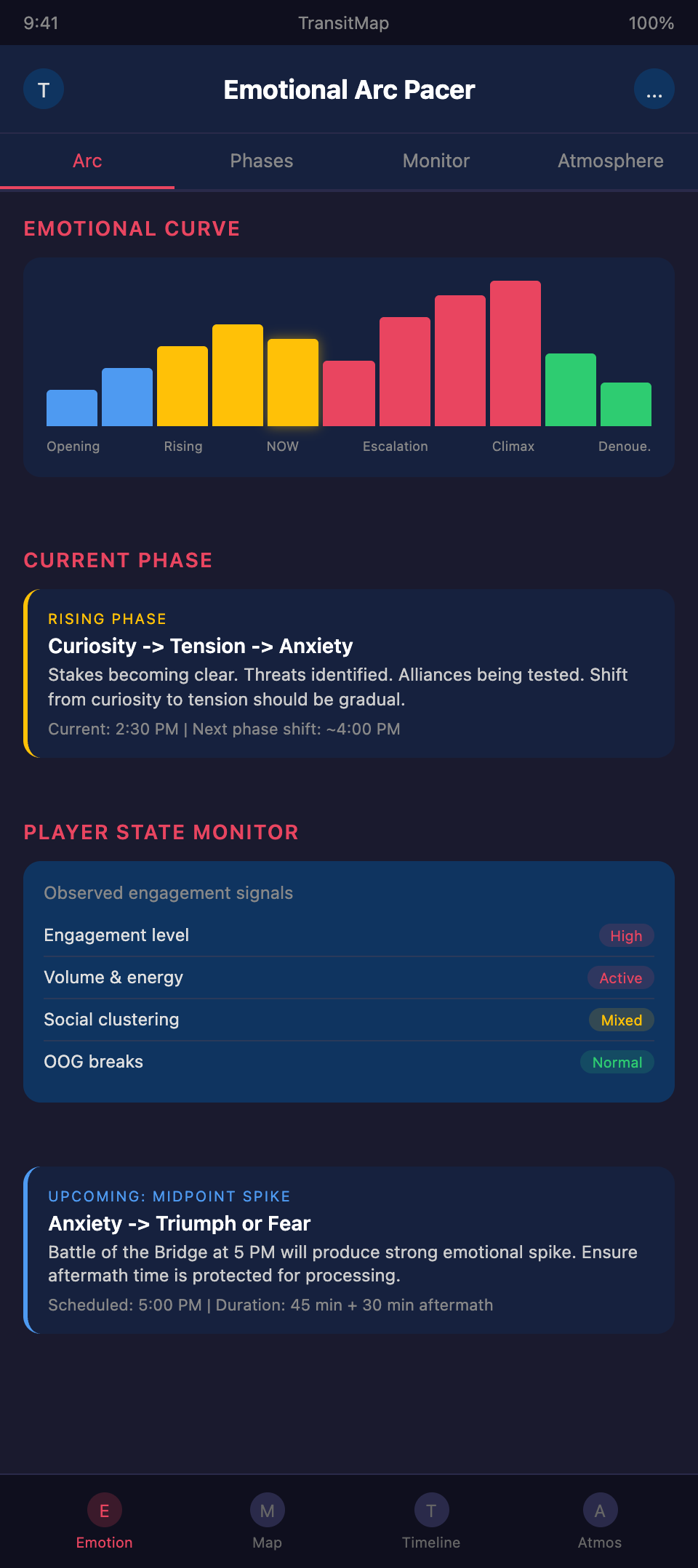
Map your event's intended emotional journey as a curve:
Opening: Anticipation → Curiosity Players arrive with out-of-game anticipation. Your first scenes should convert that into in-game curiosity. Mystery hooks, atmospheric introductions, reunion scenes between established characters.
Rising: Curiosity → Tension → Anxiety As storylines activate and stakes become clear, curiosity transforms into tension. Threats are identified. Alliances are tested. Choices present themselves. The shift from curiosity to tension should be gradual — do not slam players into anxiety within the first hour.
Midpoint: Anxiety → Fear or Triumph Your midpoint event should produce a strong emotional spike — either the relief of triumph or the intensity of fear. A battle won (triumph) or a devastating revelation (fear). This spike resets emotional energy for the second half.
Escalation: Tension → Dread → Determination The second half builds toward the climax with sustained high-tension content. Dread (the villain is winning, the deadline is approaching) should be punctuated by moments of determination (the players rally, a new ally arrives, a weakness is discovered).
Climax: Maximum Tension → Catharsis The climactic moment should be the emotional peak. The outcome resolves accumulated tension into catharsis — the release of emotional pressure. Whether the outcome is victory or defeat, the catharsis comes from resolution.
Denouement: Catharsis → Warmth → Nostalgia After the climax, the emotional arc descends through warmth (celebration, reunion, reflection) into nostalgia (the event is ending, the experience is being stored as memory). Do not skip this phase. Players need emotional closure.
Practical Emotional Design Tools
Atmosphere management. Physical environment directly affects emotion:
- Lighting: candlelight creates intimacy and vulnerability; harsh light creates exposure and anxiety
- Sound: ambient music sets tone; sudden silence creates tension; drums create urgency
- Temperature: cold creates vulnerability; warmth creates comfort
- Smells: smoke, food, incense — sensory details anchor emotional states
Pacing through contrast. The most powerful emotional moments come from contrast. Grief hits harder after joy. Triumph feels greater after despair. Fear is more effective after safety. Design your emotional arc with deliberate contrasts.
Communal emotional moments. Some emotions are amplified by shared experience. A battle cry before combat. A toast at the feast. A moment of silence for the fallen. These communal moments synchronize the group's emotional state and create the most powerful LARP memories.
Individual emotional moments. Other emotions are most powerful in private. A quiet confession between two characters. A solo scene where a character faces their fear. A private moment of grief. Protect space for these individual emotional experiences within your event design.
Monitoring Emotional State During Events
Watch your players for signs of emotional state:
- Engagement level — Are players leaning in or pulling back?
- Volume and energy — Loud, active players are engaged. Quiet, passive players may be overwhelmed or disengaged.
- Social clustering — Players gathering in tight groups may be processing intense content together. Players isolating may need a check-in.
- Out-of-game breaks — Players stepping out of game frequently may be experiencing emotional fatigue.
If you notice emotional fatigue (too much intensity without relief), deploy a low-intensity scene or a social moment. If you notice emotional flatness (nothing is landing), deploy a catalyst that raises stakes.
Want to design LARP events with deliberate emotional arcs? Join the TransitMap waitlist — map your event's emotional journey alongside its plot structure, with pacing tools that help you craft the complete player experience.