LARP Event Debriefing Best Practices
Why Debriefs Matter More Than You Think
Most LARP organizers skip the debrief. The event is over, everyone is exhausted, and the last thing anyone wants to do is sit in a circle and talk about what just happened. So the lessons learned evaporate. The same mistakes get repeated at the next event. The things that worked brilliantly are forgotten and not deliberately reproduced.
A structured debrief is the single highest-value activity in LARP event management. One hour of debrief time generates more improvement for your next event than ten hours of planning without the benefit of systematically captured lessons.
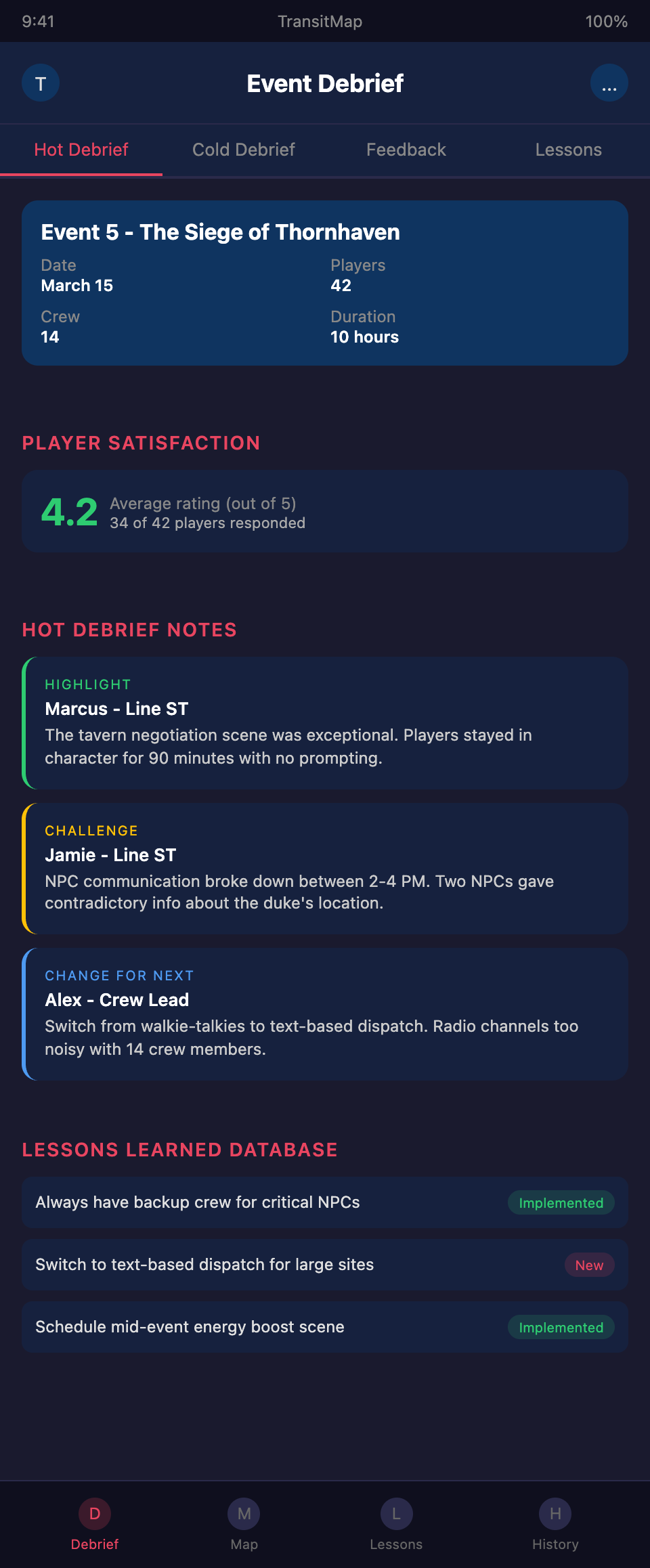
The Two-Stage Debrief
Stage 1: The Hot Debrief (Day of, 30-60 minutes)
Conduct this immediately after the event, while the team is still together and memories are vivid. Keep it focused and structured:
Who attends: The lead storyteller and all line storytellers. Crew members who ran significant scenes or observed critical moments. Keep it to core team — too many people makes the conversation unfocused.
Format: Go around the room. Each person answers three questions in under three minutes:
- What was your highlight? One moment that worked exceptionally well. This surfaces best practices and celebrates successes.
- What was your biggest challenge? One thing that went wrong or was harder than expected. This surfaces problems without blame.
- What would you change for next time? One specific, actionable change. Not vague wishes but concrete adjustments.
Documentation: One person takes notes. Capture each response in bullet points. Do not try to discuss or solve problems during the hot debrief — just capture the data. Discussion happens in Stage 2.
Emotional temperature check. Before starting, acknowledge that everyone is tired and emotionally invested. Set the ground rule: this is about improving future events, not about blaming anyone for past ones. Critique the process, not the person.
Stage 2: The Cold Debrief (1-2 weeks later, 60-90 minutes)
Conduct this after the hot debrief data has been compiled and everyone has had time to decompress and reflect. This is where analysis and planning happen.
Review the hot debrief data. Compile all highlights, challenges, and change suggestions. Identify patterns — if three people mentioned the same challenge, it is a systemic issue.
Analyze by category:
Storyline quality:
- Which storylines landed well with players? Why?
- Which storylines fell flat? Why?
- Were there any storylines that players loved that were not planned?
- Were there any planned storylines that no players engaged with?
Logistics and operations:
- Did the NPC schedule work? Where were the gaps?
- Did communication systems function? Where did they break down?
- Were there any site or space issues?
- Were crew members adequately supported (breaks, food, briefings)?
Player experience:
- What does player feedback (surveys, informal conversations) say?
- Were there any safety concerns or incidents?
- Did any players feel excluded from content?
- Were new players adequately integrated?
Pacing and timing:
- Did the event follow its planned energy curve?
- Were there dead periods? Why?
- Was the climax timed well?
- Did the event start and end on schedule?
Processing Player Feedback
Player feedback is a critical debrief input but requires careful interpretation:
Gather it systematically. Send a post-event survey to all players within 48 hours. Keep it brief:
- Rate your overall experience (1-5)
- What was your favorite moment?
- What would you change?
- Any concerns about safety or conduct?
Interpret with context. Player feedback reflects individual experience, which may not represent the event as a whole:
- A player who happened to be in the wrong place at the wrong time will rate the event lower despite excellent overall design
- A player who had one amazing personal scene may rate the event highly despite systemic issues
- Players are more likely to report negative experiences than positive ones
Look for patterns, not outliers. One negative review is an individual experience. Five negative reviews about the same issue are a pattern that demands attention.
Separate content complaints from experience complaints. "I did not like the storyline" is a content preference. "I had nothing to do for two hours" is an experience failure. Focus on experience failures — they affect everyone regardless of content preference.
Building a Lessons Learned Database
Individual debriefs are valuable. A cumulative lessons learned database across events is transformative.
After each cold debrief, add entries to your database:
| Category | Lesson | Event | Status |
|---|---|---|---|
| NPC Management | Always have backup crew for critical NPCs | Event 3 | Implemented Event 4 |
| Pacing | Schedule a mid-event energy boost scene | Event 2 | Ongoing |
| Communication | Switch to text-based dispatch instead of walkie-talkies for large sites | Event 4 | Testing Event 5 |
| Mystery Design | Five clues per conclusion minimum for LARP mysteries | Event 3 | Standard practice |
Over time, this database becomes your organization's institutional knowledge — the accumulated wisdom of every event you have run.
Common Debrief Mistakes
- Skipping the debrief — The most common and most costly mistake. Even a fifteen-minute hot debrief is better than nothing.
- Blame-focused discussion — Debriefs that become arguments about who made mistakes. Keep it process-focused: "This happened. How do we prevent it next time?" Not "You did this wrong."
- No follow-through — Identifying changes but never implementing them. Track action items from the cold debrief and assign owners and deadlines.
- Only debriefing failures — Analyzing what went wrong without analyzing what went right. Understanding success is as important as understanding failure.
- Debriefing too late — Waiting months between the event and the debrief. Memories have faded and emotional investment has dissipated. Debrief within two weeks.
The Debrief Template
For consistency, use the same template for every event debrief:
- Event overview — Date, location, player count, crew count, duration
- Hot debrief summary — Compiled highlights, challenges, and change suggestions
- Player feedback summary — Survey results and notable individual feedback
- Storyline analysis — Per-storyline assessment of what worked and what did not
- Operations analysis — NPC management, communication, pacing, logistics
- Lessons learned — New entries for the lessons learned database
- Action items — Specific changes for the next event, with owners and deadlines
- Continuity notes — What carries forward to the next event (link to canonical record)
Want to track lessons learned and event improvements across your entire LARP campaign? Join the TransitMap waitlist — build a visual record of your event series where every lesson, improvement, and storyline evolution is mapped across your campaign's history.