LARP Event Timeline Planning: Scheduling Drama Effectively
The Timeline as Narrative Architecture
Most LARP organizers create event timelines as logistical schedules: NPC deployment at 10 AM, battle at 3 PM, feast at 7 PM. But a timeline is more than logistics. It is the architecture of your event's narrative experience — the structure that determines when players feel tension, when they feel relief, and when the dramatic moments land with maximum impact.
A well-designed timeline creates a rhythm that carries players through the event emotionally. A poorly designed timeline creates either relentless intensity (exhausting) or aimless meandering (boring).
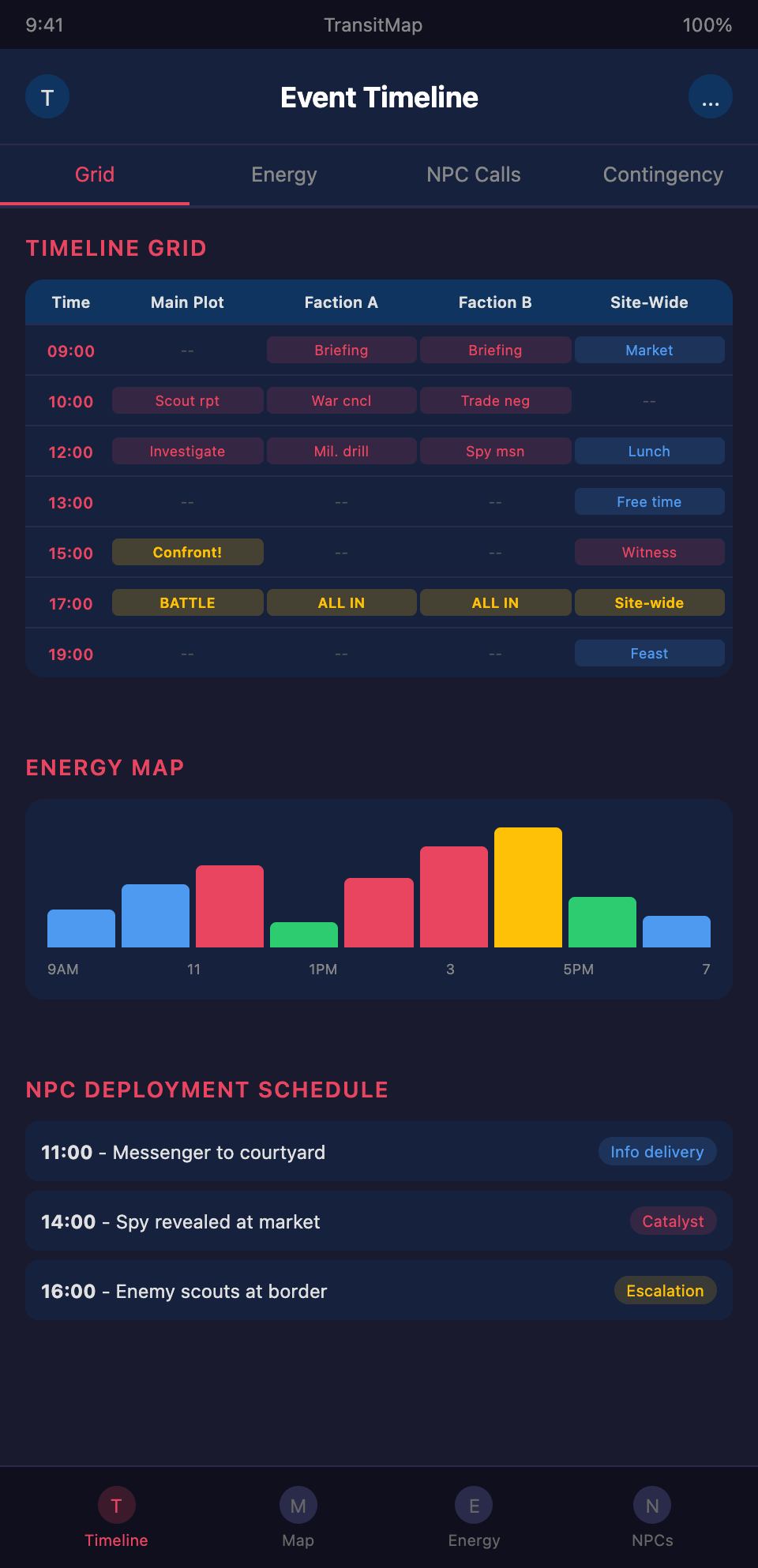
The Timeline Grid
Build your timeline as a grid with time on one axis and storylines/locations on the other. This reveals the full picture of what is happening when and where:
| Time | Main Plot | Faction A | Faction B | Site-Wide |
|---|---|---|---|---|
| 09:00 | — | Morning briefing | Morning briefing | Market opens |
| 10:00 | Scout reports threat | War council | Trade negotiations | — |
| 11:00 | NPC messenger arrives | — | — | Emergency assembly |
| 12:00 | Investigation begins | Military drill | Spy mission | Lunch break |
| 13:00 | — | — | — | Free time |
| 14:00 | Evidence discovered | Alliance meeting | Sabotage attempt | — |
| 15:00 | Confrontation scene | — | — | All witness |
| 16:00 | — | Battle preparation | Evacuation prep | — |
| 17:00 | THE BATTLE | All involved | All involved | Site-wide |
| 18:00 | Aftermath | Celebration/mourning | Celebration/mourning | — |
| 19:00 | — | — | — | Feast |
This grid immediately reveals:
- Conflict-free windows (1 PM) where players can rest and socialize
- Convergence points (5 PM battle) where all storylines come together
- Storyline gaps (Faction A has nothing from noon to 2 PM) that need either content or intentional downtime
- Pacing rhythm — the pattern of activity and rest across the day
Scheduling Principles
Principle 1: Never schedule two climactic moments simultaneously.
If your main plot's confrontation scene happens at the same time as Faction B's sabotage attempt, players must choose which to attend. Some will miss a climactic moment, which feels like a failure of event design. Space climactic moments at least sixty to ninety minutes apart.
Principle 2: Schedule downtime deliberately.
Planned downtime is not wasted time — it is essential recovery. Players need periods to:
- Process what just happened
- Plan their next moves
- Have unstructured character interactions
- Eat and rest physically
Schedule at least one sixty-minute downtime block for every four hours of active content. Mark it on your timeline so storytellers do not fill it with additional plot.
Principle 3: Front-load setup, back-load payoff.
The first third of your event should establish situations. The middle third should complicate them. The final third should resolve them. Do not schedule your biggest revelation in the first hour — players need time to build investment before payoffs mean anything.
Principle 4: Schedule NPC appearances with intent.
Every NPC deployment should have a purpose:
- Information delivery — The NPC brings news that advances a storyline
- Catalyst — The NPC's presence creates a situation that demands player response
- Atmosphere — The NPC adds richness to the world (use sparingly — do not deploy NPCs just for color)
- Escalation — The NPC raises the stakes of an active storyline
If you cannot articulate the purpose of an NPC appearance, cut it from the timeline.
Principle 5: Build in flexibility.
Your timeline is a plan, not a contract. Build buffer time around key moments. If the negotiation scene runs long because players are deeply engaged, you need time to absorb the overrun without cascading delays.
Mark which elements are fixed (the battle starts at 5 PM because it needs daylight) and which are flexible (the confrontation can happen anywhere from 2:30 to 3:30 PM depending on investigation progress).
The Energy Map Overlay
Layer an energy map over your timeline to visualize the emotional rhythm:
High    |          *              *****
        |        **  *           *     *
Medium  |      **     *        **       *
        |    **        **    **          **
Low     |  **           ****              ***
        |__________________________________
         9   10  11  12  1   2   3   4   5   6   7
The energy map shows whether your timeline creates the rising-and-falling pattern that sustains engagement. If the energy is flat (medium all day) or sawtooth (high-low-high-low with no trend), adjust your beat placement.
Contingency Timelines
Prepare alternative timelines for common contingencies:
Bad weather contingency. If outdoor content is rained out, which indoor locations absorb which scenes? How does the schedule compress?
Early resolution contingency. If a storyline resolves faster than expected, what fills the gap? Have standby content ready — secondary quests, social catalysts, or accelerated timeline for the next storyline beat.
Delayed resolution contingency. If a storyline stalls, how do you compress the remaining timeline to still reach the climax? Identify which beats can be cut and which are essential.
Player count contingency. If fewer players attend than expected, which content scales down? If more attend, which content can absorb additional participants?
Communicating the Timeline to Your Team
Your storyteller team needs the timeline, but they need it in a format they can use during the event:
The master timeline — The full grid with all details. Kept at the operations point for reference.
Storyteller-specific timelines — Each line storyteller gets a version showing only their storyline and cross-storyline touchpoints. This prevents information overload.
The public schedule — An in-game schedule of events that players can see: meal times, market hours, scheduled ceremonies. This is a subset of the full timeline — enough to orient players without revealing plot.
The NPC call sheet — A timeline showing when each crew member is deployed, where, and as which character. Each crew member gets their personal call sheet.
Want to build LARP event timelines that orchestrate narrative beats like a transit schedule? Join the TransitMap waitlist — design event timelines with storyline routing, NPC deployment, and pacing curves all on one visual map.