Integrating New Players Into LARP Storylines
The New Player Integration Problem
Every growing LARP community faces a tension: the campaign has accumulated rich history, deep relationships, and complex storylines that reward long-term players — and all of that complexity creates a wall for newcomers.
A new player arrives and encounters:
- Players speaking about events they were not present for
- Factions with internal politics they do not understand
- NPCs who react based on relationships the new player has no part in
- Quests that assume knowledge of previous events
- Inside jokes, shared references, and established social dynamics
Without deliberate integration, new players spend their first event confused, excluded, and unlikely to return. You lose potential long-term community members because the barrier to entry is too high.
The Integration Framework
Pre-Event Preparation
Integration starts before the event:
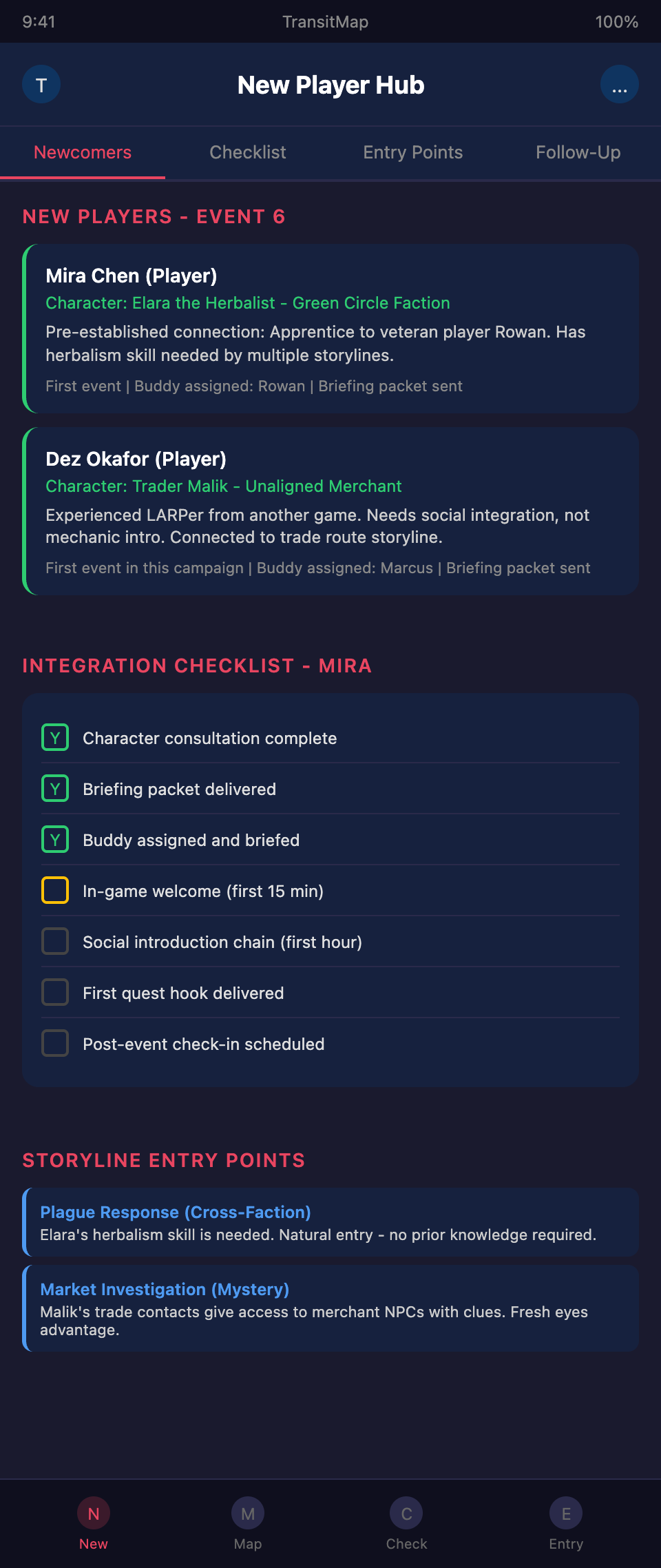
Character consultation. Work with the new player to create a character that has natural entry points into existing storylines. Instead of a generic lone wanderer, create a character who:
- Has a pre-established relationship with an existing character (arranged with the other player's consent)
- Belongs to a faction (giving them immediate community)
- Has a personal goal that intersects with an active storyline
- Has a skill or resource that existing characters need
Briefing packet. Provide a one-page "what your character would know" document:
- The world's current state in three paragraphs
- The major factions and their publicly known positions
- Two or three recent events that are common knowledge
- The new character's starting situation and connections
Do not dump the entire campaign history on a new player. Give them what they need to function, not what they need to be an expert.
Buddy assignment. Assign an experienced player to serve as the new player's in-game point of contact. This should be a player who is:
- Friendly and patient
- Well-connected in the game's social web
- Playing a character who would logically interact with the newcomer
- Willing to actively include the newcomer rather than passively being available
First Hour On-Site
The first hour determines whether a new player will enjoy the event or feel lost:
Immediate in-game welcome. The buddy player meets the newcomer in character and provides context: "Welcome to the town. You've arrived just in time — the council is meeting this afternoon about the border threat. Let me introduce you to some people."
Social introduction chain. The buddy introduces the newcomer to three to five other players in quick succession. Each introduction should be in character and should give the newcomer a reason to interact with that person later: "This is Marcus. He runs the trading post. If you need supplies, he's your man."
First quest hook within sixty minutes. Give the new player something specific to do within the first hour. Not a major quest — a small, achievable task that introduces them to the game's mechanics and social dynamics:
- Deliver a message to a faction leader (introduces factions)
- Investigate a minor mystery (introduces investigation mechanics)
- Help with a task that requires interacting with multiple established characters (builds social connections)
Ongoing Integration
Integration does not end after the first hour:
Storyline touchpoints. Design at least one moment per event where the new player's character is specifically relevant to an active storyline. Their backstory skill is needed. Their faction connection provides access. Their fresh perspective notices something veterans overlooked.
Escalating responsibility. Over multiple events, gradually increase the new player's narrative responsibility:
- Event 1: Participant in storylines designed by others
- Event 2: Key contributor to a storyline beat
- Event 3: Co-owner of a minor storyline
- Event 4+: Full participant in all campaign activities
Check-ins. After the event, contact the new player:
- How was your experience?
- Did you feel included?
- What would you like more of at the next event?
- Do you have questions about anything that happened?
Designing New-Player-Friendly Content
Certain content types naturally integrate new players:
The arriving stranger trope. Build into your world lore a reason for new characters to arrive regularly — a trade route, a refugee crisis, a pilgrimage, a frontier settlement. This provides narrative justification for newcomers without requiring elaborate backstories.
The fresh eyes advantage. Design situations where an outsider's perspective is valuable. The established characters are too close to a problem to see the obvious solution. The new character, unencumbered by history and politics, can ask the question nobody else thought to ask.
Mentor-student relationships. Create explicit in-game mentor roles for experienced characters. Veterans who take on students have narrative motivation to include newcomers, and students have a built-in guide to the game's social landscape.
Accessible storyline entry points. Every active storyline should have at least one entry point that does not require prior event knowledge. The investigation has a new lead that anyone can follow. The faction needs new recruits for a mission. The NPC is looking for help from someone who is not already involved.
Common Integration Mistakes
- The info dump — Explaining two years of campaign history to a new player in their first thirty minutes. They will retain nothing and feel overwhelmed.
- The sink-or-swim approach — Expecting new players to figure everything out on their own. Some will. Most will not.
- The permanent outsider — New player characters who are designed as outsiders with no connections. Outsiders stay outside unless actively pulled in.
- Veteran gatekeeping — Established players who resent newcomers' lack of knowledge or who hoard social access. Address this cultural issue directly.
- One-size-fits-all integration — Treating every new player the same. Introverted players need more structured integration. Extroverted players need less. Experienced LARPers from other games need different support than complete newcomers.
Integrating new players into your ongoing LARP campaign? Join the TransitMap waitlist — visualize entry points on your campaign's storyline map where new characters can naturally connect to existing narrative routes.