LARP Political Intrigue Plot Management
Political Intrigue at Scale
Political intrigue in tabletop gaming involves four to six players and one GM managing the web of information. Political intrigue in LARP involves twenty to sixty players, each pursuing their own agenda, forming secret alliances, trading information, making deals, and betraying each other — all simultaneously, all in real time, and all without the organizer knowing half of what is happening.
This is both the appeal and the terror of political LARP. The intrigue is genuine because the players are genuine autonomous agents. The management challenge is immense because you cannot monitor, let alone control, the political landscape.
Your job is not to run the politics. It is to create the conditions for politics to happen and then track the results.
Creating Political Conditions
Political intrigue requires structural ingredients:
Asymmetric information. Different players and factions know different things. The duchess knows the treasury is empty. The general knows the army is mutinous. The spy knows both but has their own agenda. When information is asymmetric, trading, deceiving, and leveraging information becomes gameplay.
How to create it:
- Give each faction a sealed briefing with faction-specific secrets
- Distribute individual character secrets that intersect with faction politics
- Have NPCs reveal different information to different players based on relationship or approach
Scarce resources. There must be something that multiple political actors want and not all can have. A council seat. The monarch's favor. Control of a trade route. Military command. Access to a magical artifact. When resources are scarce, negotiation, alliance, and conflict emerge naturally.
Formal structures. Political intrigue needs political structures to operate within and against. A council that votes. A court with protocols. A guild with internal hierarchy. A legal system that can be manipulated. These structures give players levers to pull and constraints to work around.
Personal stakes. Abstract political conflict (our faction versus their faction) is less engaging than personal political conflict (if I lose this vote, my character's family loses their land). Connect political outcomes to individual character concerns.
The Political State Tracker
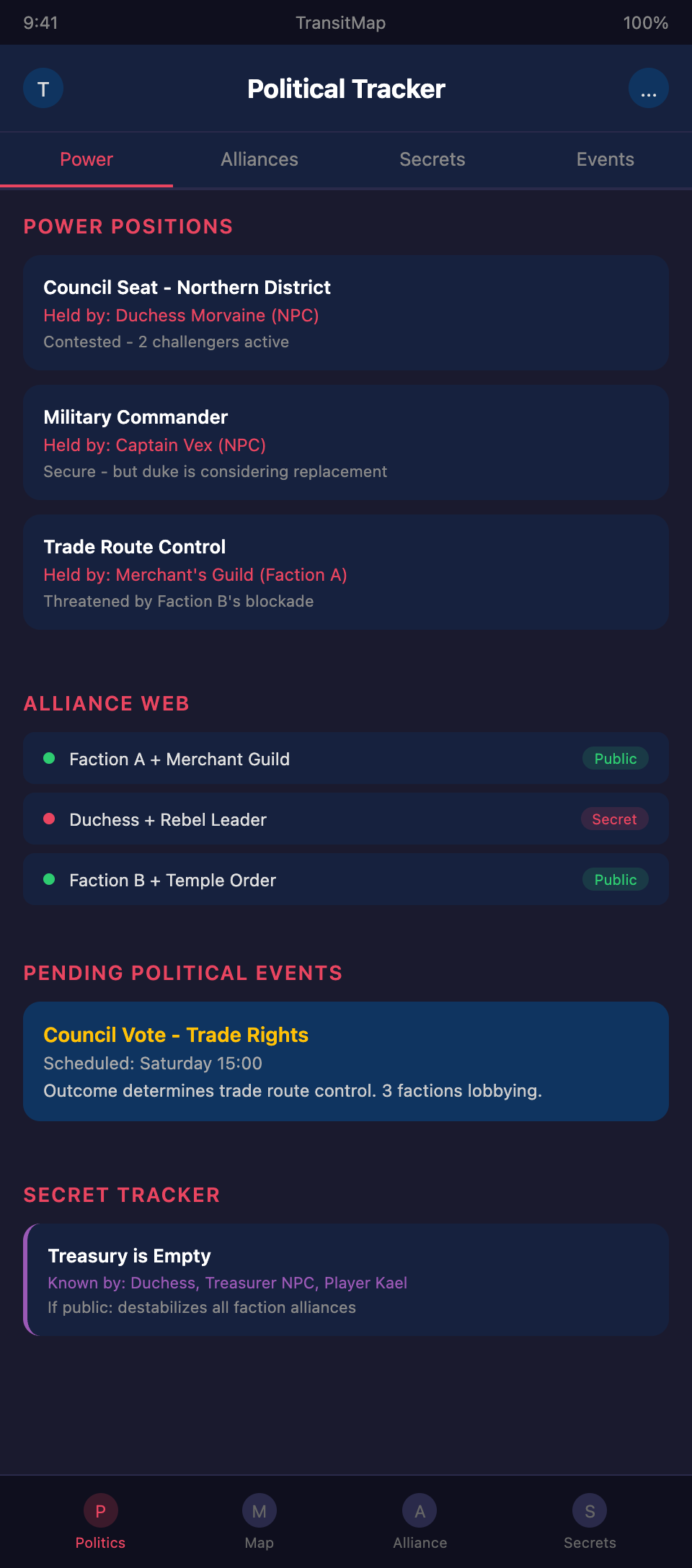
Maintain a real-time tracker of the political landscape:
Power positions. Who holds what position? Who controls what resource? This is the objective political state.
Alliance web. Who is allied with whom? Which alliances are public and which are secret? This is the relational political state. Update it as alliances form and break during the event.
Active operations. What is each political actor currently doing? The duchess is lobbying council members. The general is positioning troops. The spy is gathering blackmail material. These operations may not be visible to the organizer — you will learn about many of them after the fact.
Pending decisions. What political decisions are scheduled? When is the vote? When is the audience with the monarch? When is the tribunal? These are the moments when political maneuvering resolves into outcomes.
Managing Information Flow in Political LARP
The hardest part of political LARP management is information control. You need players to have enough information to act intelligently but not so much that the intrigue collapses.
Seed, do not dictate. Provide starting conditions and let players generate the political dynamics. Give the duchess the secret about the treasury and let her decide what to do with it. Do not script who she tells, when, or how.
Track information spread. When a secret is revealed, note who now knows it. This affects NPC behavior and future plot development. At a minimum, track the spread of your three to five most important secrets.
Use NPCs as information valves. NPCs who hold critical information can be briefed to release it under specific conditions: "Tell the truth if presented with evidence. Lie if asked directly without evidence. Reveal everything if tortured (but send a distress signal first)." This controls the flow without scripting it.
Accept information chaos. At a certain scale, you will lose track of who knows what. This is okay. The political landscape is a living system. Your tracker captures the major movements, not every whispered conversation. Focus on tracking the secrets that affect storyline structure, not every piece of gossip.
Running Political Set Pieces
Political LARP needs set-piece moments where political maneuvering produces visible outcomes:
The council vote. A formal voting session where faction representatives make their case and a decision is reached. Design the issue, the voting rules, and the consequences of each outcome. Let the players do the politics.
The tribunal. A character is accused of a crime (real or fabricated). The accusation, the defense, and the verdict are all player-driven. Provide the framework (judge, prosecution, defense, witnesses) and let it play out.
The feast. A social gathering where political actors interact informally. Seat players strategically. Have NPCs circulate with gossip and offers. The feast is where deals are made and alliances are tested.
The crisis. An external threat that forces political actors to cooperate — or to compete for who leads the response. Invasions, plagues, magical catastrophes. The crisis reveals political priorities and creates opportunities for power grabs.
Each set piece should be scheduled at a specific time, with clear rules of engagement, and should produce an outcome that visibly changes the political landscape.
Post-Event Political Reconciliation
After a political LARP event, reconcile the political state:
- What positions changed hands?
- What alliances formed or broke?
- What secrets were revealed?
- What resources were gained or lost?
- What promises were made?
- What grievances were created?
This reconciliation becomes the starting state for the next event. Political LARP campaigns are defined by the cumulative weight of political decisions across events.
Managing political intrigue across your LARP campaign? Join the TransitMap waitlist — map every alliance, secret, and power position as interconnected transit lines that shift and reroute as your players play the game of politics.