LARP Storyteller Team Coordination: Running a Unified Narrative
The Multi-Storyteller Coordination Problem
Small LARPs can be run by a single organizer. But once your event exceeds twenty players or runs multiple simultaneous storylines, you need a storyteller team. And the moment you have a team, you have a coordination problem.
Each storyteller brings their own creative instincts, pacing preferences, and narrative priorities. Without coordination, their storylines drift apart — different tones, conflicting facts, incompatible NPC behaviors. The event feels like several small events stapled together rather than one unified experience.
Coordination does not mean controlling every storyteller's creative output. It means establishing shared frameworks, communication systems, and decision-making protocols that keep everyone aligned while preserving individual creative freedom.
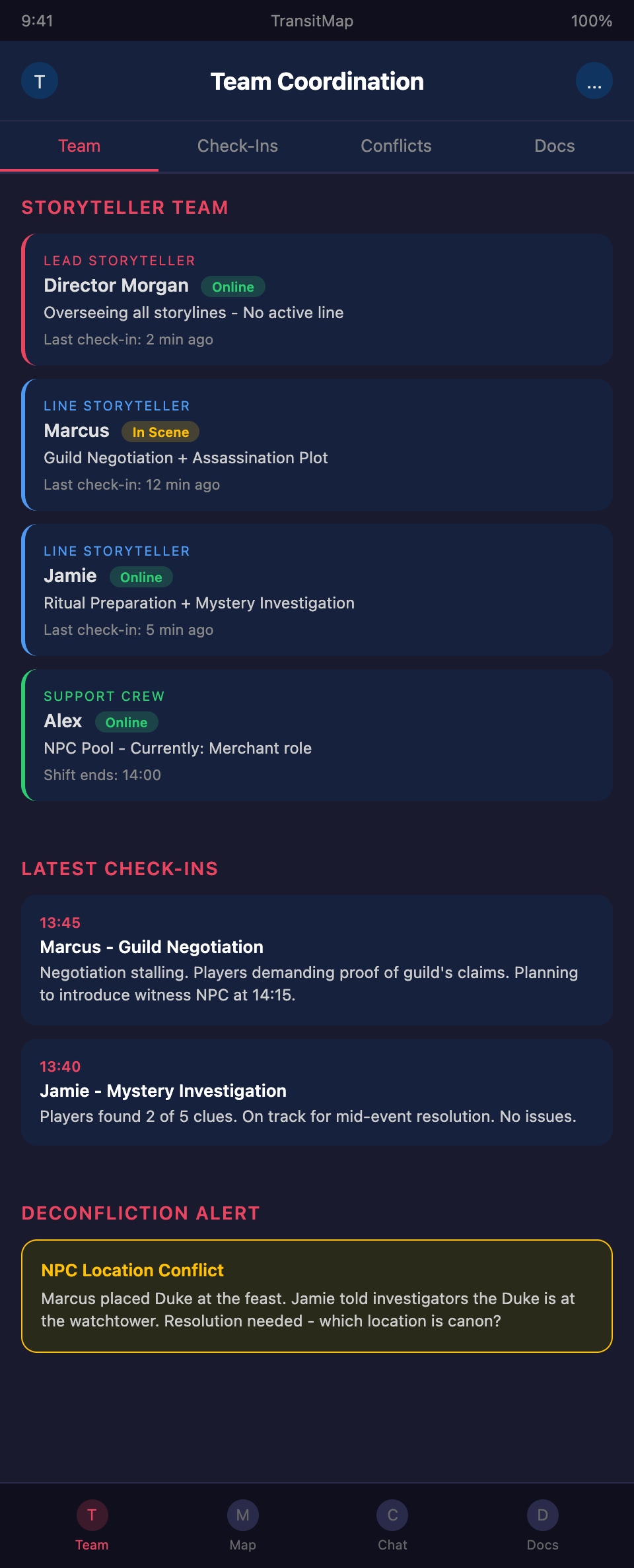
Team Structure
The Lead Storyteller
One person must have final authority on narrative decisions. This is not about ego — it is about preventing contradictions and deadlocks. The lead storyteller:
- Sets the event's overall narrative direction and tone
- Resolves conflicts between storylines when they contradict each other
- Makes real-time decisions during the event when storylines collide
- Maintains the big picture while line storytellers focus on their specific plots
- Does not run their own storyline during the event (this is critical — running a storyline and maintaining oversight are both full-time jobs)
Line Storytellers
Each line storyteller owns one or two storylines and has creative authority within them:
- Designs the storyline's beats, NPCs, and contingencies
- Runs the storyline during the event, directing NPCs and managing player interactions
- Reports status to the lead storyteller at regular intervals
- Adjusts their storyline in response to coordination decisions
Support Crew
Crew members who are not running storylines but supporting them:
- NPC players who take direction from line storytellers
- Logistics coordinators who manage props, spaces, and costumes
- Safety monitors who watch for out-of-game issues
Pre-Event Coordination
Coordination starts well before the event. The team should meet at least three times before any significant event:
Meeting 1: Vision Alignment (6-8 weeks out)
- Lead storyteller presents the event's narrative vision: the overall theme, the central conflict, the intended emotional arc, and the desired outcomes
- Each line storyteller pitches their storyline concepts
- The team identifies potential conflicts, overlaps, and synergies between storylines
- Decisions are made about shared NPCs, shared locations, and shared timeline elements
Meeting 2: Design Review (3-4 weeks out)
- Each line storyteller presents their storyline in detail: beats, NPCs, contingencies
- The team reviews for consistency: do all storylines share the same world facts? Do NPC behaviors align? Are there timeline contradictions?
- The team designs intentional crossover points — moments where storylines are planned to intersect
- The NPC schedule is drafted and crew assignments are confirmed
Meeting 3: Operations Briefing (1 week out)
- Final review of all storylines and their current state
- The timeline grid is finalized
- Communication protocols are confirmed (walkie-talkie channels, text group, check-in schedule)
- Contingency plans are reviewed for common deviation scenarios
- Each storyteller confirms they have written briefs for all their NPCs
Communication During the Event
The single most important coordination tool during a live event is real-time communication. Every storyteller team coordination failure can be traced back to a communication failure.
Scheduled check-ins. Every sixty to ninety minutes, each line storyteller sends a brief status update to the lead storyteller. Format: "[Storyline name]: [Current status]. [Any issues]. [Next planned beat and timing]."
Example: "Assassination plot: Target has been warned by an unknown source. Players are now investigating who leaked the information. Planning the assassin's backup approach for 3 PM."
Collision alerts. When a storyline is about to cross into another storyline's territory — same location, same NPCs, overlapping player groups — the line storytellers involved must communicate directly. Do not assume the other storyteller knows what is happening in your storyline.
Decision escalation. When a line storyteller faces a decision that affects other storylines, they escalate to the lead storyteller. "The players captured my villain. If she reveals her information, it invalidates Jamie's mystery plotline. How should I handle this?"
The deconfliction channel. Maintain a communication channel specifically for deconfliction — resolving contradictions between storylines. "I told the players the duke was at the feast. Did anyone else tell them the duke was elsewhere?" Quick corrections prevent compounding contradictions.
The Shared World Document
Maintain a document that all storytellers reference during the event. This is not a full campaign bible — it is an active reference sheet with only the information needed for coordination:
- Shared NPCs — Name, current location, current state, who is responsible for playing them
- World facts — Established facts that all storylines must respect
- Timeline — Current in-game time and scheduled events
- Player faction status — Current faction dispositions and any recent changes
- Known contradictions — Any contradictions that have already been identified and their resolution
This document should be accessible on phones or tablets during the event. Update it in real time as the event progresses.
Post-Event Team Debrief
After every event, the storyteller team should debrief:
- What worked? Which storylines landed well? Which coordination practices were effective?
- What did not work? Where did communication break down? Where did storylines contradict each other? Where did pacing suffer?
- What did we learn? What do we need to change for the next event?
- Continuity reconciliation — What actually happened versus what was planned? What is now canon?
Document the debrief results. They are your team's institutional memory and the foundation for improving future events.
Common Team Coordination Mistakes
- No clear authority — When nobody has final say, contradictions accumulate and arguments consume event time
- Over-centralization — The lead storyteller tries to control every decision, bottlenecking the event and burning themselves out
- Silent running — Storytellers go quiet during the event, assuming everything is fine, and discover contradictions hours later
- Personal attachment — A storyteller prioritizes their storyline over event coherence, refusing to adjust when coordination requires it
- No written references — Everything is verbal, and in the heat of the event, verbal agreements are forgotten
Need a coordination tool for your LARP storyteller team? Join the TransitMap waitlist — see all your storylines on one map, track team assignments, and coordinate crossover points so every storyteller stays aligned.