LARP World Persistence Between Events: Building a Living Setting
What World Persistence Means
World persistence is the continuity of your game world between events. When a player builds a blacksmith shop at Event 3, that shop exists at Event 4. When a faction conquers territory, that territory remains conquered. When an NPC dies, they stay dead.
This seems obvious, but maintaining world persistence across months between events is surprisingly difficult. Without systems, the world quietly resets — NPCs forget their histories, locations lose their player-made modifications, and the cumulative effect of player actions evaporates.
World persistence matters because it is the foundation of player investment. Players who know their actions endure invest more deeply in the game world. Players who suspect the world resets between events treat each event as disposable entertainment.
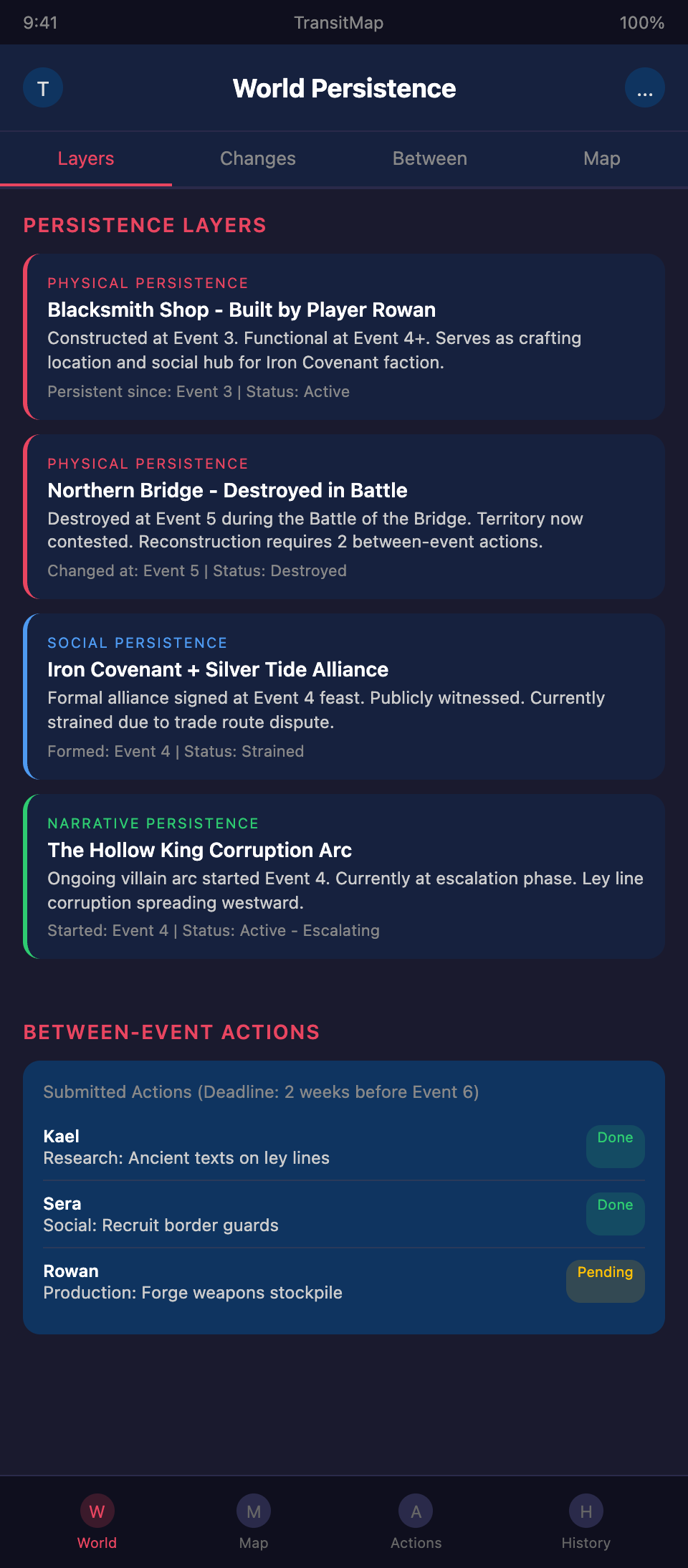
The Three Layers of Persistence
Layer 1: Physical Persistence
Changes to the physical game world that carry between events:
- Structures — Buildings built, fortifications constructed, camps established
- Territory — Land claimed, borders drawn, contested zones
- Resources — Stockpiles accumulated, mines depleted, trade routes established
- Damage — Destruction from battles, natural disasters, or magical events
Physical persistence is the most visible and the most challenging to maintain, especially if your event site changes or if you use the same site but cannot leave permanent structures.
Tracking methods:
- A canonical map updated after each event showing territory, structures, and physical changes
- Photo documentation of significant constructions or destructions
- A resource ledger tracking faction and player-owned resources
Between-event maintenance:
- Advance construction projects that were started but not completed
- Apply environmental effects (weather damage, resource depletion, natural growth)
- Update the canonical map and share it with players before the next event
Layer 2: Social Persistence
Changes to relationships, alliances, and social structures:
- Alliances and enmities between factions and individuals
- Political structures — Elected leaders, appointed officials, dissolved councils
- Social debts — Favors owed, promises made, contracts signed
- Reputation — How individuals and factions are perceived by others
Social persistence is maintained through documentation and communication:
- The faction relationship map, updated after each event
- Individual character relationship records, maintained by the organizer team
- A public ledger of formal agreements (treaties, contracts, oaths) that have been witnessed
- Reputation tracking for significant characters and factions
Between events, social dynamics can evolve through:
- Between-event communication (in-character letters, faction meetings)
- Organizer-driven developments (NPC factions react to player actions)
- Time-passage effects (how do relationships change with distance and time?)
Layer 3: Narrative Persistence
Changes to the game world's story:
- Resolved storylines and their outcomes
- Active storylines and their current state
- Established lore — History, magical rules, cultural facts that have been canonized
- Character development — How player and NPC characters have changed
Narrative persistence is maintained through the canonical record (discussed in the post-event continuity post) and the storyline registry.
Between-Event World Advancement
The time between events is game-world time. Things happen during this gap:
Passive advancement — The natural consequences of time passing. Crops grow. Seasons change. Construction progresses. Wounds heal. These happen automatically based on the world's established systems.
Active advancement — NPC factions pursue their agendas. The merchant guild expands operations. The rebel movement recruits. The cult advances its ritual preparations. These happen according to the organizer's faction tracking system.
Player-driven advancement — Players take between-event actions. They send letters. They conduct trade. They train. They research. These require a system for players to submit between-event actions and for organizers to adjudicate their outcomes.
The Between-Event Action System
Allow players to take limited between-event actions that advance their characters and affect the game world:
Action budget. Each player gets a fixed number of between-event actions (typically two to four). This prevents some players from gaining massive advantages through sheer volume of between-event activity.
Action categories:
- Communication — Send a letter, spread a rumor, contact an NPC
- Research — Investigate a topic, study a skill, analyze an artifact
- Production — Craft an item, build a structure, cultivate a resource
- Social — Recruit followers, broker a deal, petition an authority
- Exploration — Scout a location, map a route, investigate a rumor
Adjudication — The organizer team reviews submitted actions and determines outcomes. Communicate results to players before the next event so they arrive knowing the current state of their activities.
Deadlines — Set a submission deadline (typically two to four weeks before the next event) to give the organizer team time to adjudicate and incorporate results into event planning.
When Persistence Creates Problems
World persistence is not always beneficial:
- Snowballing advantages — Factions or players who have been present longest accumulate persistent advantages that new entrants cannot match. Build in balancing mechanisms: resource decay, political upheaval, external disruptions.
- Persistent grudges — In-game conflicts that persist across events can evolve into out-of-game resentment. Monitor long-running rivalries and intervene if they become unhealthy.
- Accumulated complexity — After ten events, the world's persistent state is enormously complex. Periodically simplify: resolve dormant storylines, archive inactive characters, consolidate faction structures.
- Narrative stagnation — A world where everything persists but nothing changes feels stale. Persistence must coexist with disruption — periodic events that shake up the established order and create new dynamics.
Building a persistent LARP world across multiple events? Join the TransitMap waitlist — track physical, social, and narrative persistence on a visual map that evolves event by event, showing your world's growth in real time.