Managing LARP Storyline Information Flow
Information Is the Narrative Engine
Plot events happen in LARP. Battles are fought, rituals are performed, treaties are signed. But the engine that drives all of this is information — who knows what, when they learned it, and what they do with it.
A murder happens. The information about who committed it, how, and why drives the entire investigation plotline. A betrayal occurs. The information about the betrayal — who knows, who suspects, who is still in the dark — drives the political fallout. A magical threat emerges. The information about how to counter it drives the quest to save the world.
Managing information flow is managing your narrative. Get it right and your storylines unfold with dramatic precision. Get it wrong and your event devolves into confusion, metagaming, or an unsolvable mess.
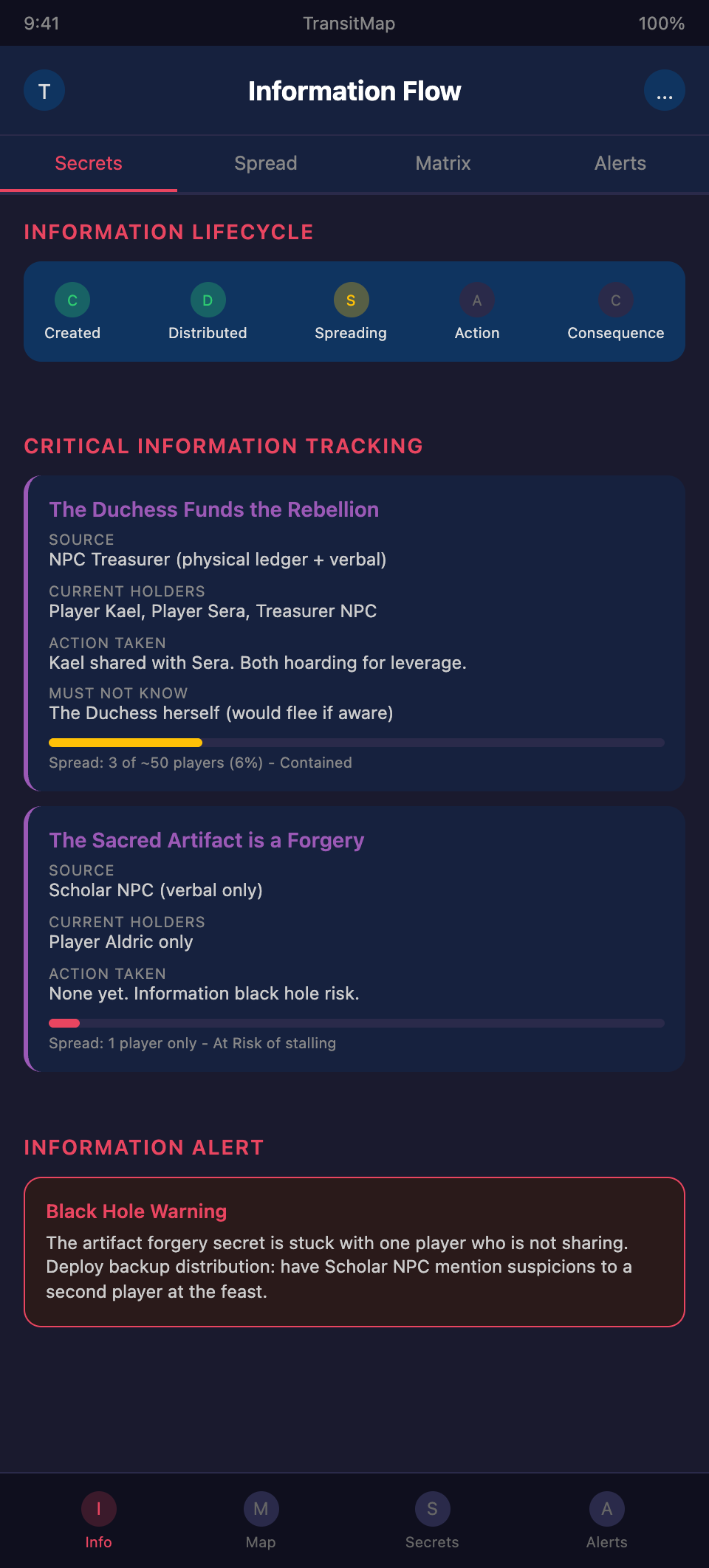
The Information Lifecycle
Every piece of narratively significant information goes through a lifecycle:
Creation — The information is established. This usually happens during event design: "The duchess is secretly funding the rebellion." The information exists but is known only to the organizer and possibly one NPC.
Distribution — The information enters the game world through clues, NPC interactions, discovered documents, or overheard conversations. Distribution is the organizer's primary information management activity.
Spread — Once a player has the information, it spreads through player-to-player interaction. This spread is largely outside the organizer's control. Players whisper, negotiate, trade, and gossip — and information travels through the social network at unpredictable speed.
Action — Players act on the information. They confront the duchess. They join the rebellion. They sell the information to the highest bidder. The action phase is where information becomes narrative.
Consequence — The action produces new information and new situations. The cycle begins again.
Controlling Distribution
Distribution is the phase where you have the most control. Design your distribution strategy deliberately:
Who receives the information first? This determines who has the initial advantage. Giving information to a faction leader first empowers that leader. Giving it to a neutral character creates a different dynamic.
How is it delivered? The delivery method affects how the information is perceived:
- Physical document — Can be stolen, shared, or destroyed
- NPC conversation — Subject to the NPC's personality and willingness
- Overheard dialogue — Uncertain — did the player hear correctly?
- Environmental observation — Requires attentive players to notice
- Rumor — Accuracy is uncertain — is it true or gossip?
When is it released? Timing affects impact:
- Too early: players have time to investigate and prepare, reducing dramatic tension
- Too late: players do not have time to act, making the information feel pointless
- Just right: players have enough time to act but feel urgency
How much is revealed? Partial information creates mystery. Complete information creates urgency. Choose based on the narrative phase:
- Investigation phase: distribute partial information to drive inquiry
- Crisis phase: distribute complete information to drive action
- Resolution phase: distribute confirmatory information to enable conclusion
Tracking Information State
Maintain an information matrix — a tracking document showing what each significant character or faction knows:
For each piece of critical information, track:
- Source — Where does this information originate?
- Current holders — Who knows this right now?
- How they learned it — Through which channel?
- What they have done with it — Shared? Hoarded? Acted on?
- Who should NOT know — Are there characters for whom learning this would break a storyline?
This matrix is your information dashboard. During the event, update it as information spreads. Before the event, use it to plan your distribution strategy.
Managing Uncontrolled Spread
Once information enters the player population, you cannot control its spread. But you can influence it:
Information stickiness. Information attached to physical props (letters, maps, artifacts) spreads more slowly because it requires physical transfer. Information shared verbally spreads faster but is subject to distortion.
Trust networks. Information tends to spread within factions before crossing faction boundaries. Players share with allies before sharing with neutrals. Design your distribution with faction boundaries in mind.
Incentive structures. Give players reasons to hoard information rather than share it freely. The information is worth something in trade. Sharing it would endanger the source. The information is only valuable if few people know it.
Disinformation. Plant false information alongside true information. When players cannot be sure what is accurate, they spread information more cautiously. This also creates gameplay around verification and deduction.
Common Information Flow Problems
The information black hole. One player receives critical information and shares it with nobody. The storyline that depends on that information spreading stalls. Prevention: distribute critical information to multiple players. If one hoards it, another will share it.
The information explosion. A secret is revealed and within thirty minutes, every player at the event knows it. The mystery that was supposed to last all day is solved by lunch. Prevention: distribute information in layers — the first player learns a clue, not the full answer. Full understanding requires assembling multiple clues.
The metagaming leak. Players use out-of-game communication (phones, whispered player-to-player OOG conversations) to share in-game information. Prevention: establish clear metagaming rules and enforce them. Also design storylines that remain interesting even if information spreads faster than intended.
The information contradiction. Two NPCs tell different players contradictory information about the same topic, not by design but by error. Players are confused about what is true. Prevention: written NPC briefs with specific "say exactly this about topic X" instructions. Post-deployment verification.
Ready to manage information flow across your LARP event's storylines? Join the TransitMap waitlist — track every secret, revelation, and information channel as data flows along your event's narrative transit lines.