Multi-Day LARP Storyline Continuity: Keeping the Thread Across 48 Hours
The Multi-Day Continuity Challenge
Multi-day LARP events — typically running Friday evening through Sunday afternoon — offer extraordinary narrative depth. Forty-eight hours of continuous gameplay allow storylines to develop slowly, relationships to deepen, and plot twists to land with the weight of accumulated experience.
But multi-day events also introduce continuity challenges that single-day events avoid:
- The overnight gap — What happens to storylines when players sleep? Do clocks keep ticking? Do NPCs keep operating?
- Player energy cycles — Players arrive energized, fatigue through the night, and may be foggy on Day 2. Content designed for sharp thinking at 8 AM Sunday will not land.
- Information decay — Details from Friday evening are hazy by Sunday morning. Players remember the big beats but forget the specifics.
- Crew endurance — Crew members running NPCs for forty-eight hours face burnout that affects performance and consistency.
- Accumulating contradictions — The longer the event runs, the more improvised details accumulate and the higher the risk of contradictions.
Designing the Multi-Day Arc
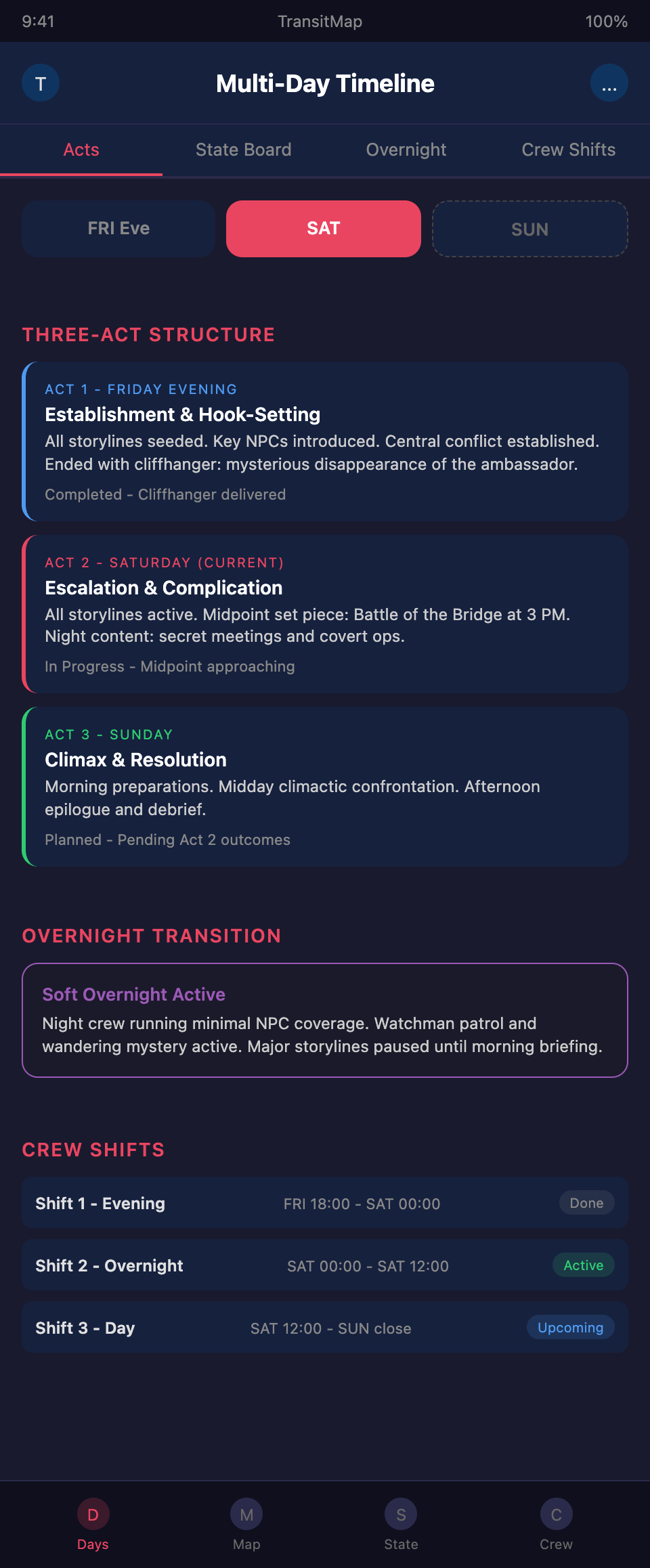
Structure your event as a three-act arc mapped to the multi-day schedule:
Act 1: Friday Evening (4-5 hours)
Purpose: Establishment and hook-setting.
- Players arrive and settle into character
- All major storylines are seeded
- Key NPCs make their introductions
- The central conflict of the event is established but not yet urgent
- End Friday with a cliffhanger or mystery — something that gives players reason to discuss, plan, and anticipate through the night
Friday evening content should be social and investigative, not combat-heavy. Players are settling in, reconnecting, and finding their footing.
Act 2: Saturday (10-12 hours)
Purpose: Escalation and complication.
- All storylines are fully active
- Factions conflict, investigations intensify, alliances form and break
- The midpoint event (Saturday afternoon/evening) is your biggest set piece — a battle, a revelation, a betrayal
- Saturday night content should be intimate and atmospheric — secret meetings, covert operations, horror encounters
- End Saturday with an escalated crisis — the situation is worse than it was Friday night
Saturday is your longest block and needs the most careful pacing. Build in lulls. Allow for meals and rest. Monitor player energy and adjust intensity accordingly.
Act 3: Sunday (4-6 hours)
Purpose: Climax and resolution.
- Sunday morning: final preparations and last-minute revelations
- Sunday midday: the climactic event — the final battle, the ritual, the political resolution
- Sunday afternoon: epilogue, aftermath, out-of-game debrief
Sunday content should be decisive and conclusive. Players who have invested forty-eight hours deserve a clear resolution.
Managing the Overnight Transition
The transition from Day 1 to Day 2 is a narrative choke point. Handle it deliberately:
Option A: The Hard Stop. At a designated time (usually midnight to 2 AM), the game world pauses. Nothing in-game happens overnight. Players sleep as players, not as characters.
Advantage: Clean transition. No continuity issues from overnight scenes. Disadvantage: Breaks immersion. Loses the atmosphere of a night at a LARP.
Option B: The Soft Overnight. The game continues overnight for players who choose to stay awake, with reduced intensity. Night crew runs minimal NPC coverage — a watchman, a wandering mystery, an ambient presence. Storylines do not advance significantly overnight, but atmosphere is maintained.
Advantage: Preserves immersion. Rewards dedicated players with special overnight experiences. Disadvantage: Creates information asymmetry (players who stayed up learned things sleepers missed). Night crew must be specifically scheduled.
Option C: The Narrative Skip. Time passes in-game overnight. The game world jumps forward — "A week has passed since the battle." This is useful when the story needs a time gap that does not warrant playing through.
Advantage: Allows for natural story pacing. Time-sensitive events can mature. Disadvantage: Players may feel they missed things. Actions taken "during the week" need to be negotiated.
Day 2 Reorientation
Regardless of your overnight approach, Day 2 needs a reorientation moment:
- Morning briefing — An in-game device (town crier, morning assembly, posted news) that summarizes the current state of affairs
- Faction recaps — Each faction briefly recaps their situation, ensuring all members (including those who slept through late-night developments) are aligned
- Storyline status check — Storytellers verify the state of each storyline before activating Day 2 content
The reorientation should take fifteen to thirty minutes and should feel like a natural part of the game world, not an administrative pause.
Tracking Continuity Across Two Days
Your continuity tracking system needs to handle the volume of a multi-day event:
The running log. Maintain a continuous log of significant events throughout the event. Each entry timestamped and categorized:
- [FRI 21:00] Faction A discovered the poison. Investigation plotline advanced.
- [SAT 03:00] Night ambush on patrol group. Three players involved. Monster NPC deployed.
- [SAT 14:00] Alliance brokered between Faction A and Faction C. Political plotline shifted.
The state board. A physical or digital board that shows the current state of every major element:
- Each storyline: active/paused/resolved, current progress
- Each faction: disposition, resources, active operations
- Each key NPC: location, status, relevant interactions
- Timeline: current in-game time and upcoming scheduled events
Update the state board at every check-in period (every 60-90 minutes during active play).
The overnight reconciliation. Before Day 2 begins, reconcile overnight developments:
- What happened overnight that affects Day 2 content?
- Are there any contradictions between overnight actions and planned Day 2 beats?
- Which storylines need adjustment based on overnight developments?
Crew Endurance Management
A multi-day event without crew endurance planning will collapse. Your crew's energy directly affects narrative quality.
Shift rotation. No crew member should work more than eight consecutive hours without a four-hour break. For a 48-hour event, this means at least three shifts:
- Shift 1: Friday evening to midnight
- Shift 2: Midnight to Saturday noon
- Shift 3: Saturday noon to Sunday close
Role intensity balancing. Crew members in high-intensity roles (combat NPCs, emotional scenes) need more frequent breaks than those in low-intensity roles (ambient NPCs, logistics).
Crew-only space. A dedicated space where crew members can decompress, eat, and rest without being in character. This space must be truly off-limits to players.
Crew morale. Thank your crew. Feed them well. Check in on their well-being. A demoralized crew delivers poor performances that undermine every storyline.
Running a multi-day LARP and need to maintain continuity across 48 hours? Join the TransitMap waitlist — track storylines, events, and transitions across your entire multi-day timeline with real-time status updates and overnight reconciliation tools.