Player-Driven Narrative in LARP: Empowering Players to Create Story
The Organizer's Paradox
LARP organizers face a paradox: the more carefully you script storylines, the less agency players have, and the less engaged they feel. But the less you script, the higher the risk of an empty, directionless event where players wander around waiting for something to happen.
The resolution is player-driven narrative design — creating conditions, systems, and frameworks that empower players to generate their own storylines while the organizer provides structure, catalysts, and a shared world to operate in.
This is not lazy organizing. It is arguably harder than scripted events because it requires a different skill set: designing systems instead of scenes, facilitating instead of directing, and responding to emergent content instead of executing planned content.
The Conditions for Player-Driven Narrative
Players will generate narrative spontaneously if certain conditions are met:
Clear character motivations. Every player character should enter the event with at least one goal they are actively pursuing. This does not need to be organizer-provided — players can and should create their own goals. But the organizer should ensure every player has thought about what their character wants before arriving.
Pre-event prompt: "What is your character's goal for this event? What are they willing to do to achieve it? What would stop them?"
Interconnected characters. Players who have relationships with other players generate narrative through those relationships. Encourage pre-event relationship building:
- Assign each new character two connections to existing characters
- Create faction structures that put characters into collaborative and competitive relationships
- Design starting situations that force character interaction
Scarce and contested resources. When players want things that not everyone can have — titles, territory, romantic interests, magical artifacts, political power — they generate narrative through pursuit, negotiation, and conflict.
Consequences for actions. Player-driven narrative only works if player actions have lasting consequences. If nothing the players do matters, they stop trying. Build consequence systems:
- Actions taken publicly are witnessed and remembered
- Commitments (oaths, contracts, alliances) are tracked and enforceable
- In-game economies respond to player activity
- Political structures change based on player actions
The Catalyst Model
Instead of designing storylines, design catalysts — events, revelations, or situations that provoke player-driven narrative without prescribing outcomes.
Types of catalysts:
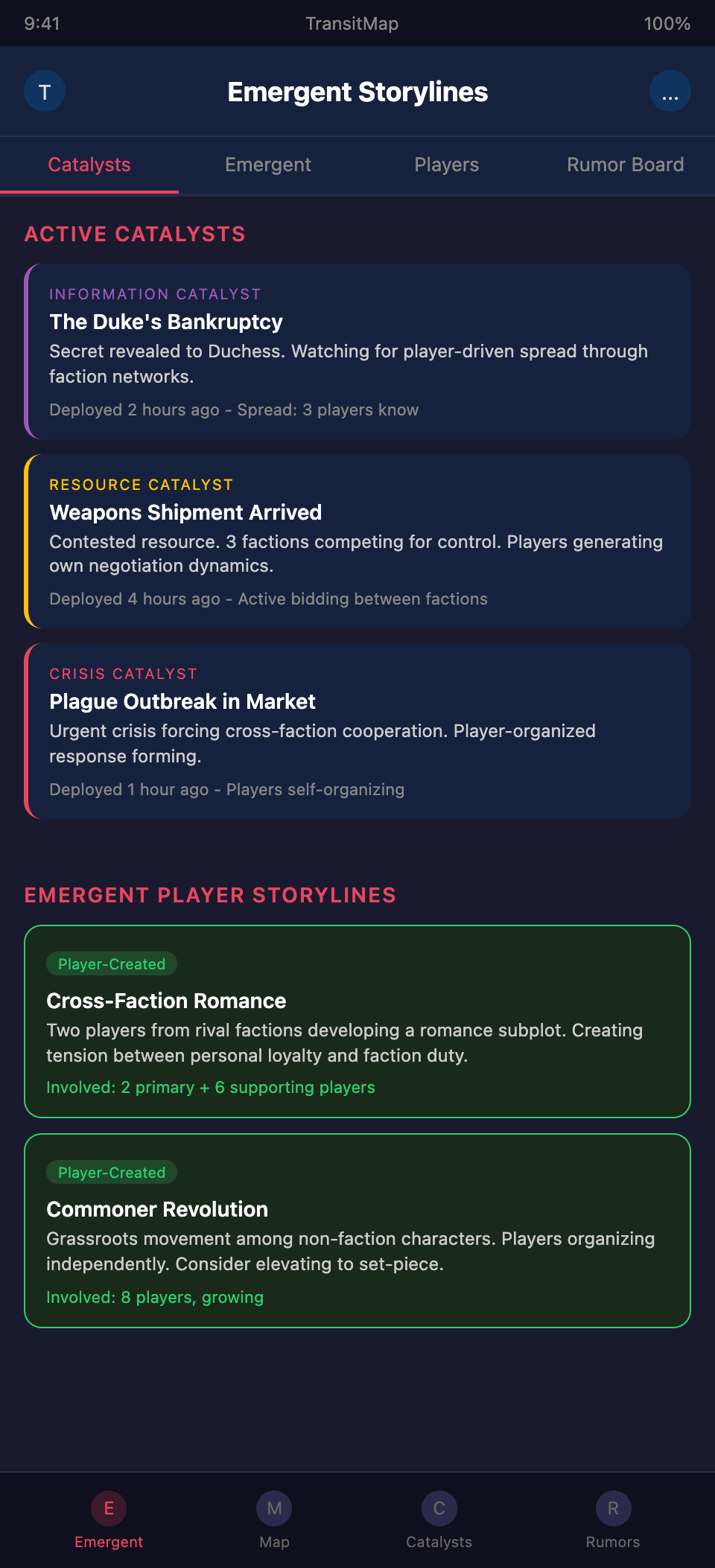
Information catalysts. Reveal a piece of information that changes the status quo. "The duke is secretly bankrupt." "The sacred artifact is a forgery." "One of the council members is a spy." Release the information and let players react.
Resource catalysts. Introduce a new resource into the game economy. A shipment of weapons arrives and multiple factions want it. A new territory is discovered and must be claimed. A rare spell component appears on the market. Players will generate their own plotlines around acquiring, trading, and fighting over the resource.
Crisis catalysts. Create an urgent problem that demands response. A plague breaks out. An army approaches. A magical catastrophe threatens the area. The crisis is the catalyst — how players organize, who leads, what sacrifices are made — that is the player-driven narrative.
Social catalysts. Introduce social dynamics that provoke interaction. A wedding that requires cross-faction attendance. A trial where witnesses must testify. An election where candidates must campaign. These events force interaction and generate drama through player choices.
Facilitating Emergent Storylines
When players start generating their own narratives, the organizer's role shifts from directing to facilitating:
Recognize emergent storylines. Watch for player-created narratives that gain momentum — a romance developing between rival faction members, a conspiracy forming to overthrow the faction leader, a grassroots movement among commoner characters. These are your best content — acknowledge and support them.
Provide resources for player storylines. When players create a storyline, offer logistical support: an NPC to play a role they need, a prop for a ceremony they are planning, a location for their secret meeting, a rules adjudication for their duel.
Do not co-opt player storylines. Resist the urge to take over a player-created storyline and redirect it toward your own narrative goals. The players created it — it is theirs. You can suggest connections to other storylines, but let the players decide whether to pursue those connections.
Elevate player storylines to event-wide significance. When a player-created storyline reaches a critical mass — enough players are engaged, the stakes are high enough — help elevate it to a set-piece moment. The player-created trial becomes a formal court scene with spectators. The player-created rebellion becomes a battle with full crew support.
Designing for Different Player Types
Not all players are equally comfortable driving narrative. Design your event to serve different engagement levels:
Drivers — Players who naturally create storylines, form alliances, and pursue ambitious goals. These players need resources and opportunities, not direction. Give them clear systems (political structures, economic systems, military mechanics) and let them operate.
Participants — Players who engage actively when presented with opportunities but do not generate storylines independently. These players need catalysts and invitations. NPCs who approach them with requests, faction leaders who assign missions, social events that include them.
Observers — Players who prefer to watch and react rather than initiate. These players need a rich environment to observe and occasional moments where their opinion or contribution is specifically requested. Do not mistake observers for disengaged players — many observers are deeply immersed and enjoying themselves.
New players — Players who do not yet understand the game's social dynamics and are unsure how to engage. These players need mentors — experienced players or NPCs who guide them into the game's social fabric and help them find their footing.
Tracking Player-Driven Narrative
Player-driven narratives are harder to track than organizer-designed ones because they emerge unpredictably. Adaptive tracking methods:
- The rumor board — A physical or digital space where players can post in-game rumors, accusations, and news. This gives organizers visibility into player-created narratives.
- Storyteller observation rounds — Storytellers who walk through the event space at regular intervals, noting active scenes and emerging dynamics.
- Player-reported highlights — Quick end-of-day check-ins where players share their most significant moment. This surfaces player-created content the organizers missed.
- Post-event narrative mapping — After the event, reconstruct the player-created storylines that emerged. Document them for continuity purposes and to inform future event design.
Want to track player-driven narratives as they emerge in real time? Join the TransitMap waitlist — map emergent storylines as new transit routes that appear on your event map organically, connecting to the existing network as players create the story.