Building Recurring Antagonist Arcs Across LARP Campaigns
Why Recurring Villains Work Differently in LARP
In tabletop RPGs, a recurring villain is a character the GM plays across multiple sessions. In LARP, a recurring villain is a character played by a crew member across multiple events — potentially over months or years. This creates unique challenges and opportunities:
The crew member is a performer. The quality of your recurring villain depends heavily on the crew member's acting ability, physical presence, and emotional investment. Cast this role carefully.
The villain must survive player attempts. In tabletop, the GM controls the narrative and can protect the villain until the right moment. In LARP, players can physically attack the villain at any time. Your villain needs narrative justification for survival, not plot armor.
The villain has witnesses. Every interaction with the villain is witnessed by multiple players. The villain cannot quietly retcon their behavior between events because players remember what happened and will call out inconsistencies.
The villain becomes communal property. Over time, the recurring villain becomes part of the community's shared narrative. Players develop strong feelings — hatred, grudging respect, even sympathy. The villain's eventual defeat (or victory) becomes a community event.
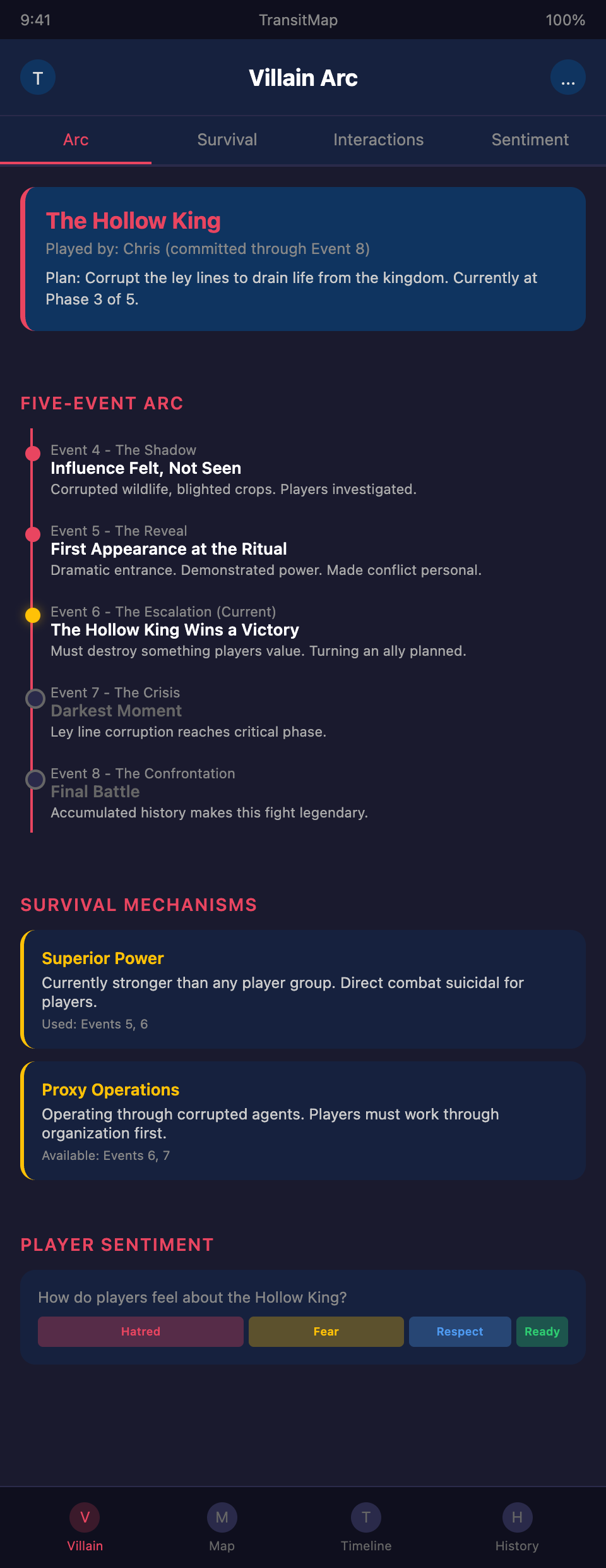
The Five-Event Villain Arc
For a campaign with quarterly events, a five-event arc spans over a year — enough time to build a meaningful antagonist relationship:
Event 1: The Shadow. The villain is not seen. Their influence is felt through consequences: destroyed settlements, corrupted officials, mysterious disappearances. Players learn that something is operating behind the scenes. The villain is a mystery.
Event 2: The Reveal. The villain appears in person — briefly, dramatically, and memorably. They demonstrate their power, establish their goal, and make the conflict personal. The crew member playing the villain must make a strong first impression. This is the performance that defines the character for the rest of the arc.
Event 3: The Escalation. The villain and the players are in active conflict. The villain should win a significant victory at this event — destroying something the players value, turning an ally, or demonstrating that the players' current approach is insufficient. This event establishes the villain as a genuine threat, not just a dramatic presence.
Event 4: The Crisis. The villain's plan reaches its critical phase. The stakes are at maximum. The players face their darkest moment. This event should include a significant interaction between the villain and the players — a negotiation, a philosophical confrontation, or a moment of vulnerability that reveals the villain's depth.
Event 5: The Confrontation. The final battle. The accumulated history between the villain and the players makes this fight meaningful beyond its mechanics. The villain's defeat (or escape, or tragic end) should be the most memorable moment of the campaign.
Designing the Villain's Survival Mechanisms
The biggest practical challenge of a recurring LARP villain is keeping them alive until the story demands their end. Players will try to kill them at every opportunity. You need narratively justified reasons for the villain to survive:
Superior power. The villain is simply more powerful than the players at this stage of the campaign. Direct combat is suicidal. The players must grow, gather allies, and develop strategies before they can confront the villain. This is narratively satisfying because it motivates player development.
Strategic retreat. The villain is intelligent enough to disengage before a fight turns against them. They arrive with escape routes, bodyguards, and contingency plans. This feels earned if the villain is established as cunning.
Proxy operations. The villain operates through agents and lieutenants. Defeating the lieutenant is a victory, but the villain is elsewhere. The players must work through the villain's organization before reaching the villain directly.
Environmental protection. The villain operates from a fortress, a protected realm, or a location that the players cannot easily access. Reaching the villain is a quest in itself.
Avoid: Invisible plot armor, deus ex machina escapes, or "the villain teleports away" without established magical justification. Players who feel cheated will disengage from the antagonist relationship.
Casting Your Recurring Villain
The crew member who plays a recurring villain must:
- Commit to the full arc. A villain actor who drops out after Event 2 derails the entire campaign's narrative center.
- Perform consistently. The villain must feel like the same character at every event, even if that event is six months after the last one.
- Accept player aggression gracefully. Players will hate the villain. The crew member must be comfortable being the target of in-game hostility without taking it personally.
- Collaborate with the organizer team. The villain's actions must serve the campaign's narrative. The crew member and the lead storyteller must be aligned on the villain's arc, motivations, and boundaries.
- Stay in character under pressure. LARP combat, unexpected player actions, and emotional scenes demand an actor who can maintain character consistency when things go off-script.
Tracking the Villain Arc
Across multiple events, track:
- The villain's plan progress — Where are they in their scheme? What milestones have they reached?
- The villain's knowledge of the players — What has the villain learned about the player characters? How does this inform their strategy?
- Interaction history — Every significant interaction between the villain and the players, with outcomes and emotional tone
- Player sentiment — How do the players feel about the villain? Angry? Afraid? Intrigued? Ready for the confrontation?
- Survival justifications used — Which escape mechanisms have been used? Avoid repeating the same one — players will see through it
The Villain's End
The villain's final event must be designed to honor the entire arc:
- The battle should reference previous encounters
- Allies and enemies from the arc should be present
- The villain's defeat should require something the players earned throughout the campaign
- The crew member playing the villain should have a moment of genuine drama — a final speech, a last stand, a moment of vulnerability
- Win or lose, the community should feel that the villain's story had a satisfying conclusion
After the villain falls, give the community time to celebrate, mourn, or reflect. The end of a year-long antagonist is a significant emotional event for the entire LARP.
Building a recurring villain arc for your LARP campaign? Join the TransitMap waitlist — map the antagonist's storyline as a dark transit line running parallel to the players' journey, with confrontation points, survival mechanisms, and escalation milestones all tracked visually.