Scaling Storylines for a Growing LARP Community
The Growth Inflection Points
LARP communities grow in stages, and each stage requires a different narrative approach:
Stage 1: Intimate (5-15 players). Everyone is in the same storyline. The organizer can give personal attention to each player. One or two storylines are sufficient. Coordination is verbal and informal.
Stage 2: Small Group (15-30 players). Multiple storylines become necessary. Some players are not involved in every plot. A small crew is needed. The organizer needs basic tracking systems.
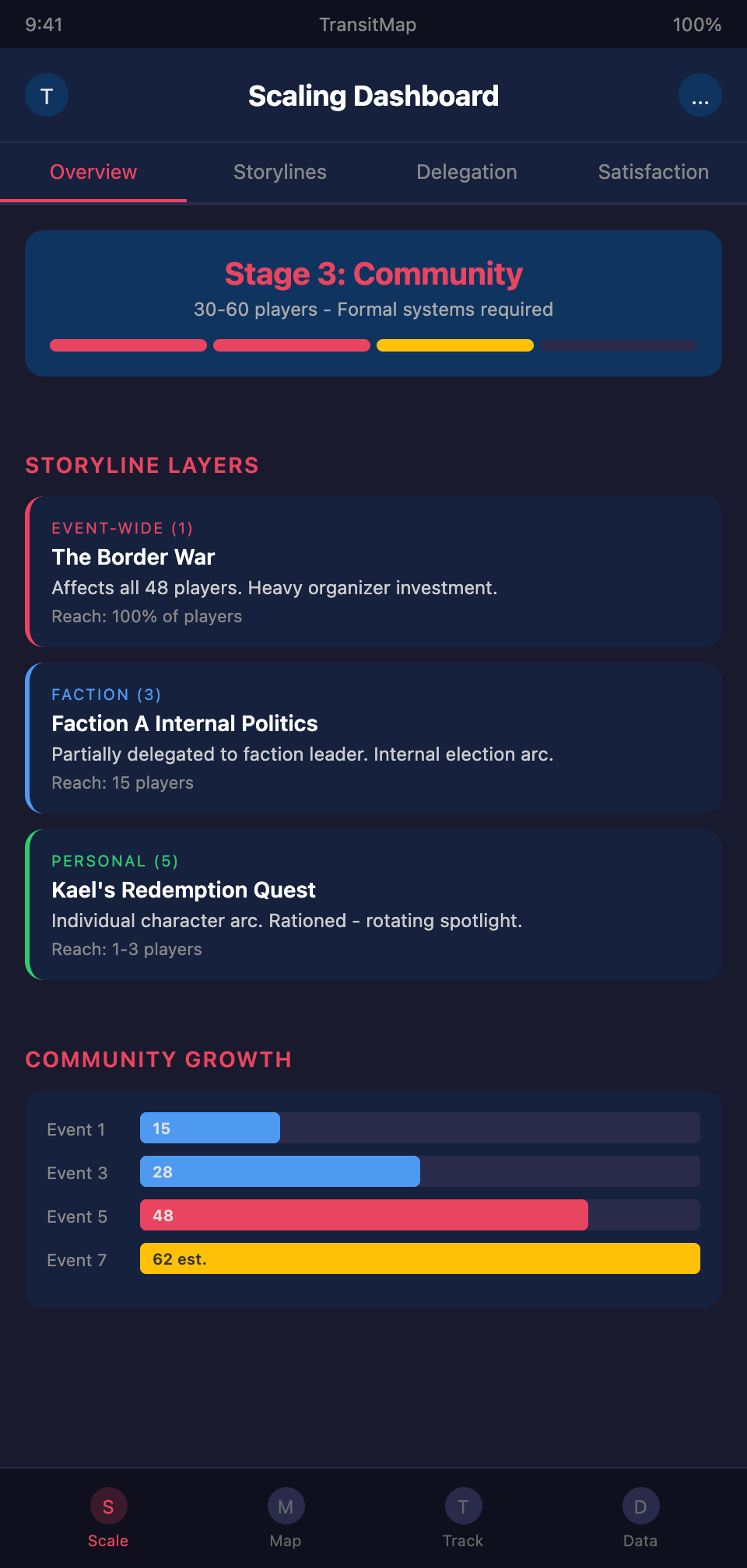
Stage 3: Community (30-60 players). The organizer cannot personally interact with every player at every event. Factions or player groups become structural elements. A storyteller team is essential. Formal tracking and communication systems are required.
Stage 4: Organization (60-100+ players). The LARP is an organization, not a hobby project. Multiple crews, formal governance, logistical infrastructure, and scalable narrative systems are necessary.
Each transition is a crisis point where the previous approach breaks down and must be replaced. The most common failure mode is trying to run a Stage 3 LARP with Stage 1 methods — an organizer who personally writes and runs every plotline for sixty players and burns out within two events.
Scaling Narrative Capacity
As your community grows, you need to increase the amount of narrative content available per event without proportionally increasing the organizer team's workload. Strategies:
Layer your storylines by scope:
- Event-wide storylines (1-2) — Affect everyone. The battle. The political crisis. The festival. These require heavy organizer investment but serve the entire player base.
- Faction storylines (1 per faction) — Affect faction members. Internal politics, faction-specific quests, inter-faction diplomacy. Partially delegated to faction leaders.
- Personal storylines (as capacity allows) — Affect individual players. Backstory arcs, character-specific quests, relationship developments. These are the hardest to scale and should be rationed carefully.
Delegate narrative authority:
- Faction leaders as story generators. Empower experienced players who lead factions to create content within their factions, with organizer approval. A faction leader who designs and runs their faction's internal politics reduces the organizer's workload while increasing content depth.
- Player-created content frameworks. Provide systems that let players generate narrative content without organizer involvement: craft systems, trade systems, social structure mechanics. These create gameplay that is self-sustaining.
- Junior storytellers from the community. Recruit experienced players who want to try organizing. Start them with small, contained storylines. Mentor them. Over time, they become additional narrative capacity.
Design self-sustaining conflict:
At scale, the most efficient narrative model is faction-versus-faction conflict with organizer-designed catalysts. Instead of writing storylines for players to follow, create situations that pit factions against each other and let the players generate the drama:
- Introduce a scarce resource that multiple factions need
- Reveal information that changes the power balance
- Create an external threat that requires cooperation but also creates opportunities for betrayal
- Run elections, trials, or contests where the outcomes are determined by player action
These catalysts require minimal organizer time to create but generate hours of player-driven content.
Maintaining Quality at Scale
The risk of scaling is dilution — more content but shallower content. Prevent this:
Protect the personal touch. Even at sixty players, ensure that every player has at least one personally meaningful interaction per event. This might be a brief NPC scene, a moment where their character's backstory is acknowledged, or a scene designed specifically for them. Rotate which players receive this treatment so everyone gets it eventually.
Maintain NPC quality. A common scaling mistake is adding more NPCs to cover more storylines, but lowering the quality of each NPC because crew is spread thin. Better to have fewer, better-briefed NPCs than many poorly prepared ones.
Do not scale the climax. The event's climactic moment should be as focused and impactful at sixty players as it was at fifteen. If the climax is a battle, make it a battle with clear objectives and personal stakes — not just a larger melee. If the climax is a political resolution, ensure every faction has a role.
Survey and adjust. As you scale, player satisfaction data becomes essential. Survey after every event. Track trends. If satisfaction is declining as attendance grows, you are scaling too fast or in the wrong direction.
Scaling Your Tracking Systems
Your tracking systems must scale with your community:
At 15 players: A notebook and your memory.
At 30 players: A spreadsheet for NPC tracking, a written schedule, and a storyteller team group chat.
At 60 players: A dedicated tracking tool or wiki for storyline state, NPC management, and faction tracking. Formal communication channels. Written protocols.
At 100+ players: Integrated management systems covering storyline tracking, NPC scheduling, crew management, player character databases, and event logistics. Possibly custom software or adapted project management tools.
The tracking system transition often lags behind community growth, creating a period where the organization has outgrown its tools. Upgrade proactively, not reactively.
When Not to Scale
Bigger is not always better. Some LARP experiences work best at intimate scale:
- Horror LARPs lose effectiveness above twenty players because fear requires intimacy
- Intrigue-heavy LARPs become unwieldy above forty players because information management explodes
- High-immersion LARPs are harder to maintain at scale because costume, prop, and set dressing standards multiply with attendance
If your LARP's core appeal is something that does not scale well, consider capping attendance and running multiple instances rather than growing a single event.
Scaling your LARP and need tracking systems that grow with you? Join the TransitMap waitlist — a storyline management platform designed to scale from intimate events to community-sized campaigns without losing narrative quality.