Accessibility in RPG Module Design
Why Accessibility Matters for Publishers
Accessibility in RPG module design serves both ethical and business purposes. An accessible module reaches more customers. A module that is hard to read, navigate, or use excludes potential buyers and reduces your market.
Beyond market considerations, tabletop RPGs are fundamentally social games. When a module's design prevents a GM or player from participating fully, it undermines the game's core value — bringing people together around a shared story.
Visual Accessibility
Font size and readability. Body text should be no smaller than 9 point, with 10 or 11 point preferred. Headers should be significantly larger. Choose fonts with clear letterform distinction — fonts where lowercase l, uppercase I, and numeral 1 are easily distinguished.
Color contrast. Text should have sufficient contrast with its background. Black text on white or light cream backgrounds is standard. Avoid light-colored text on medium backgrounds, colored text on colored backgrounds, or text over busy artwork.
Color-independent information. Never use color as the only means of conveying information. If your flowchart uses color-coded paths, also use different line styles (solid, dashed, dotted) or labels. If your map uses color to indicate terrain types, also use patterns or icons.
Image descriptions. Maps, illustrations, and diagrams should include text descriptions that convey the essential information visually depicted. A GM using a screen reader needs to understand the map's layout through text.
PDF accessibility. Digital modules should use tagged PDFs with proper heading structure, reading order, and alt text for images. This enables screen readers and assistive technology to navigate the document.
Cognitive Accessibility
Clear language. Use straightforward prose without unnecessary jargon. When game terms are required, define them on first use or provide a glossary.
Consistent structure. Use the same organizational structure throughout the module. If encounters are presented as Description → Creatures → Treasure → Development in one section, use that order everywhere.
Chunked information. Break complex information into smaller, labeled chunks. A single paragraph containing room description, creature behavior, trap mechanics, and treasure is hard to process. Separate elements with headers, bullets, or distinct formatting.
Summary sections. Provide brief summaries at the start of each major section. A GM who cannot process the full text should be able to run the section from the summary alone, even if the experience is less rich.
Reduced cognitive load. Minimize the number of things a GM must hold in working memory. Cross-references, conditional triggers, and state tracking all consume cognitive resources. Design for the minimum necessary complexity.
Physical Accessibility
Book binding and weight. Print modules should lie flat when open so GMs do not need to hold them open. Spiral binding or lay-flat binding is preferable for table use.
Digital alternatives. Offer digital versions alongside print. GMs with limited hand mobility may prefer a tablet or laptop to a physical book. Digital versions should be fully functional, not just scanned print pages.
Font and layout consistency. GMs who use magnification tools or screen readers benefit from consistent layout. Unexpected format changes force reorientation and consume time.
Content Accessibility
Safety tools integration. Include notes about potentially sensitive content and suggestions for safety tools. A sidebar at the beginning of the module can list themes that groups might want to discuss before play: violence level, horror elements, themes of loss or betrayal.
Adjustable intensity. Provide guidance for adjusting the adventure's emotional intensity. Not every group wants the full horror experience or the most morally ambiguous version of a scene. Offer lighter alternatives without judgment.
Cultural sensitivity. Review your module for stereotypical or harmful representations. Fantasy cultures inspired by real-world cultures should be depicted with nuance and respect. Villainous cultures should not be thinly veiled versions of marginalized real-world groups.
Practical Implementation
Start with structure. Accessible structure (clear headers, consistent organization, logical flow) is the foundation. Without good structure, other accessibility improvements have limited impact.
Test with diverse users. Include GMs and players with different accessibility needs in your playtesting. Their feedback will identify issues you cannot see from your own perspective.
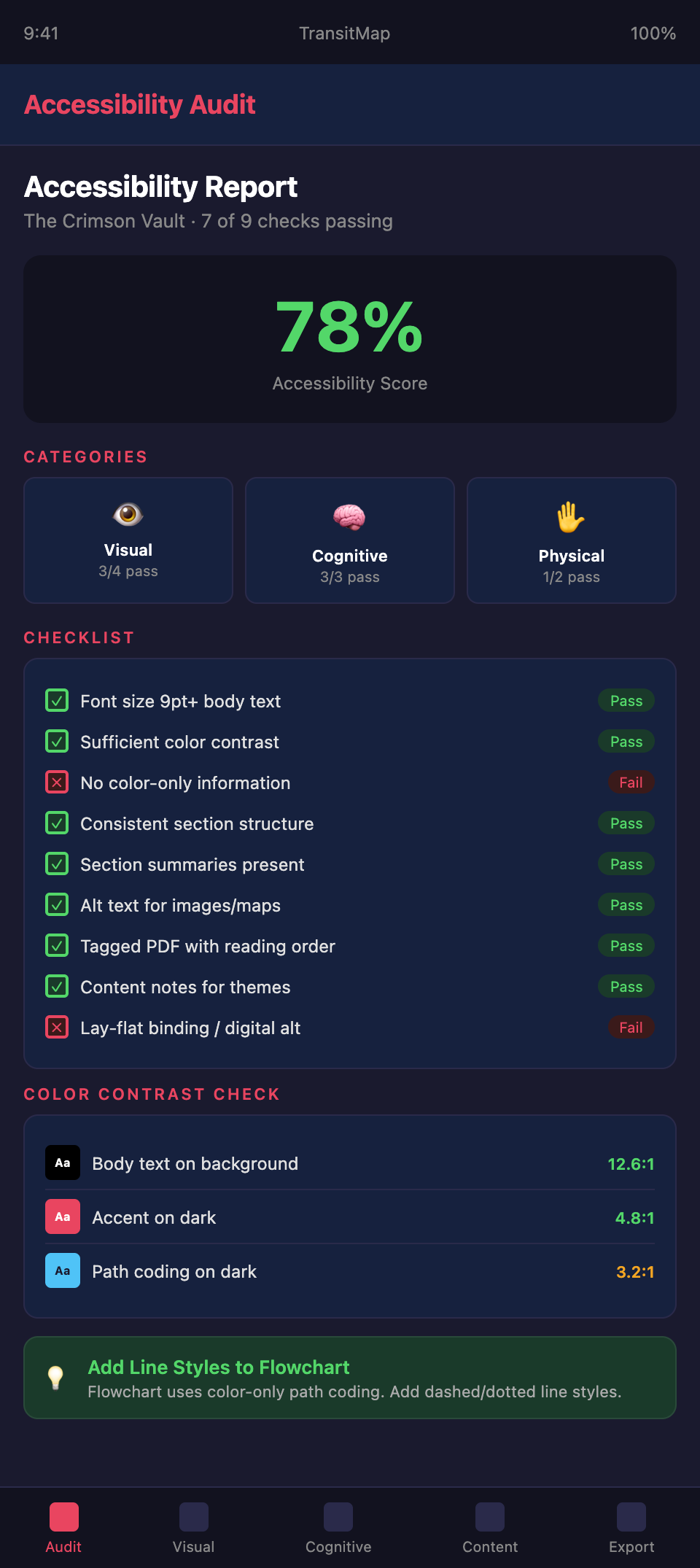
Use accessibility checklists. Before publication, run your module through an accessibility checklist:
- Font size 9pt+ for body text
- Sufficient color contrast throughout
- No information conveyed by color alone
- Consistent section structure
- Summaries for major sections
- Alt text for all images and maps
- Tagged PDF with proper reading order
- Content notes for sensitive themes
- Lay-flat binding for print (or digital alternative available)
Iterate. Accessibility is not a one-time checklist — it is an ongoing practice. Each module should be more accessible than the last as you learn from feedback and develop better habits.
The Business Case
Larger market. Accessible modules serve GMs and players who are excluded by inaccessible design. This is not a niche market — an estimated 15-20% of the population has some form of disability.
Better reviews. Accessible modules receive better reviews because they are easier to use. Usability and accessibility overlap significantly — an accessible module is a usable module for everyone.
Industry leadership. Publishers who prioritize accessibility build reputation and community trust. This translates to long-term brand loyalty and word-of-mouth marketing.
Designing accessible RPG modules? Join the TransitMap waitlist — build your adventure's structure with accessibility-first design, featuring clear visual hierarchy, text descriptions for all visual elements, and navigable organization that works for every GM.