Designing Branching Adventure Paths for Tabletop RPGs
The Branching Path Design Challenge
Every RPG module designer faces the same fundamental tension: players want freedom, but published modules need structure. A module that accounts for every possible player choice would be infinitely long. A module that accounts for none would be a railroad.
Branching adventure paths solve this by offering structured choice points where the adventure splits into two or more paths, each leading to different content before eventually converging or reaching distinct endpoints. The art is in designing branches that feel meaningfully different without multiplying your page count beyond what is publishable.
The Three Branching Architectures
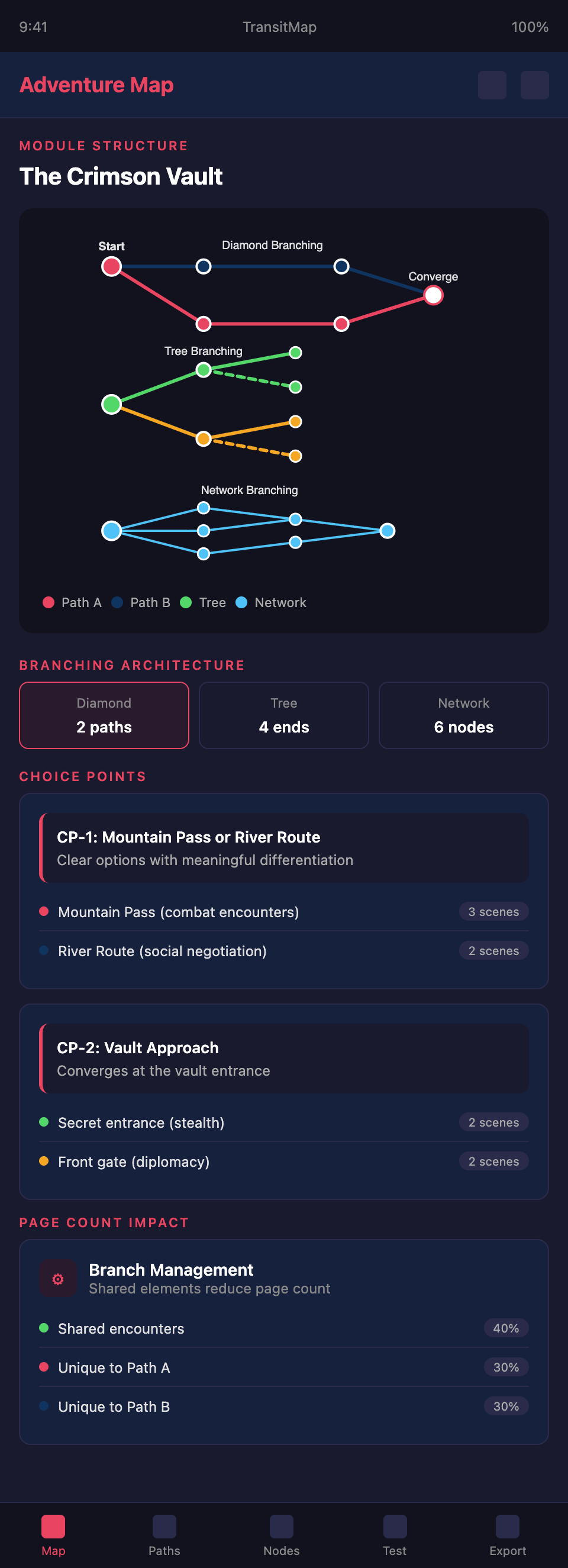
Diamond branching. The adventure splits at a choice point and reconverges at a later node. The players take different routes but arrive at the same destination. Each branch provides different encounters, information, and experiences, but the overall adventure structure remains manageable.
Best for: Adventures where the destination matters more than the journey. Mysteries where different investigation approaches lead to the same revelation.
Tree branching. The adventure splits and each branch splits again, creating a tree of possibilities. Paths do not reconverge — each branch leads to a different endpoint.
Best for: Short adventures with dramatic consequences for choices. Adventures where the ending should reflect the players' decisions throughout.
Network branching. Nodes are connected by multiple paths, and players can move between nodes in various orders. This is the most complex architecture but provides the most player freedom.
Best for: Investigation adventures, exploration-focused modules, and adventures set in a defined location where players choose their own approach.
Designing Choice Points
A choice point is the moment where the adventure branches. Effective choice points share several characteristics:
Clear options. The players should understand what their choices are, even if they do not know the consequences. "Do you go through the mountain pass or take the river route?" is clear. "What do you do?" is not a designed choice point — it is an open question that your branching structure cannot anticipate.
Meaningful differentiation. Each branch should offer genuinely different content. If Branch A and Branch B both involve fighting goblins in slightly different rooms, the choice is cosmetic. If Branch A involves a combat encounter and Branch B involves a social negotiation, the choice is meaningful.
Consequences that matter. The choice should affect the adventure going forward. Different information gained, different allies acquired, different resources available, different challenges faced. The branch should change the players' experience, not just their route.
No wrong answers. Every branch should be viable and enjoyable. If one branch is obviously better than the others, you have not created a choice — you have created a trap.
Managing Page Count
Branching multiplies content. Two branches doubles your encounter count. Four branches quadruples it. Managing this multiplication is essential:
Share common elements. Many encounters can appear on multiple branches with minor modifications. A guard post encounter works whether the players approach from the north or south — change the guard captain's dialogue and the tactical setup, but reuse the core encounter.
Use modular encounters. Design encounters as self-contained units that can be placed on different branches. A "convince the reluctant ally" scene works in multiple contexts with minimal modification.
Converge strategically. Diamond branching controls page count by reconverging paths. Place convergence points after every two to three choice points to prevent exponential branch growth.
Vary branch length. Not every branch needs to be the same length. A risky shortcut might be one encounter. A safe detour might be three. This variation adds strategic depth while keeping total content manageable.
Accept asymmetry. Some branches will have more content than others. This is fine — it reflects the natural consequence of different choices. The players who chose the longer path get more content. The players who chose the shortcut get less content but faster progress.
Documenting Branches for GMs
The GM reading your module needs to understand the branching structure quickly:
Include a flow chart. A visual diagram of the adventure's branching structure should appear early in the module. Every choice point, every branch, every convergence point should be visible at a glance.
Label branches clearly. Each branch should have a clear identifier that is referenced consistently throughout the text. "Path A: The Mountain Pass" and "Path B: The River Route" are better than unnamed branches that require page-flipping to track.
Cross-reference convergence points. When branches converge, clearly indicate what information, items, or conditions the players might have from each branch. "If the party came via Path A, they know about the secret entrance. If via Path B, they have the key but do not know about the entrance."
Flag GM decisions. When the GM needs to make a judgment call about how branches interact, flag it clearly: "GM Decision: If the party split and took both paths, determine which group arrives first based on their travel speed."
Testing Branching Adventures
Branching adventures require more testing than linear ones:
Test each branch independently. Play through each branch separately to ensure it provides a complete, satisfying experience.
Test transitions. Play through each combination of connected branches to ensure transitions are smooth and information continuity is maintained.
Test convergence. At convergence points, verify that the adventure works regardless of which branch the players took to arrive there.
Test for dead ends. Ensure no combination of choices leaves the players stuck without a path forward.
Designing a branching adventure and losing track of how all the paths connect? Join the TransitMap waitlist — map every branch, choice point, and convergence as a visual transit network that shows your entire adventure's structure at a glance.