Designing Memorable NPCs for Your RPG Module
The NPC Usability Problem
Module NPCs serve two masters. They need to be interesting characters with depth and motivation — but they also need to be instantly playable by a GM who might be reading their description for the first time during a live session.
Most module NPCs fail at the second requirement. They have detailed backstories, complex motivations, and nuanced relationships — none of which the GM can absorb or portray in the thirty seconds between "I want to talk to the merchant" and needing to speak as the merchant.
Memorable module NPCs are designed from the outside in. The external — the immediately visible, hearable, playable elements — comes first. The internal — the motivation, history, and complexity — supports the external rather than replacing it.
The Three-Second NPC
Every NPC should be portrayable after three seconds of reading. This requires three instantly graspable elements:
The look. One distinctive visual feature that sets the NPC apart. Not a paragraph of physical description — one feature. "Missing left ear." "Always wears gloves, even indoors." "Covered in flour." The GM mentions this detail and the NPC immediately has visual identity.
The voice. One speech pattern or verbal habit that the GM can perform. "Whispers everything." "Ends statements as questions." "Never uses contractions." "Calls everyone 'friend.'" The voice cue gives the GM an instant performance hook.
The want. One thing the NPC wants from the current interaction. Not their life goal — their immediate desire in this scene. "Wants the party to leave." "Wants to sell something." "Wants information about the road ahead." The want drives the NPC's behavior in the scene.
The NPC Stat Card
Present NPC information in a scannable card format:
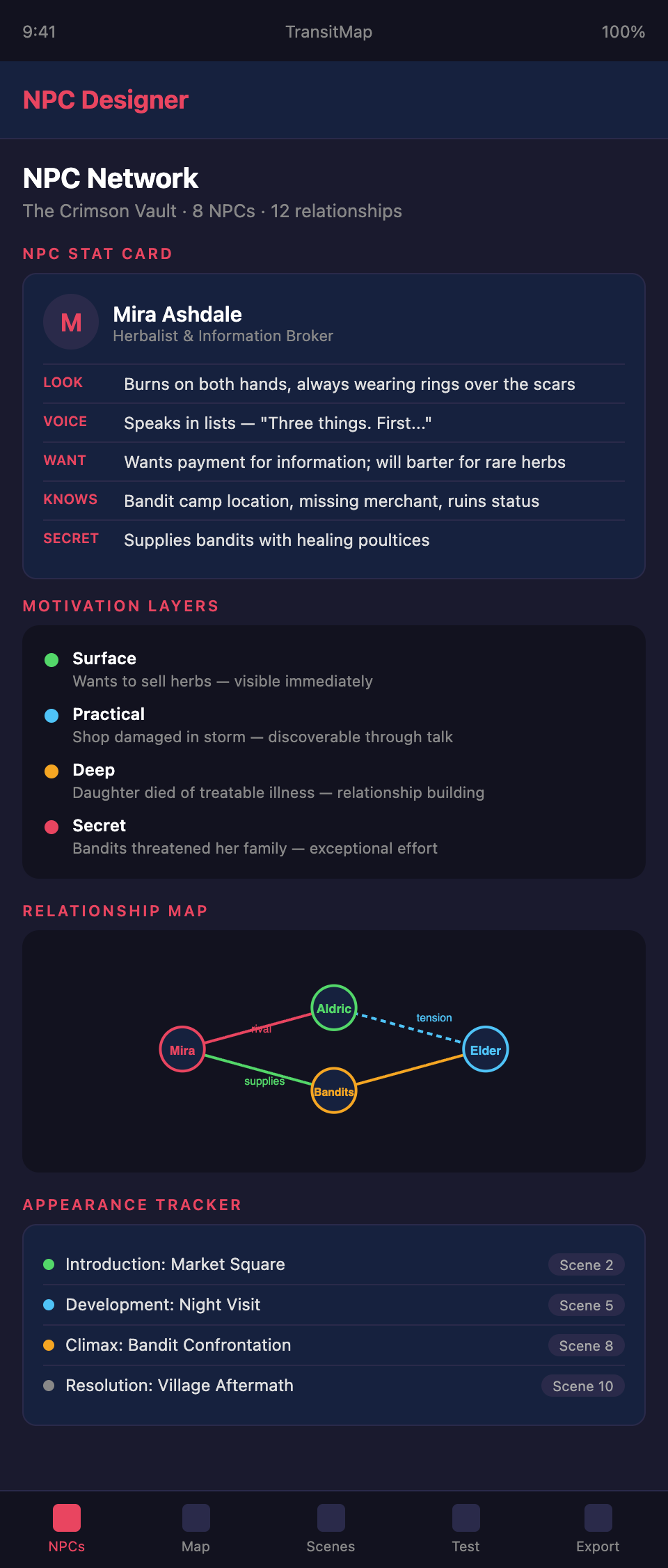
Name: Mira Ashdale Role: Herbalist and information broker Look: Burns on both hands, always wearing rings over the scars Voice: Speaks in lists — "Three things. First, the road is dangerous. Second, you need supplies. Third, I can help with both." Want: Wants payment for information; will barter for rare herbs Knows: The bandits have a camp two miles north; the missing merchant was last seen heading to the old bridge; the ruins are not as abandoned as people think Secret: She supplies the bandits with healing poultices in exchange for protection Stat block: Commoner (MM p. 345) with proficiency in Medicine and Nature
This entire NPC fits on a quarter of a page and can be played immediately.
Motivation Layers
Behind the three-second elements, build motivation in layers:
Surface motivation. What the NPC appears to want. This is visible to the players immediately: "She wants to sell you herbs."
Practical motivation. What the NPC actually needs. This is discoverable through conversation: "She needs money because her shop was damaged in the last storm."
Deep motivation. What drives the NPC's life choices. This is discoverable through relationship-building or investigation: "She became an herbalist because her daughter died of a treatable illness and she vowed no one in the village would suffer the same."
Secret motivation. What the NPC hides. This is discoverable through exceptional effort or specific plot developments: "She supplies the bandits because they threatened her remaining family."
Most interactions only reach the surface and practical layers. The deeper layers exist for GMs and players who invest in the NPC.
NPC Relationships
NPCs become more memorable when connected to other NPCs:
Define two to three relationships for important NPCs. A rival, an ally, a family member, a former partner. These relationships give the NPC social context and provide additional roleplay opportunities.
Make relationships visible. An NPC who mentions other NPCs by name creates a sense of community. "Have you spoken to Aldric at the forge? He knows more about the ruins than I do."
Create relationship tension. When two NPCs have a strained relationship, the players can get involved. The herbalist and the blacksmith disagree about how to handle the bandits. The players might mediate, take sides, or exploit the tension.
NPCs Across the Adventure
Track how NPCs appear across the adventure:
Introduction scene. Where and how the NPC first appears. Design this scene to showcase the NPC's three-second elements.
Development scenes. Later appearances where the NPC's deeper motivations are revealed. These scenes should occur naturally through the adventure's progression.
Climax involvement. How the NPC participates in the adventure's climax, if at all. Important NPCs should have a role in the climactic events — even if that role is being threatened, providing information, or making a sacrifice.
Resolution. What happens to the NPC after the adventure concludes. A brief note on the NPC's fate provides closure.
Common NPC Design Mistakes
The backstory-heavy NPC. Pages of history with no performance cues. The GM knows the NPC's life story but cannot voice them.
The motivation-free NPC. Detailed appearance and personality but no clear want. The GM does not know what the NPC does in a scene.
The interchangeable NPC. Multiple NPCs with similar roles, appearances, and personalities. Players cannot distinguish between them.
The omniscient NPC. An NPC who knows everything the GM knows. Real people have limited, biased knowledge. NPCs should too.
The static NPC. An NPC who never changes regardless of player actions. Important NPCs should react to events and evolve over the adventure.
Designing NPCs for a complex module? Join the TransitMap waitlist — map every NPC as a stop on your adventure's transit network, with relationship lines connecting characters and appearance tracking across every scene.