Designing Random Encounters for RPG Modules
Beyond Wandering Monsters
The traditional random encounter is a combat: roll on a table, fight the indicated monsters, collect experience. This approach treats random encounters as taxes on travel — costs the players pay for moving between important locations. Players and GMs both resent this approach because it consumes time without advancing the story.
Modern random encounter design treats each encounter as a micro-scene — a brief narrative event that reveals something about the world, creates a decision point, or establishes atmosphere. The encounter might involve combat, but it might also involve a social interaction, an environmental challenge, a piece of world-building, or a moral dilemma.
The Random Encounter Table Structure
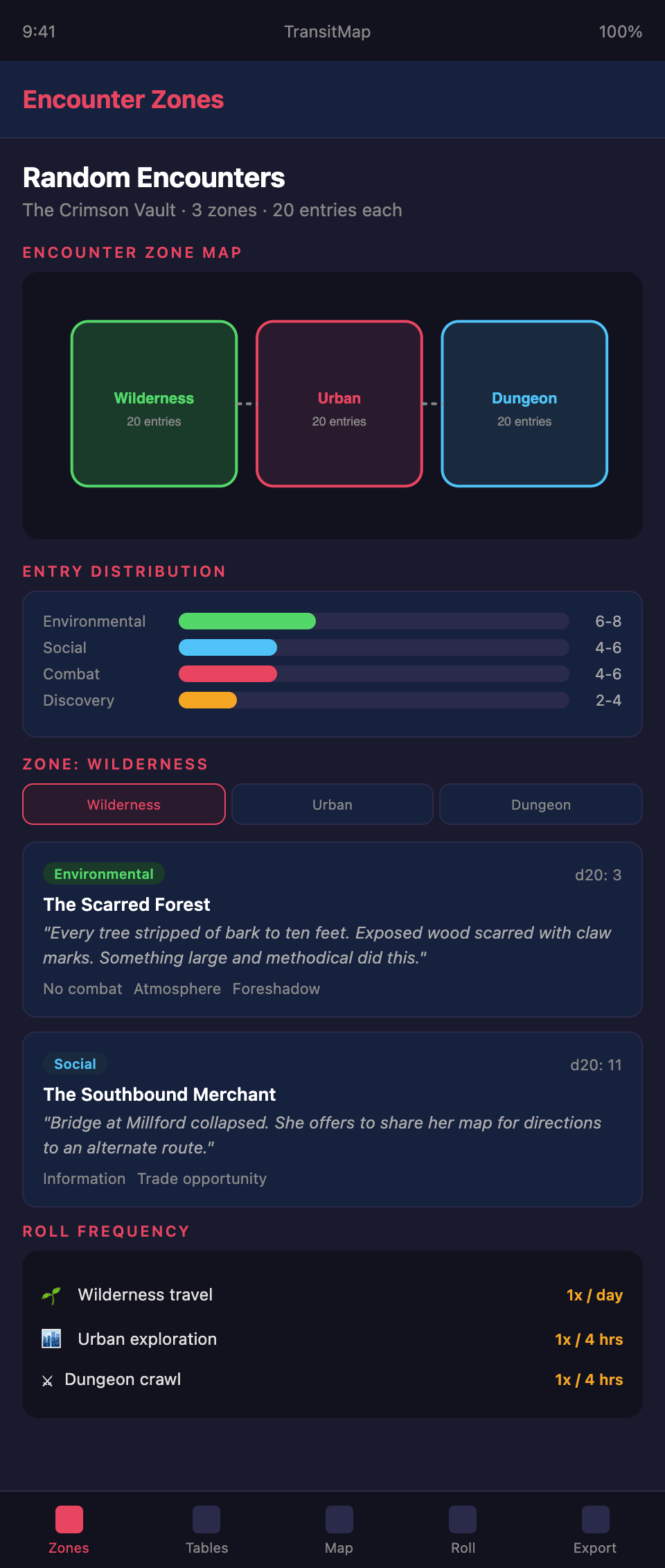
Design your random encounter tables with variety:
A twenty-entry table is the standard. Twenty entries provide enough variety to avoid repetition while remaining manageable for the designer to write and the GM to reference.
Entry distribution:
- 6-8 entries: Environmental or atmospheric (no combat)
- 4-6 entries: Social encounters (NPCs, travelers, merchants)
- 4-6 entries: Combat encounters (threats appropriate to the area)
- 2-4 entries: Discovery encounters (lore, treasure, mystery hooks)
This distribution ensures that random encounters are varied and that combat is not the default.
Environmental Encounters
These encounters establish the world's character without requiring interaction:
Weather events. A sudden storm, an unusual fog, a temperature drop. Weather affects travel, forces shelter decisions, and creates atmosphere.
Natural phenomena. A herd of migrating animals, a geyser eruption, a peculiar rock formation. These encounters reward the players' attention to the world.
Signs of civilization. An abandoned campsite, road markers, a collapsed bridge. These signs tell stories about who has been here before and what happened to them.
Sensory details. A distant sound of drums, the smell of smoke from beyond the hills, tracks in unusual patterns. These details build tension and encourage investigation.
Example: "The trail passes through a section of forest where every tree has been stripped of bark to a height of ten feet. The exposed wood is scarred with claw marks. Whatever did this was large and methodical."
Social Encounters
These encounters populate the world with people:
Travelers. Merchants, pilgrims, messengers, refugees. Each traveler has a reason for being on the road and information to share. "A merchant heading south warns that the bridge at Millford has collapsed. She is looking for an alternative route and offers to share her map."
Locals. Hunters, farmers, herders, woodcutters. Local people know the area and can provide guidance, warnings, or quests. "A woodcutter is collecting timber and mentions that his last three axe handles have broken. He suspects the wood in this area is cursed."
Faction agents. Representatives of the adventure's factions who are operating in the area. These encounters connect random events to the adventure's larger narrative.
Unusual characters. A wandering scholar, a lost child, a disguised noble. Unusual characters create memorable moments and potential story hooks.
Combat Encounters With Narrative
Combat encounters should have context:
Why is this creature here? Every combat encounter should have a reason. The wolves are hunting because prey has been scarce. The bandits are desperate because their leader was captured. The undead are guarding something they protected in life.
What happens after combat? The wolves' den contains pups. The bandits carry a letter from their captive leader. The undead guard a sealed door. Every combat encounter should have a post-combat discovery that rewards investigation.
Can combat be avoided? Provide at least some combat encounters with non-combat resolution options. The wolves back off if the party offers food. The bandits surrender if outmatched and can provide information. These options make the world feel realistic.
Discovery Encounters
These encounters reward exploration:
Lore discoveries. An ancient boundary stone, a ruined shrine, a forgotten monument. Each discovery includes a brief inscription or visual detail that connects to the adventure's world-building.
Minor treasure. A small cache, a valuable herb, a useful tool. These rewards make travel feel worthwhile without disrupting the adventure's economy.
Mystery hooks. A cryptic symbol carved into a tree, a campsite with signs of a struggle but no bodies, a message in a bottle. These hooks can be standalone mysteries or connections to the main adventure.
Quest seeds. A brief encounter that could become a side quest: a lost animal, a damaged wagon, a stranded traveler. These give the GM material if the players want to explore beyond the main adventure.
Location-Specific Tables
Create different encounter tables for different areas:
Wilderness tables focus on natural phenomena, wildlife, and travelers.
Urban tables focus on social encounters, faction activity, and crime.
Dungeon tables focus on environmental hazards, creature encounters, and discoveries.
Faction-controlled areas should have tables weighted toward that faction's activities — patrols, checkpoints, and agents.
Frequency and Pacing
Include guidance on how often to roll:
Frequency recommendation: "Roll once per day of travel" or "roll once per four hours of exploration." This helps the GM calibrate the adventure's pacing.
When not to roll: "Do not roll random encounters when the party is engaged in a main quest scene or during the adventure's climax." Random encounters should supplement the adventure, not interrupt it.
Designing random encounter tables for your module? Join the TransitMap waitlist — map encounter zones across your adventure's geography, with location-specific tables and narrative connections to your main storyline all organized visually.