Encounter Balance in Branching RPG Adventures
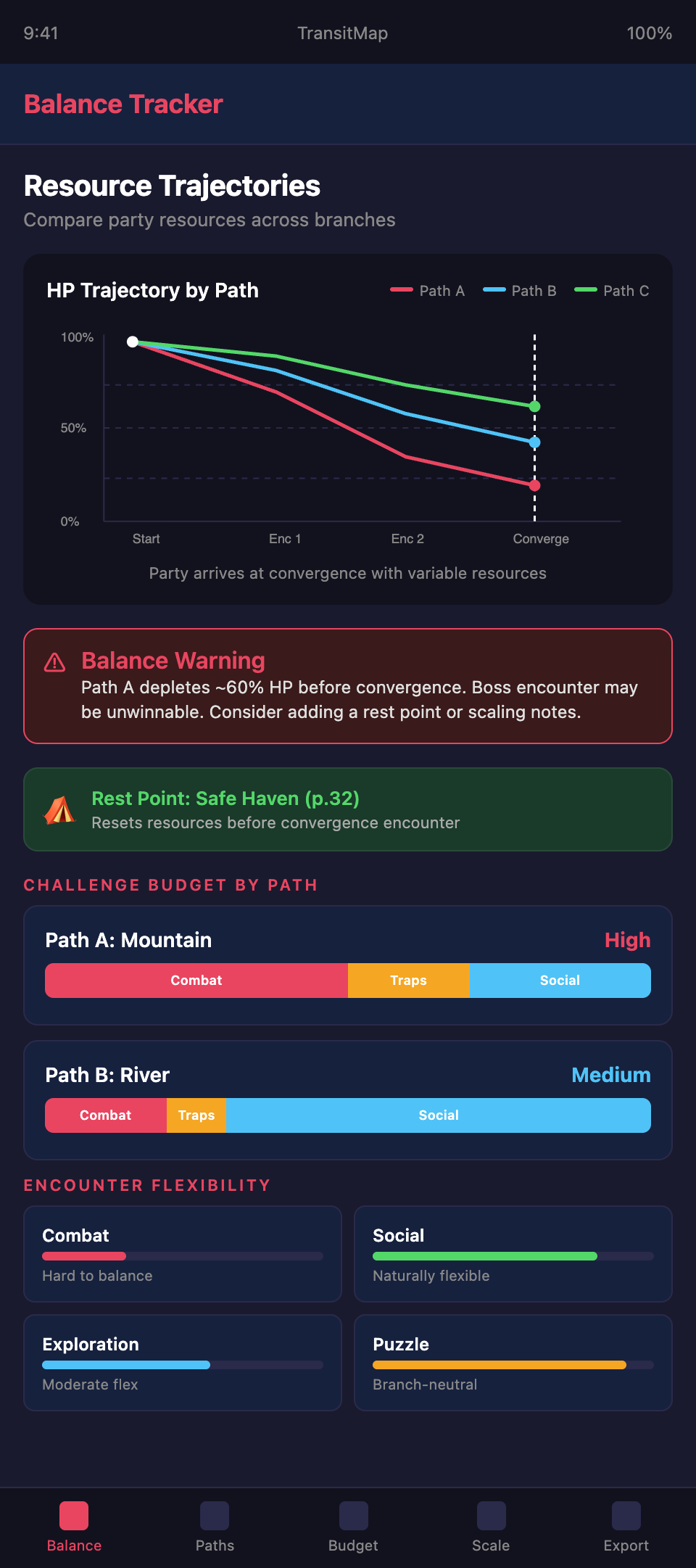
The Variable State Problem
Linear adventure balance is straightforward: the party starts at point A with known resources and progresses through encounters in a known order. You can calibrate each encounter to the party's expected state at that point.
Branching adventures break this model. When multiple paths lead to the same encounter, the party's state at arrival is variable. They might have full resources from a short path with few encounters, or depleted resources from a long path with many encounters. They might have crucial information from one path or be operating blind from another.
Resource Tracking Across Branches
Map the resource trajectory for each path through your adventure:
Hit points and healing. Track expected HP loss per encounter on each path. A path with three combat encounters depletes more HP than a path with one combat and two social encounters. If both paths converge at a major combat, the depleted party may be at a severe disadvantage.
Spell slots and abilities. Track expected expenditure of limited-use abilities. Casters who used multiple spell slots on Path A arrive at the convergence with fewer options than casters who took the less demanding Path B.
Consumable resources. Potions, scrolls, ammunition, and other consumables spent on one path are unavailable at later encounters. If Path A includes a section that encourages potion use, the party has fewer potions for the finale.
Information resources. Knowledge gained on different paths affects encounter difficulty in non-mechanical ways. A party that learned the dragon's weakness on Path A has an easier time than a party that took Path B and lacks that knowledge.
Balancing Strategies
Several approaches handle the variable state problem:
The rest point. Place a mandatory or strongly encouraged rest before major convergence encounters. This resets the party's resources to a known baseline regardless of which path they took. A safe haven, a time skip, or a narrative break serves this purpose.
Encounter scaling notes. Include explicit scaling guidance: "If the party arrived via the mountain pass (Path A), reduce the number of guards by two, as the party has likely expended more resources." This puts the balancing tool in the GM's hands.
Self-balancing encounters. Design encounters where the difficulty adjusts based on the party's approach. A social encounter where the party negotiates with a faction leader is easier with more information (gained on a specific path) but still achievable without it. A combat encounter where reinforcements arrive in waves allows the GM to call fewer waves if the party is depleted.
Branch-specific rewards. Give each branch rewards that compensate for its challenges. The harder path provides more healing potions. The longer path provides more gold. The information-sparse path provides a powerful ally. When paths converge, parties from different branches have different advantages rather than one party simply being worse off.
The Challenge Budget
Assign a challenge budget to each path and ensure paths of similar length have similar budgets:
Define your challenge currency. This might be "expected HP loss," "expected spell slots spent," "number of significant encounters," or a combination. The specific metric matters less than using it consistently.
Budget each path. A path from choice point A to convergence point B should have a similar total challenge budget regardless of which branch is taken. If Path 1 has a deadly combat encounter, its total budget is higher — so it should have fewer other encounters to compensate.
Budget the convergence encounter. The encounter at a convergence point should be balanced for the lowest-resource party that might arrive. If the toughest path depletes approximately 60% of party resources, the convergence encounter should be designed for a party at 40% resources.
Budget the full adventure. The total challenge budget from start to finish should be similar regardless of which path combination the party takes. A party that takes the easy path early should face harder content later. A party that suffered early should find relief later.
Encounter Types and Branch Suitability
Different encounter types handle branching better than others:
Combat encounters are the hardest to balance across branches because they depend heavily on resource state. Use scaling notes or self-balancing mechanics when placing combat at convergence points.
Social encounters are naturally flexible. A negotiation can succeed or fail regardless of the party's resource state. Information from different paths might change the approach but rarely makes the encounter impossible.
Exploration encounters are moderately flexible. A trapped corridor is harder for a depleted party, but traps can be detected and avoided through player skill rather than character resources.
Puzzle encounters are branch-neutral. A puzzle's difficulty does not depend on the party's mechanical state. However, information-based puzzles may be easier for parties who gained relevant knowledge on specific paths.
Testing Balance Across Branches
Theoretical testing. Calculate expected resource expenditure for each path and compare the party's expected state at each convergence point. Identify the hardest and easiest path combinations and check if the difficulty difference is acceptable.
Practical testing. Run the same convergence encounter with playtest groups arriving from different paths. Note the difficulty difference. If one group breezes through while another barely survives, the balance needs adjustment.
Edge case testing. Consider the worst-case scenario: a party that took the hardest path at every choice point. Can they still complete the adventure? If not, add safety valves — opportunities to recover resources, gain allies, or bypass encounters when the party is severely depleted.
Balancing encounters across a branching adventure? Join the TransitMap waitlist — visualize resource trajectories across every path, compare challenge budgets between branches, and ensure balanced play regardless of player choices.