Designing Player Choice and Consequence in RPG Modules
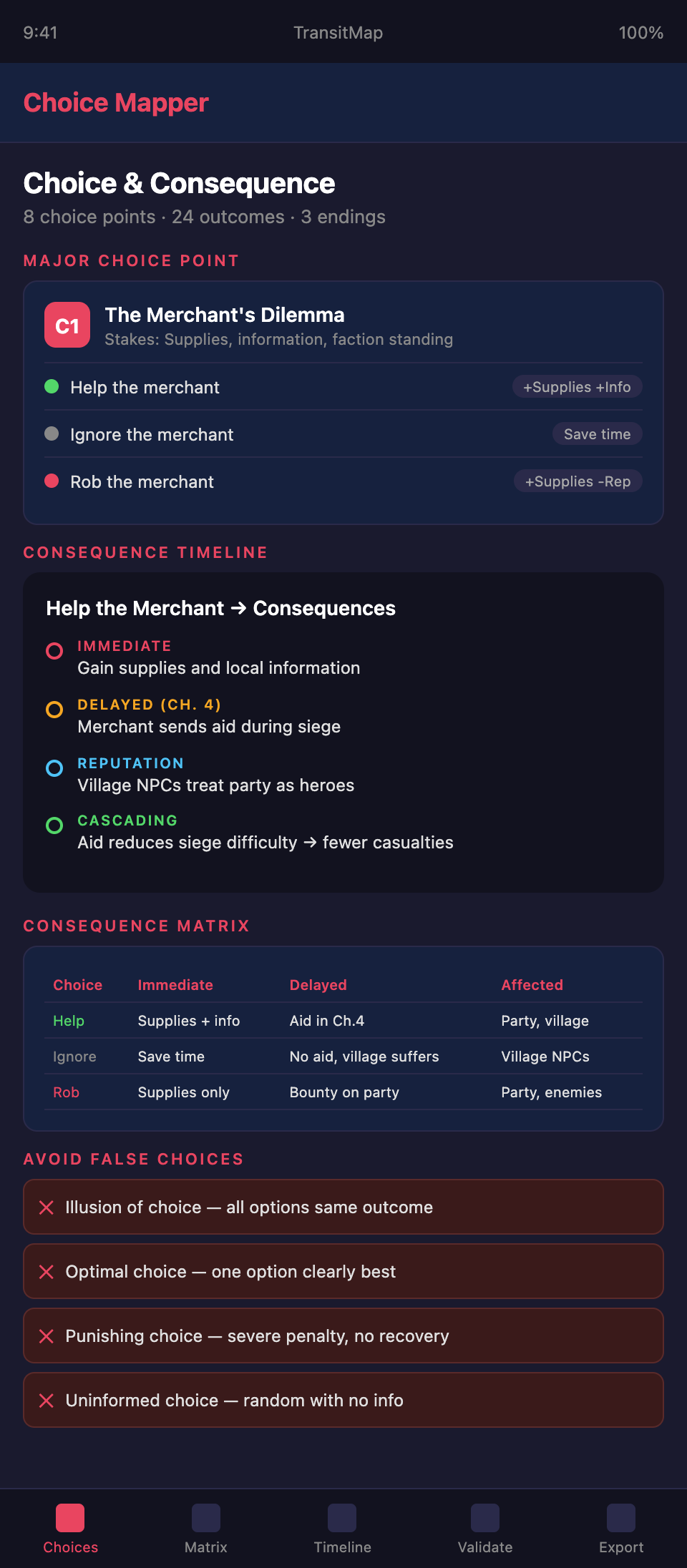
Why Choice and Consequence Define Quality
Players buy RPG modules to make meaningful decisions in an interactive story. The module's quality is ultimately measured by how well their choices affect their experience. A module where every path leads to the same outcome regardless of player decisions fails at its fundamental purpose — no matter how well-written the prose or how balanced the encounters.
Consequence design is the discipline of ensuring that player choices produce visible, meaningful changes in the adventure's events, characters, and outcomes.
The Choice Design Framework
Every designed choice point should answer four questions:
What are the options? The choices available to the players. These should be clear, distinct, and genuinely different. Two options that are superficially different but lead to the same outcome are not real choices.
What are the stakes? What the players risk or gain by choosing. Stakes give choices weight. A choice with no stakes is a preference, not a decision.
What information do the players have? What the players know when making the choice. Informed choices (where the players understand the options and stakes) are fundamentally different from blind choices (where the players are guessing). Both are valid, but informed choices produce more satisfying gameplay.
What are the consequences? What happens as a result of each choice. Consequences should be proportional to the stakes, visible to the players, and persistent throughout the adventure.
Types of Consequences
Immediate consequences. The direct result of the choice, experienced in the same scene. The players choose to fight the guards, and combat begins. Immediate consequences provide instant feedback.
Delayed consequences. Results that appear later in the adventure. The players spared the bandit leader in Chapter 1, and he returns as an ally in Chapter 4. Delayed consequences reward attentive play and make the adventure feel interconnected.
Cascading consequences. A consequence that triggers further consequences. The players destroyed the bridge, which prevented reinforcements from arriving, which made the siege easier, which resulted in fewer civilian casualties. Cascading consequences make the world feel reactive and complex.
Reputation consequences. How NPCs and factions respond to the players based on their choices. A party known for mercy receives different treatment than a party known for violence. Reputation consequences make the social world responsive to player behavior.
Resource consequences. Choices that affect the party's resources — gold, items, allies, information. These consequences are concretely felt through mechanical advantage or disadvantage.
Making Consequences Visible
A consequence the players do not notice is a wasted consequence:
Show, do not imply. When a consequence occurs, make it explicit. Do not rely on the players inferring that the friendly merchant's attitude is different because they helped her village. Have the merchant say: "I heard what you did for Millbrook. Your gold is no good here — take what you need."
Reference the choice. When a consequence manifests, reference the original choice that caused it. "The prisoner you freed in the mines is here — and she brought friends." This connection between choice and consequence is the payoff.
Contrast paths. When possible, give the players a glimpse of what would have happened if they had chosen differently. An NPC mentions what the other faction is doing. A location shows the damage that could have been avoided. This contrast makes the consequence of their choice more vivid.
Mechanical impact. When choices affect mechanical outcomes (difficulty, resources, combat parameters), state it clearly in the module text so the GM communicates it effectively.
The Consequence Matrix
For each major choice point, create a consequence matrix:
| Choice | Immediate Consequence | Delayed Consequence | Who Is Affected |
|---|---|---|---|
| Help the merchant | Gain supplies + info | Merchant sends aid in Ch. 4 | Party, merchant, village |
| Ignore the merchant | Save time | No aid in Ch. 4, village suffers | Village NPCs |
| Rob the merchant | Gain supplies, no info | Merchant warns enemies, bounty on party | Party, merchant, enemies |
This matrix ensures every choice has thought-through consequences and helps you track how choices ripple through the adventure.
Avoiding False Choices
The illusion of choice. All options lead to the same outcome. "Do you go left or right?" — both corridors lead to the same room. Players quickly recognize false choices and stop engaging.
The optimal choice. One option is clearly better than all others. Rational players will always choose it, making the other options decorative. Balance choices so each has genuine advantages and tradeoffs.
The irreversible punishing choice. One option leads to severe punishment with no recovery path. Players feel tricked rather than challenged. Consequences should be significant but survivable.
The uninformed choice. Players choose randomly because they have no information to guide the decision. Uninformed choices feel arbitrary rather than meaningful. Provide enough information for informed decision-making.
Scaling Consequences
Match consequence scale to choice significance:
Minor choices (tactical decisions, social preferences) produce minor consequences — a slightly easier encounter, a small reward, a brief NPC reaction.
Moderate choices (strategic decisions, alliance selections) produce moderate consequences — different encounters, significant resource changes, NPC relationship shifts.
Major choices (adventure-defining decisions) produce major consequences — different endings, fundamental changes to the adventure's direction, lasting world effects.
If every choice has major consequences, the adventure feels chaotic. If no choice has consequences beyond the immediate moment, the adventure feels static. Graduated consequence scales create a natural rhythm.
Designing choice and consequence into your module? Join the TransitMap waitlist — map every choice point and its consequences as branching transit routes, with cascading effects visible across your entire adventure structure.