Playtesting Non-Linear RPG Modules Effectively
Why Non-Linear Modules Need Different Testing
A linear adventure has one path. If you playtest it once and it works, you have tested the entire module. A non-linear adventure has multiple paths, and a single playtest only covers one combination of choices. The untested paths may contain balance issues, information gaps, logical contradictions, or dead ends that will not surface until a paying customer encounters them.
The challenge is practical: you cannot playtest every possible path combination. A module with five binary choice points has thirty-two possible paths. You need a testing strategy that maximizes coverage with limited testing resources.
The Critical Path Method
Identify and prioritize your testing paths:
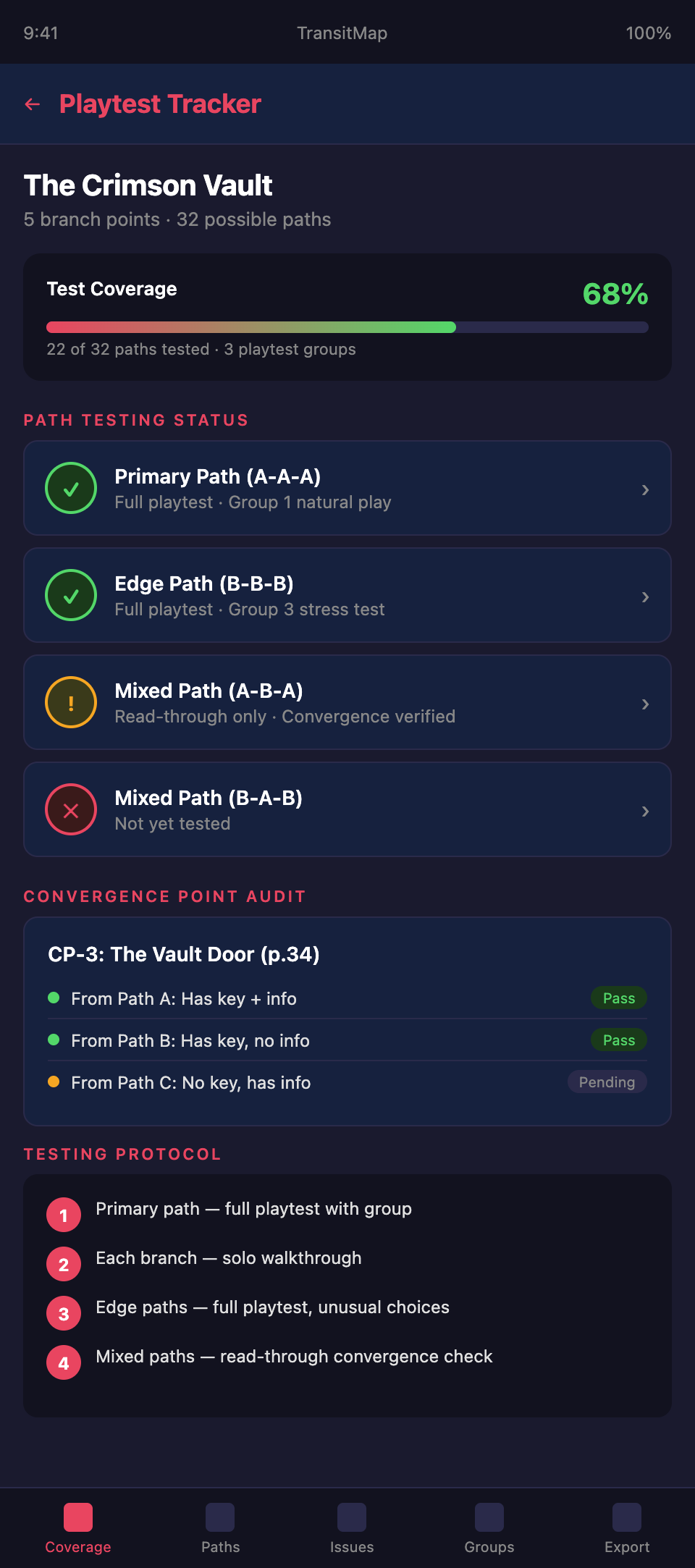
The primary path. The path you expect most groups to take based on the most obvious or appealing choices. This path should receive the most thorough testing, including full mechanical playthrough.
The edge paths. The paths created by the least obvious choices — the ones that test your module's flexibility. These paths are most likely to contain untested content because they were written with less attention.
The mixed paths. Paths that combine choices from different branches — taking Path A at the first choice but Path B at the second. These test your convergence points and information handoffs.
Priority testing order:
- Primary path — full playtest with a group
- Each individual branch — can be tested through read-through and solo walkthrough
- Edge paths — full playtest with a second group, asking them to make unusual choices
- Mixed paths — read-through verification of convergence points
Solo Walkthrough Testing
Before involving playtest groups, conduct solo walkthroughs:
The information walkthrough. For each path, track what information the players receive and when. At every point where information is needed (to solve a puzzle, make an informed decision, or understand the plot), verify that a path exists to obtain that information.
The resource walkthrough. Track what resources (items, allies, currency, abilities) are available on each path. Verify that no path leaves players without the resources needed to proceed.
The logic walkthrough. Read through each path checking for logical contradictions. Does an NPC reference something the players have not yet learned on this path? Does a location description assume the players arrived from a specific direction?
The tone walkthrough. Read each path for tonal consistency. Does a comedic scene appear immediately after a tragic one without transition? Does the adventure's overall tone hold across different path combinations?
Group Playtest Protocols
When running group playtests for non-linear modules:
First playtest: Natural play. Run the module as written without steering. Note which choices the group makes naturally — this reveals your primary path. Note where the group gets confused, stuck, or disengaged.
Second playtest: Guided deviation. Run the module with a different group. At each choice point, gently encourage the choice that the first group did not make. This tests your secondary paths.
Third playtest: Stress test. Run the module with a group that you have asked to make deliberately unusual choices. Ask them to split the party, choose the option that seems worst, and test the edges of the module's flexibility.
Playtest documentation template:
For each choice point encountered:
- Which option did the group choose and why?
- Did they understand all available options?
- Did the chosen path provide a satisfying experience?
- Did any information feel missing or confusing?
- Did any encounter feel unbalanced for their path?
Testing Convergence Points
Convergence points — where multiple branches merge — are the most error-prone elements in non-linear modules:
Variable state testing. At each convergence point, list every possible state the players could be in based on their prior choices. Test the convergence scene with each state to ensure it works.
Information asymmetry. Players arriving from different branches may know different things. Verify that the convergence scene does not assume knowledge that only one branch provides.
Resource variation. Players from different branches may have different resources. Verify that the convergence content is achievable regardless of which branch the players took.
NPC awareness. NPCs at convergence points may need to react differently based on the players' prior choices. Verify that conditional NPC responses are documented and make sense.
Common Non-Linear Testing Failures
The orphaned clue. A clue exists on one branch but is required on all paths. Players who took a different branch never receive it and cannot progress.
The impossible encounter. An encounter balanced for players who took the resource-rich branch is unwinnable for players who took the resource-poor branch.
The contradictory NPC. An NPC says one thing on Branch A and the opposite on Branch B, and both groups might encounter the NPC later at a convergence point.
The timeline paradox. Events on parallel branches imply different timelines. Branch A suggests three days have passed while Branch B suggests one day.
The dead end. A branch leads to a situation with no exit — no information to proceed, no encounter to resolve, no path back to the main adventure.
Iterative Testing
Non-linear modules benefit from iterative testing:
Test, revise, retest. After each playtest, revise the problem areas and retest specifically those sections. Do not rely on a single round of testing for complex branching structures.
Targeted retesting. When you revise a branch, retest its connections to adjacent branches and convergence points. Changes to one branch can create new problems at connection points.
Reader testing. After playtesting, have someone read the module without playing it. A fresh reader will catch logical gaps, unclear instructions, and navigation problems that players and GMs might overlook during the excitement of play.
Playtesting a non-linear module and struggling to track which paths have been tested? Join the TransitMap waitlist — map every path through your adventure, mark tested and untested branches, and ensure complete coverage before publication.