Publishing Non-Linear RPG Supplements Successfully
The Publishing Challenges
Non-linear content creates specific publishing challenges that linear adventures avoid:
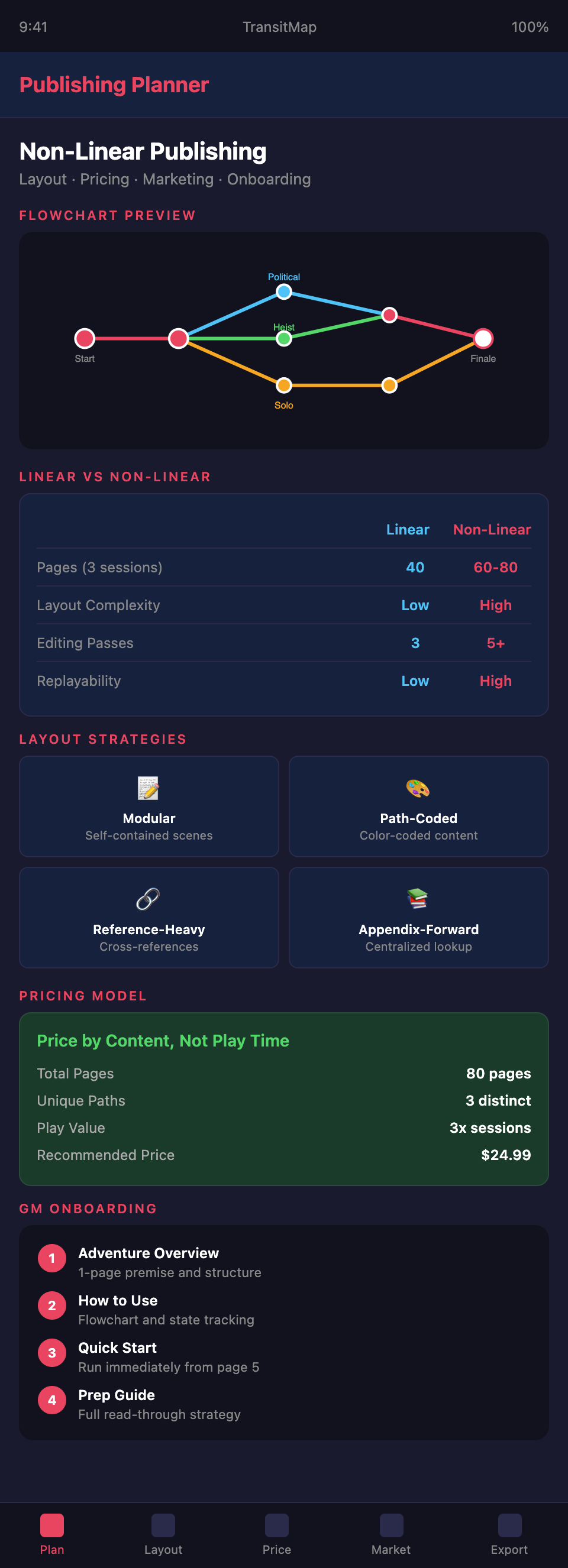
Page count inflation. Branching content means more total content for the same play-time length. A linear adventure that takes three sessions might be forty pages. A non-linear adventure for the same three sessions might be sixty to eighty pages because it includes content for paths the players will not take.
Layout complexity. Non-linear modules need more cross-referencing, more flowcharts, more conditional text formatting, and more careful information architecture than linear modules. The layout is harder and takes longer.
Editing difficulty. Editors must verify continuity across multiple paths, check that conditional triggers work correctly, and ensure that no path combination creates a plot hole. This is significantly more work than editing a linear adventure.
Reader onboarding. GMs purchasing a non-linear module need to understand how to navigate and run it. The module must teach its own structure before the GM can use it.
Pricing Non-Linear Content
Non-linear modules contain more content than linear modules of similar play length. Price accordingly:
Price by content, not by play time. If your module contains eighty pages of content that produces three sessions of play (with each playthrough using about forty pages), price it as an eighty-page product, not a three-session product.
Communicate the value. In your product description, explain what the buyer gets: "Eighty pages of adventure content with three distinct paths, each providing a unique three-session experience. Designed for multiple playthroughs."
Consider the replayability premium. A module designed for three playthroughs is three modules' worth of entertainment. Price above a single-use linear module of similar page count — the value justifies it.
Marketing Non-Linear Modules
Non-linear modules require different marketing than linear ones:
Lead with the promise of choice. "Your players' decisions shape the adventure" is a stronger hook than describing the plot. Non-linear modules sell on the promise of agency.
Describe multiple experiences. Instead of one plot summary, provide two or three: "In one playthrough, the party allies with the merchant guild and faces a political conspiracy. In another, they join the thieves' guild and pull off a daring heist. In a third, they go it alone and uncover a threat that both guilds are hiding."
Use testimonials from different playthroughs. Playtesters who took different paths can provide testimonials that demonstrate the module's variety: "We played it twice and had completely different experiences both times."
Show the flowchart. A well-designed adventure flowchart is compelling marketing material. It visually communicates the module's complexity and the promise of meaningful choice.
Layout Strategies for Non-Linear Content
The modular layout. Organize the module by scene or location rather than by sequence. Each scene is self-contained with its own header, NPC references, and conditional notes. The GM can navigate to any scene without reading the preceding scenes.
The path-coded layout. Use color coding or icons to identify which path each section belongs to. Path A content is blue, Path B is green, shared content is black. This lets the GM visually identify path-specific content during play.
The reference-heavy layout. Include more cross-references, page references, and navigation aids than a linear module would need. Every mention of a scene, NPC, or location should include a page reference.
The appendix-forward layout. Move reference material — stat blocks, NPC cards, handouts, maps — to a comprehensive appendix. This keeps the adventure text focused and gives the GM a single location for reference lookup.
Editing Non-Linear Modules
Path-specific editing passes. Edit each path independently as if it were a standalone adventure. Check for narrative coherence, pacing, and completeness within each path.
Cross-path editing passes. Edit the connections between paths — convergence points, conditional triggers, shared content, and information handoffs. These are where errors hide.
Continuity matrix. Build a matrix showing what information, items, and conditions exist on each path at each convergence point. Verify that every convergence scene accounts for every possible incoming state.
Play-like editing. Read through the module as a GM would — jumping between sections, following cross-references, checking conditional triggers. This editing style catches navigation problems that sequential reading misses.
Reader Onboarding
The first few pages of your module must teach the GM how to use it:
Adventure overview. One page maximum. The premise, the structure, and the expected play time.
How to use this module. A section explaining the non-linear format: how to read the flowchart, how conditional triggers work, how to track state, and how to navigate between sections.
Quick-start guide. For GMs who want to start running immediately: "Read pages 1-5 for the opening scene. The players will choose between three options — turn to the indicated page for each option."
Prep guide. For GMs who want to prepare thoroughly: "Read the full module once, then review the flowchart. Before each session, re-read the sections relevant to the players' current path and the next likely convergence point."
Publishing a non-linear RPG supplement? Join the TransitMap waitlist — map your entire module's structure as a navigable transit network, generate flowcharts and cross-references automatically, and give GMs a visual guide to your adventure's branching content.