Mapping Location Connections in RPG Adventure Design
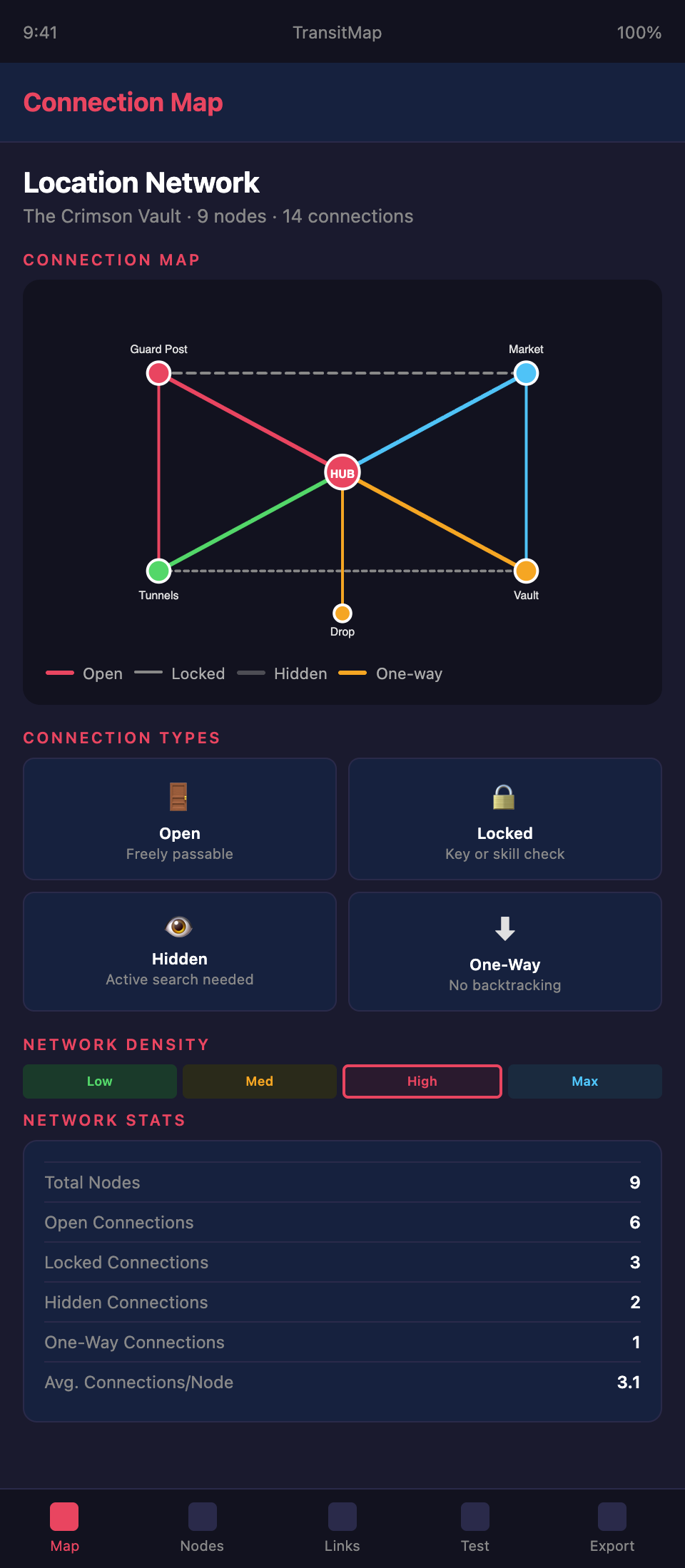
Locations Are Defined by Their Connections
A room with one entrance is a dead end. The same room with three entrances is a hub. The physical space has not changed, but its role in the adventure is completely different because of its connections.
When designing adventure locations — dungeons, cities, wilderness areas, buildings — the connections between locations are as important as the locations themselves. Connections create:
Navigation choices. When a location connects to multiple other locations, the players must choose where to go. These choices are the foundation of exploration gameplay.
Tactical considerations. Connections determine escape routes, flanking opportunities, and defensive positions. A room with one door is defensible. A room with four doors is not.
Discovery opportunities. Hidden connections — secret doors, tunnels, passages behind waterfalls — reward thorough exploration and provide alternative routes.
Pacing control. The density and arrangement of connections control how quickly players move through the adventure. Tight, linear connections slow them down. Open, networked connections let them move freely.
Connection Types
Not all connections are equal. Different connection types create different gameplay:
Open connections. Doorways, corridors, and paths that are immediately visible and freely passable. These are the default connections that define basic navigation.
Locked connections. Doors, gates, or barriers that require a key, skill check, or puzzle to open. Locked connections gate content behind challenges and create backtracking opportunities when keys are found later.
Hidden connections. Secret doors, concealed passages, or disguised paths that require active searching to find. Hidden connections reward thorough exploration and provide experienced players with advantages.
One-way connections. Slides, drops, or magical portals that allow movement in only one direction. One-way connections create irreversible navigation decisions and prevent easy backtracking.
Conditional connections. Paths that are only available under specific conditions — a bridge that only appears at midnight, a passage that opens when a lever is pulled in a different room, a portal activated by a specific item. Conditional connections create puzzles and interconnect distant parts of the adventure.
Dangerous connections. Paths that can be traversed but at a cost — a flooded tunnel, a crumbling bridge, a passage guarded by a trap. Dangerous connections force risk-reward decisions.
The Connection Map
Separate from your spatial map, create a connection map — an abstract diagram showing how locations relate to each other:
Nodes represent locations. Each room, area, or point of interest is a node. Label each node with a name or number.
Lines represent connections. Draw lines between connected nodes. Use different line styles for different connection types:
- Solid lines for open connections
- Dashed lines for locked connections
- Dotted lines for hidden connections
- Arrows for one-way connections
Annotate critical connections. Note the key or condition required for locked and conditional connections. Note the danger level for dangerous connections.
This abstract map reveals your adventure's structure more clearly than a spatial map because it strips away physical layout and shows pure connectivity.
Designing Connection Networks
Linear networks. Locations connected in a chain: A → B → C → D. Linear networks control pacing tightly but eliminate player choice. Use linear networks sparingly — for introductory sequences or tightly scripted narrative moments.
Branching networks. Locations where paths split: A → B or A → C. Branching networks provide choice and replayability. The branch should offer meaningfully different content on each path.
Hub-and-spoke networks. A central location connects to multiple outlying locations. Hub-and-spoke networks work well for investigation adventures where the central hub is a base of operations and the spokes are investigation sites.
Loop networks. Locations connected in a circuit that returns to the starting point. Loops allow players to approach locations from multiple directions and create navigation shortcuts.
Mesh networks. Highly interconnected locations where most nodes connect to multiple other nodes. Mesh networks provide maximum exploration freedom but can be disorienting. Use landmarks and distinctive features to help players navigate.
Vertical Connections
Do not limit connections to the horizontal plane:
Stairs and ladders. Standard vertical connections between levels. Note whether they are easily traversable or require skill checks.
Shafts and drops. Vertical connections that may be one-way (down only) unless the party has climbing or flight capabilities.
Elevators and platforms. Mechanical or magical vertical connections that may be locked, conditional, or limited in capacity.
Collapses and breaches. Unplanned vertical connections — holes in floors, collapsed ceilings — that allow movement between levels at unexpected points.
Vertical connections add dimensionality to your adventure and create opportunities for three-dimensional tactical thinking.
Connection Density Guidelines
Dungeon crawls: Medium density. Most rooms connect to two or three others. Occasional hubs connect to four or more. This provides choice without overwhelming navigation.
Investigation adventures: High density. Most locations should be reachable from multiple points. Investigators need freedom to move between locations as they follow clues.
Linear adventures: Low density. Locations connect in sequence with occasional branches. The adventure guides players through a designed experience.
Sandbox adventures: Very high density. Locations are highly interconnected, and players can move freely between them. Provide a map and let the players choose their path.
Mapping location connections for your adventure? Join the TransitMap waitlist — design your adventure's connection network as a transit map with color-coded connection types, locked gates, hidden passages, and conditional routes all visible at a glance.