RPG Module Editor Collaboration Workflow
Why Module Editing Is Different
Editing an RPG module is not like editing a novel or a technical manual. It combines elements of both:
Narrative editing. The adventure needs a compelling story, well-drawn characters, and satisfying dramatic structure — like a novel.
Technical editing. The module needs accurate rules, balanced encounters, and correct mechanical references — like a technical manual.
Usability editing. The module needs to be navigable, scannable, and usable at the table under time pressure — like a reference document.
Continuity editing. In non-linear modules, the editor must verify that every path combination produces a coherent experience — like editing a choose-your-own-adventure book with ten times the complexity.
Few editors are equally skilled at all four. Many module writers work with multiple editors or a single editor who makes multiple passes focused on different aspects.
The Editing Pass Sequence
Structure your editing process in distinct passes:
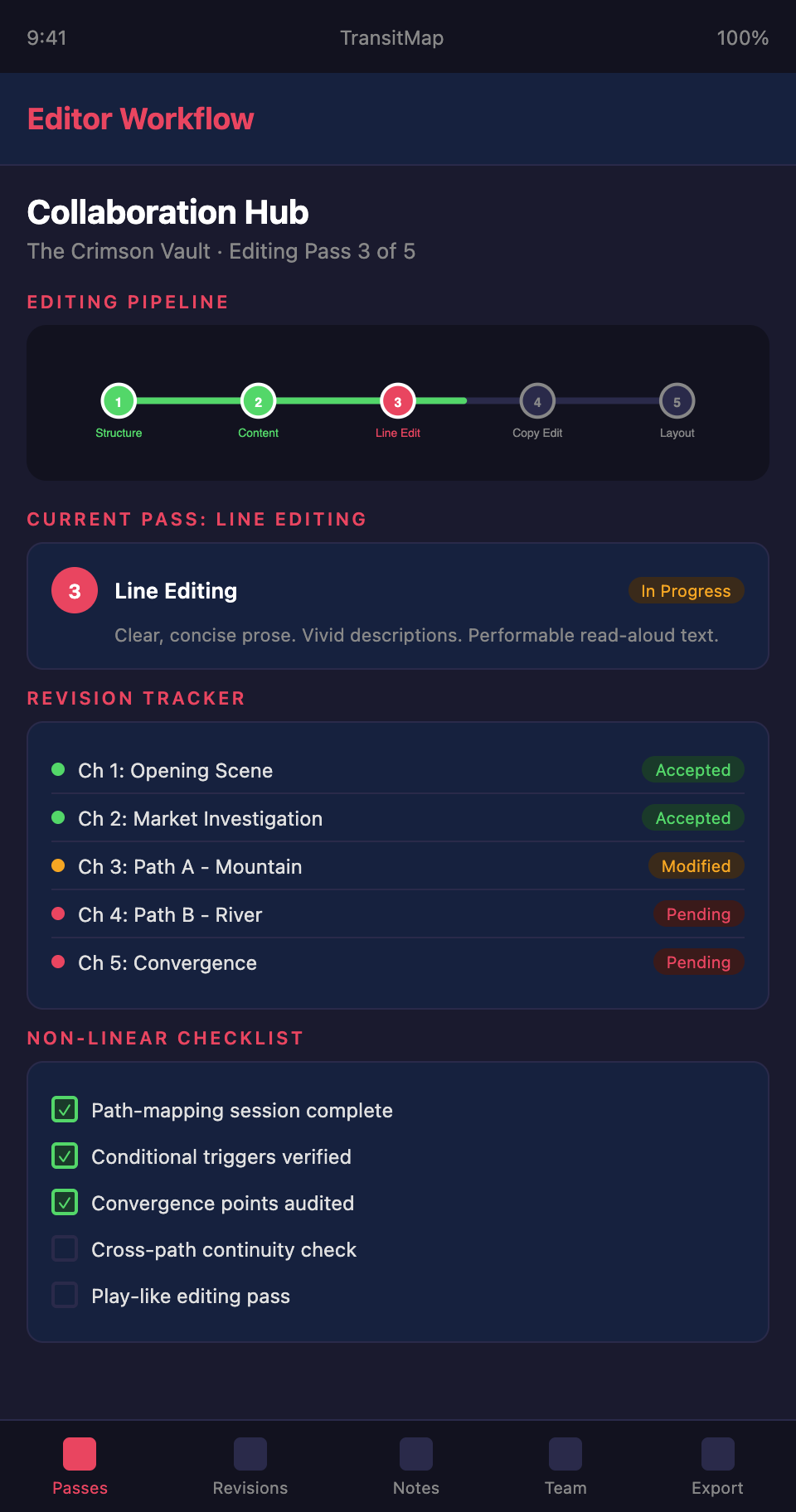
Pass 1: Structural editing. The big picture. Does the adventure structure work? Are the arcs satisfying? Is the pacing appropriate? Do the branches connect correctly? Structural editing should happen before any detail work — there is no point in polishing prose that will be cut during structural revision.
Pass 2: Content editing. The substance. Are encounters balanced? Do NPCs have clear motivations? Is the information flow correct? Does the mystery work? Content editing addresses the adventure's quality as a game product.
Pass 3: Line editing. The prose. Is the writing clear, concise, and appropriate in tone? Are descriptions vivid without being excessive? Is the read-aloud text performable? Line editing polishes the writing quality.
Pass 4: Copy editing. The details. Grammar, spelling, punctuation, consistency in terminology, correct page references, accurate stat blocks. Copy editing is the final polish before layout.
Pass 5: Layout proofing. After layout, a final pass to check that text has not been garbled, references are correct to final page numbers, and no content has been lost in the layout process.
Writer-Editor Communication
The style guide. Before editing begins, establish a style guide that covers:
- Terminology conventions (hit points vs. HP, game master vs. GM)
- Formatting standards (how to present stat blocks, read-aloud text, sidebars)
- Tone guidelines (serious, humorous, neutral)
- System-specific conventions (spell names in italics, ability scores capitalized)
The brief. Provide the editor with a brief explaining:
- The adventure's intent and target audience
- Known issues or areas of concern
- Elements that should not be changed (deliberate style choices, setting-specific terminology)
- The publishing timeline and deadline for each pass
Feedback format. Agree on how feedback will be delivered:
- Inline comments for specific text issues
- Margin notes for structural suggestions
- A separate document for big-picture feedback
- Regular check-in calls or messages for discussion
Managing Revisions
Track changes meticulously. Use tracked changes in your editing tool so the writer can see exactly what has been modified and why.
Distinguish between required and suggested changes. Not every edit is equal. Mark required changes (errors, contradictions, unusable content) differently from suggested changes (style preferences, alternative approaches).
Revision batching. Do not send revisions one at a time. Batch revisions by section or pass and send them together. This prevents revision fatigue and context-switching.
Resolution tracking. When the writer addresses revisions, they should mark each one as accepted, rejected (with explanation), or modified. The editor reviews the resolutions before the next pass.
Editing Non-Linear Content
Non-linear modules require additional editing protocols:
Path-mapping session. Before editing begins, the editor should study the adventure's flowchart and map all possible paths. This ensures the editor understands the structure before evaluating the content.
Conditional content verification. For every conditional trigger, the editor verifies:
- The condition is clearly defined
- The condition is trackable by the GM
- Both (or all) outcomes of the condition are written
- The outcomes are consistent with the adventure's logic
Convergence point auditing. At every convergence point, the editor verifies that the scene works regardless of which path the players took to arrive. This includes checking information availability, resource assumptions, and NPC knowledge.
Cross-path continuity. The editor checks that information, events, and NPC behavior are consistent across all paths. An NPC should not know something on Path A that they cannot know based on Path A's events.
The Feedback Loop
Healthy writer-editor collaboration is iterative:
First draft → structural feedback → revision → content feedback → revision → line editing → revision → copy editing → final review.
Each cycle tightens the module. Rushing or skipping cycles produces a weaker final product.
Trust the process. Writers should trust that editorial feedback improves the product even when it is hard to hear. Editors should trust that writers have reasons for their choices even when those choices seem unusual.
Collaborating with an editor on a complex module? Join the TransitMap waitlist — share your adventure's visual structure with your editing team, track revision status across branches and scenes, and ensure nothing falls through the cracks during the editing process.