Integrating World Lore into RPG Module Design
The Lore Dump Problem
Module designers who love their worlds face a persistent temptation: explain everything. The three-thousand-year history. The geopolitical alliances. The magical cosmology. The cultural traditions. All of it is fascinating — and almost none of it belongs in the adventure text.
GMs skip lore dumps. They need encounter details, NPC motivations, and tactical information. A two-page history of the elven kingdom that precedes the dungeon does not help them run the dungeon. It adds pages they have to read during prep and adds nothing they can use at the table.
Lore integration is the discipline of embedding world-building into playable content so that the world reveals itself through the adventure rather than before it.
Lore Through Environment
The most effective lore delivery method is environmental storytelling:
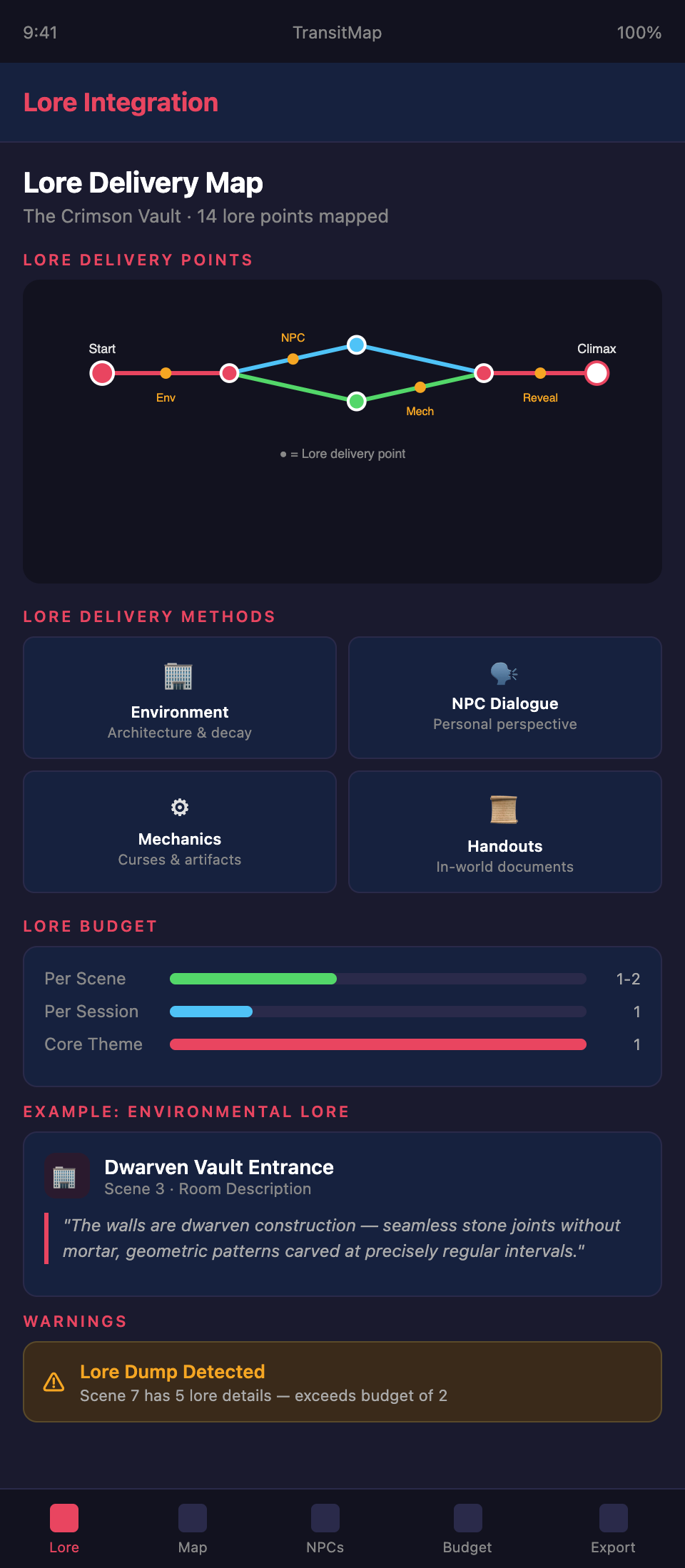
Architecture tells history. A building's design reveals its builders' culture, values, and era. "The walls are dwarven construction — seamless stone joints without mortar, geometric patterns carved at precisely regular intervals" communicates centuries of engineering tradition in one sentence of room description.
Decay tells time. The state of a location tells its age and what happened to it. "Elven script covers the walls, but the ink has been scored away in angry slashes — whoever came after the elves hated them enough to destroy their writing" delivers a historical conflict through a visual detail.
Artifacts tell stories. Objects in the environment can carry lore: a mural depicting a forgotten battle, a statue of an unknown god, a piece of technology that no one living knows how to use. These artifacts invite player curiosity without requiring exposition.
Contrasts tell change. When two architectural styles exist in the same location, the contrast tells a story of conquest, renovation, or cultural shift. "The ground floor is rough-hewn stone, but the upper levels are elegant marble — someone wealthy rebuilt on ancient foundations."
Lore Through NPCs
NPCs can deliver lore naturally through conversation:
Personal perspective. An NPC does not deliver lore objectively — they deliver their experience of it. "My grandmother remembers when the Crimson Fleet controlled this harbor. She says the taxes were lower then" is lore filtered through a character, making it feel like dialogue rather than exposition.
Conflicting accounts. Different NPCs have different versions of history. The dwarves blame the elves for the war. The elves blame the dwarves. The humans blame both. These conflicts make lore engaging because the players must decide whom to believe.
Relevant expertise. NPCs should only share lore they would plausibly know. A blacksmith knows about metallurgy traditions. A priest knows about religious history. A soldier knows about military campaigns. Limiting NPC knowledge to their expertise makes the lore feel grounded.
Reluctant sharing. Some NPCs know important lore but do not share it freely. A secret history that must be earned through trust, persuasion, or trade feels more valuable than information freely given.
Lore Through Mechanics
Game mechanics can embed lore:
Magical effects that reflect history. A curse on a location might stem from a historical event. Understanding the curse's origin (lore) provides the key to breaking it (mechanics). This makes lore mechanically relevant.
Cultural equipment. Weapons, armor, and tools from specific cultures have distinctive properties that reflect their makers' values. An elven blade is light and elegant. A dwarven hammer is heavy and unbreakable. These mechanical differences embed cultural lore.
Faction abilities. When faction NPCs use abilities or tactics distinctive to their organization, those mechanics communicate the faction's identity. The shadow assassins use poison because their culture values subtlety. The iron knights use heavy armor because their doctrine values endurance.
The Lore Budget
Set a lore budget for your module:
Per scene: one to two lore details. Each scene should communicate no more than two pieces of world-building information. More than that overwhelms the GM and the players.
Per session: one lore revelation. Each session-length portion of the adventure should include one significant lore revelation — a piece of information that deepens the players' understanding of the world in a meaningful way.
Total module: one core lore theme. The entire module should explore one aspect of the world in depth rather than touching superficially on many aspects. A module about a dwarven ruin should deeply explore dwarven culture, not briefly mention elven history, human politics, and divine cosmology.
Where Lore Belongs in the Module
In room descriptions. One or two sentences of environmental lore woven into the physical description. This is lore the GM can deliver during play without additional prep.
In NPC dialogue. Pre-written dialogue lines that include lore. The GM delivers lore naturally as part of roleplay.
In sidebars. Background lore that enriches the GM's understanding but does not need to be delivered to players. This lore informs how the GM portrays the world.
In handouts. In-world documents — letters, journal entries, inscriptions, maps — that players can read and discuss. Handouts make lore interactive.
NOT in adventure background sections. Multi-page background sections at the start of modules are the least-read content in any adventure. If lore must appear in a background section, keep it to one page and focus only on information that directly affects the adventure.
Integrating world lore into your module design? Join the TransitMap waitlist — map lore delivery points across your adventure's structure, ensuring world-building is distributed through play rather than front-loaded in unread background sections.