Writing Replayable Tabletop RPG Adventures
The Replayability Value Proposition
A replayable module delivers more value per page than a linear module. A forty-page linear adventure provides one play experience. A forty-page replayable adventure provides three, four, or more distinct experiences. For the buyer, that is dramatically better value. For the publisher, it drives word-of-mouth and repeat engagement.
Replayability also extends a module's community life. Players discuss which paths they took, compare outcomes, and recommend the module to others with the promise that "your experience will be different from mine."
What Makes a Module Replayable
Replayability comes from variability — the degree to which the experience changes between playthroughs. Variability can exist in several dimensions:
Path variability. Different routes through the adventure that provide different encounters, NPCs, and experiences. This is the most straightforward source of replayability.
Outcome variability. Different endings based on player choices. A module with three meaningfully different endings is inherently more replayable than one with a fixed conclusion.
Character variability. Content that plays differently depending on the party's composition. A stealth-focused party has a different experience than a combat-focused party, not just in difficulty but in available approaches.
Information variability. Different playthroughs reveal different information about the world, the mystery, or the backstory. Players who have completed the adventure once know certain things, but different paths reveal different secrets.
Emergent variability. Content that generates different stories through random elements, faction dynamics, or open-ended situations. This is harder to design but produces the most organic replayability.
Designing for Path Variability
True branching, not cosmetic branching. Each branch must provide substantially different content — different encounters, different NPCs, different locations. If branches differ only in flavor text, players will not feel the replay is worthwhile.
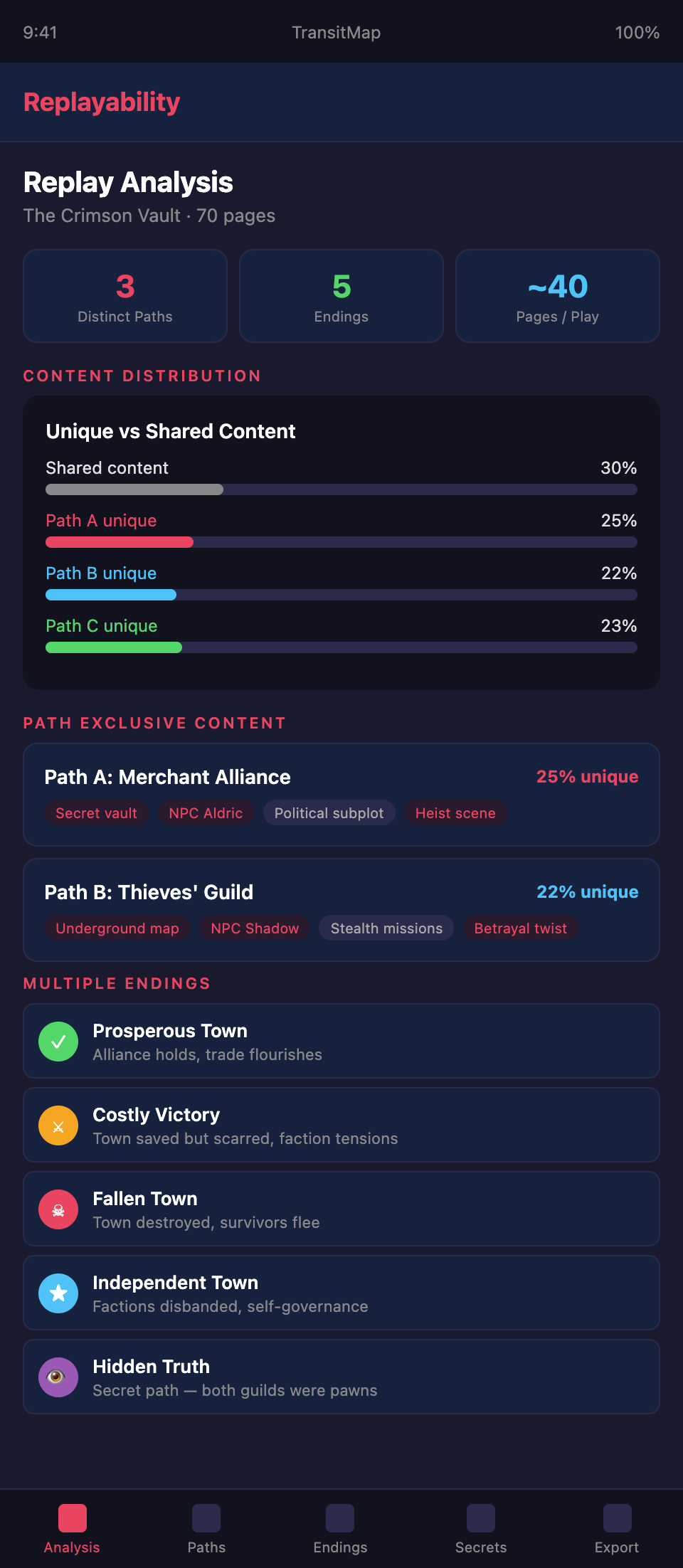
Non-overlapping content. Maximize the content that is unique to each path. If 80% of the adventure is shared between all paths, there is little incentive to replay. Target at least 40-50% unique content per path.
Mutually exclusive content. Include content that can only be experienced on one path. A room that can only be accessed from one direction. An NPC who only appears if a specific choice was made. Information that is only available through one approach. This exclusivity drives replay curiosity.
Hidden content. Include content that most groups will not find on their first playthrough. Secret rooms, hidden NPCs, alternative solutions to puzzles. Players who learn about this content from other groups or from community discussion will want to replay to find it.
Designing for Outcome Variability
Multiple endings. Write at least three distinct endings for your adventure. Each ending should feel like a complete, satisfying conclusion — not a "good ending" and two "bad endings," but genuinely different outcomes with their own emotional resonance.
Graduated outcomes. Instead of binary success/failure, design outcomes on a spectrum. The players might fully succeed, partially succeed, succeed with costs, or fail but survive. Each gradation should produce a different concluding scene.
World-state endings. The ending changes the world in different ways depending on player choices. One ending leaves the town prosperous. Another leaves it destroyed. Another leaves it independent. Players who replay want to see how different choices reshape the world.
Designing for Character Variability
Multiple solution paths. Every major obstacle should have at least two solution approaches — combat, stealth, diplomacy, magic, clever thinking. Different party compositions will naturally gravitate toward different solutions.
Class-specific content. Include optional content that triggers based on character class, background, or abilities. A rogue finds additional opportunities. A cleric receives visions. A noble has political connections. This content rewards different character choices.
Scaling challenges. Design challenges that adapt to the party's strengths, so that the experience feels tailored regardless of composition.
Designing for Emergent Variability
Random elements with narrative weight. Random tables that produce narratively significant results, not just mechanical variation. A random encounter table where each entry includes a story hook, not just a combat stat block.
Faction dynamics. When multiple factions interact based on player actions, emergent stories arise. The players help Faction A, which weakens Faction B, which makes Faction C more aggressive. Each playthrough produces a different faction landscape.
Open-ended situations. Scenes where the outcome depends entirely on player creativity rather than prescribed solutions. These scenes play differently every time because different groups bring different ideas.
Communicating Replayability
Buyers need to know your module is replayable:
State it clearly. Include replayability as a selling point in your module description: "This adventure features three distinct paths with unique content on each, leading to five possible endings."
Quantify the content. "Seventy pages of content, with each playthrough experiencing approximately forty pages." This tells the buyer how much unique content each playthrough provides.
Include a replayability guide. After the adventure text, include a section for groups replaying the module: which paths they have not yet explored, which secrets remain hidden, and what different starting choices lead to.
Designing a replayable adventure? Join the TransitMap waitlist — map every path, every exclusive content block, and every possible ending on a single visual transit map that shows the full scope of your adventure's replayable content.