Workflow for Restoring Indigo on Marian Feast Stoles
The Problem With Indigo on Liturgical Stoles
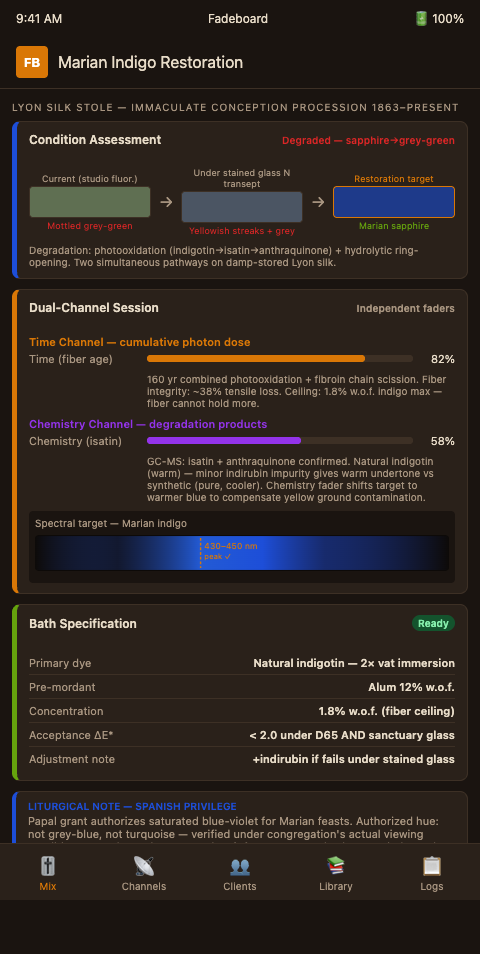
A conservator in a diocesan textile studio received a mid-nineteenth-century stole woven in Lyon silk. It had served every Immaculate Conception procession since 1863. Under studio fluorescent light it appeared a reasonable blue; under the sanctuary's stained-glass window on the north transept, the field read as mottled grey with yellowish streaks where the indigotin had photo-oxidized unevenly across the warp.
Indigo degrades through a documented sequence. Light drives the chromophore to isatin, then to anthraquinone compounds that carry no blue at all — they read as pale buff or greenish-yellow depending on the mordant residue beneath. Degradation pathways of indigo and shikonin (ScienceDirect) maps this quantum-chemical cascade and confirms that the two common paths — photooxidation and hydrolytic ring-opening — often occur simultaneously on damp-stored silk. When both pathways have run their course on the same stole panel, the fade is neither uniform nor predictable from visual inspection alone.
The liturgical stakes sharpen this problem. The Spanish Privilege: Cerulean Blue and the Immaculate Conception (Liturgical Arts Journal) documents the papal grant authorizing blue vestment use for Marian feasts in Spain and some Latin American dioceses. Blue Liturgical Vestments (EWTN) explains the scope of diocesan permission more broadly. In both traditions the authorized hue is specific — a saturated blue-violet, not a grey-blue, not a turquoise — and that specificity cannot be met by guesswork at the dye bath.
For conservators, this means the restoration target is not "a good-looking blue." It is a liturgically authorized blue, verified under the congregation's actual viewing conditions, reproducible across subsequent feast cycles.
Setting Up Independent Channels for Time and Chemistry
Indigo fade on a Marian stole involves at least two separable degradation drivers that must be treated as independent faders rather than a single combined loss.
The time channel tracks cumulative photon dose: how many decades of candlelight, stained-glass-filtered UV, and open-air procession exposure has this silk endured? Study on the photodegradation behaviors of thermal-aged silk (npj Heritage Science) shows that thermal aging and photodegradation attack the fibroin backbone at different bond sites, meaning a stole aged for 160 years will have physical fiber degradation compounding the dye loss. The time fader controls overall dye saturation recovery: how deeply can you push the restored indigo before the weakened fiber cannot hold additional mordant bath?
The chemistry channel tracks which degradation products are present. GC-MS identification confirms whether the original indigo was natural (indigotin with minor indirubin and isatan B impurities giving warm undertone) or synthetic (pure indigotin, cooler and less green on the bias). Identification of natural indigo in historical textiles by GC-MS (Springer) demonstrates the silylation protocol for making this discrimination from a fragment as small as 1 mg. Identification of Indigo and its Degradation Products on a Silk Textile (CAC-ACCR) extends this to identify isatin and anthraquinone breakdown products that must be accounted for when predicting how a restored indigo layer will read over degraded substrate.
In Fadeboard's interface, the conservator opens the stole session and creates these two faders explicitly. The time fader's midpoint corresponds to the structural fiber condition: a stole at 40% fiber integrity cannot absorb the same dye concentration as one at 80%. The chemistry fader adjusts the spectral model for the measured degradation product mix — more isatin residue shifts the target slightly toward a warmer blue to compensate for the yellow ground contamination. Adjusting one fader while holding the other fixed lets you isolate which variable is constraining your match, rather than trimming both simultaneously and losing the diagnostic record.
The output of this dual-channel session is a target spectral curve in the blue region (peak reflectance around 430–450 nm for authentic Marian indigo) along with a maximum dye-bath concentration the fiber condition can safely bear. For the Lyon silk stole, that ceiling was a 1.8% weight-of-fiber (w.o.f.) indigo in two successive vat immersions with an alum pre-mordant at 12% w.o.f.
Once the channels are balanced and the target confirmed under ISO D65 illuminant, the conservator documents the session state before touching the stole. That Fadeboard session file becomes the proof point if the restored hue is later questioned by a kermes cochineal comparison for historic scarlet copes reviewer who needs to evaluate the full restoration record.
Advanced Tactics for Marian Stole Indigo Work
Verify Under Stained Glass, Not Just D65
ISO D65 is the standard studio reference illuminant, but a Marian stole will spend its active life in a sanctuary filtered by coloured glass. Before signing off on a match, photograph the treated sample under the actual stained-glass light of the church where the stole serves. The blue-violet of a north-facing rose window can shift the perceived hue by a full Munsell step compared with studio conditions. A Brief History of Liturgical Colours (Liturgical Arts Journal) traces how the Western rite developed its canonical colors partly in the context of candlelit and glass-filtered sanctuaries — which means the authorized hue was always an in-situ concept, not a laboratory one.
Treat Both Warp and Weft Independently If They Differ
Lyon brocade and damask stoles frequently use silk warps from one dye lot and wefts from another, especially on pre-1880 pieces where the ground and the supplementary weave are structurally separate. Measure reflectance on warp threads and weft threads individually. If the time-channel values differ — older mordant on the warp, fresher on the weft — set separate dye-bath protocols for each rather than averaging them into a single bath that over-dyes one and under-dyes the other.
Record the Congregation's Memory Reference
When restoring a stole with long parish history, ask the sacristan or the parish archivist whether any photograph, fabric swatch, or written description of the original color exists. Congregation memory is liturgically authoritative in a way that no laboratory standard can fully replace. If the parish records describe "the deep blue of Our Lady's sky on a winter feast," that description constrains the restoration target in ways the Fadeboard time-channel must honor. Log this qualitative reference directly in the session notes.
Handling a Tyrian Purple analog assignment later
If the stole was catalogued ambiguously — sometimes Marian vestments used a violet-blue rather than true blue — work on the Tyrian purple analog for high-feast vestments approach in parallel before committing to the indigo-only protocol. Some Spanish-tradition Marian stoles used a bromoindigo mixture precisely because the authorized color sat between pure blue and violet.
Thread-Level Sampling Before Final Bath
Cut no more than three warp threads from a seam allowance or hem fold. Subject these to the planned dye-bath concentration and mordant sequence. Measure ΔE* against the target spectral curve under both D65 and the sanctuary's measured illuminant. Accept only if ΔE* < 2.0 under both conditions. If the sample reads within tolerance under D65 but fails under sanctuary light, the chemistry channel needs adjustment — typically a slight increase in indirubin component to compensate for the warm cast of candle-temperature glass. That adjustment feeds back into the Fadeboard session as a revised chemistry-fader position before the main treatment bath begins.
Closing Notes for Indigo Stole Work
For a painted boot pigment analysis on 1890s dolls conservator, the stakes of a wrong pigment choice are largely aesthetic. For a Marian stole, the wrong blue carries theological weight felt across a congregation's century-long feast-day memory. Channel-by-channel analysis in Fadeboard gives you the diagnostic precision to separate structural fiber age from chemical degradation before you ever open a dye vessel.
Restore Marian indigo with the certainty it deserves. Open a Fadeboard session with a dual-channel setup for your next stole, and produce a documented target before the first mordant bath touches the silk. Your diocesan review board will have a complete spectral record, and the congregation will see the authorized blue on every future feast day.