Workflow for Matching Painted Boot Pigments on 1890s Dolls
The Boot Problem Most Restorers Miss
A client drops off an 1890s Kämmer & Reinhardt composition-body doll with what she describes as "minor boot touch-up needed." What she means is that the painted ankle boots — molded in black with tan cloth-top panels — have oxidized to a muddy brownish-grey, and she wants them to match the original photograph she has pinned to the box. The face is original. The wig is original. The boots are wrong.
Boot pigments on late-Victorian dolls followed fashion trends closely. According to Vintage Dancer's history of Victorian boots, 1890s doll footwear mirrored the period's taste for black, tan, white, and two-tone cloth-top styles — the same palette that factory painters transferred to bisque and composition accessories in miniature. Those blacks were almost never carbon black. They were logwood-based.
The problem is that logwood black is not stable. As Confederate Saddles documents for military leather, oak-tanned leather bonded with a logwood-plus-iron-mordant formula for black; over decades, the logwood's haematoxylin component oxidizes back toward a warm chocolate-brown as the iron mordant breaks down. That same chemistry applies to the thinned logwood-iron washes factory painters used on doll boots. What looks like fading is actually forward chemical migration: the black reverses toward its source pigment.
Most independent restorers diagnose this as "carbon black that faded," mix carbon black with white to lighten it, and end up with a cool blue-grey that reads wrong under any light. The original chocolate-brown undertone never enters the calculation.
Separating the Channels With a Soundboard Approach
The core insight Fadeboard offers is borrowed from audio mixing: you don't fix a muddy mix by turning everything down. You find which channel is causing the problem and adjust that one fader. Boot pigments need exactly this kind of channel separation.
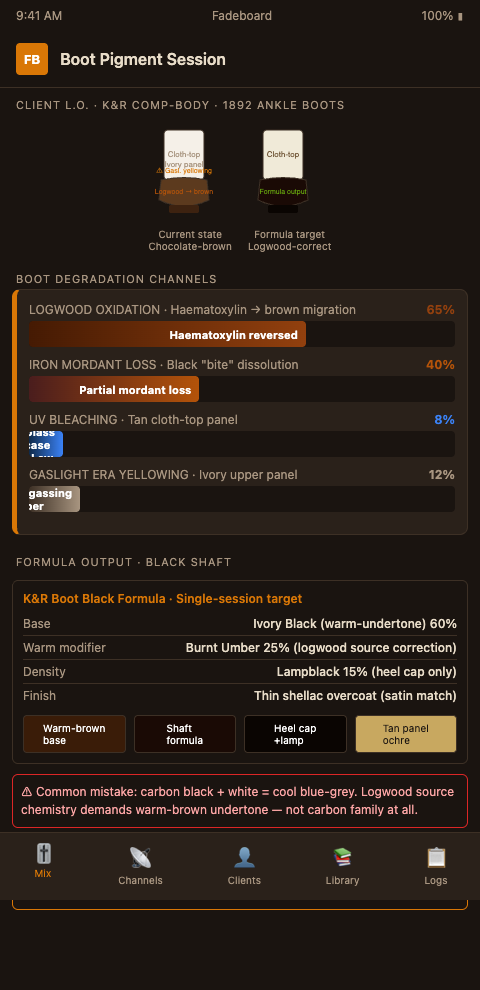
When you open a boot-pigment session in Fadeboard, you set independent faders for the relevant degradation pathways. The logwood-oxidation channel represents the haematoxylin-to-brown migration that has already occurred. The iron-mordant-loss channel tracks how much of the black's "bite" has dissolved. A third fader handles UV bleaching of any tan or buff panels. You drag each one until the on-screen simulation matches the aged reference photograph. Only then do you read the resulting pigment formula off the recipe output.
For an 1890s Kämmer & Reinhardt boot, a typical starting point has the logwood-oxidation fader pushed to about 65%, the mordant-loss fader at 40%, and the UV channel near zero (boots lived inside glass cases, not on windowsills). That combination produces a warm, slightly reddish-brown base that bears no resemblance to the raw carbon-black mixture most restorers attempt first. Before any formula is applied to the boot, the workflow for pigment matching at composition gesso loss sites addresses how to stabilize the substrate — a necessary prerequisite when the boot-to-leg boundary shows gesso deterioration that would cause uneven absorption of the boot formula.
Historic paint analysis methods — cross-section microscopy, FTIR, and optical microscopy — confirm that period pigment layers can be dated and identified precisely because each degradation pathway leaves a distinct chemical signature. Fadeboard's fader model is a practical field translation of that lab-grade insight: instead of running FTIR on a boot chip, you dial in your best estimate of each pathway's progress and let the algorithm propose the mixture.
For the tan panels, the story differs. Pre-aniline tan on 1890s doll boots typically derived from ochre or raw sienna with a small addition of lead white. The Webexhibits pigment history database documents how earth pigments like ochre are among the most photo-stable materials in the historical palette — they don't oxidize forward the way logwood does. Their fader setting stays low (15-20%) because the shift is primarily surface yellowing from varnish, not pigment chemistry. You lift that with a white-plus-burnt-sienna mix, not an ochre formula.
Building the Reference Swatch Before You Touch the Doll
The workflow that prevents a second sitting: test your formula on Bristol card cut to the same shape as the boot panel, let it dry fully, then hold it against the doll's existing surface under your studio lamp. Painted boot surfaces on composition bodies have a specific sheen — somewhere between flat and satin — because the factory applied a thin shellac overcoat over the pigment. Your Bristol card swatch needs to approximate that finish before you compare it, or you'll be chasing a phantom gloss differential.
CAMEO: Conservation & Art Materials Encyclopedia Online is invaluable here. CAMEO's entries for haematein (the oxidized form of haematoxylin) and for iron-tannate blacks give you the precise chemical properties you need to understand why your formula should skew warm rather than cool. Once you've confirmed the swatch match, record the Munsell notation. The Munsell Color System provides HVC notation that conservators use to create reproducible pigment records for future restoration — if this doll returns in five years for re-treatment, your dated recipe log eliminates the guesswork entirely.
For two-tone boots with a white or ivory upper panel, add a fourth fader pass: gaslight-era yellowing. Ivory panels in glass-case dolls often show a faint amber cast from decades of outgassing from adjacent materials. That fader sits at 10-15% for most examples but can run as high as 30% on dolls that spent time in unventilated cases.
Common Mistakes on Boot Restoration
Matching in isolation. The boot sits next to the leg, and the leg's composition body has its own degradation profile. If you match the boot correctly but the leg has shifted cooler from oxidation, the boot reads too warm. Always position your swatch against the actual adjacent surface before committing.
Ignoring the heel cap. Molded heel caps on 1890s bisque-body dolls were often painted with a higher concentration of the black formula, sometimes with added lampblack for density. That cap is usually darker than the boot shaft by half a value step. Restorers who paint the whole boot with one mixture end up with a visually flat result.
Skipping the isolating layer. Composition is porous. If you apply pigment-loaded paint directly to a raw or deteriorated composition surface, it absorbs unevenly and dries patchy. A thin isolating layer — dilute PVA or Japanese tissue with wheat-starch paste — normalizes absorbency before inpainting and prevents the "dries two shades too warm" problem that sends restorers back for a second round.
The approach here connects naturally to work on Parisian fashion doll accessories: the accent-color conventions for painted trim on Parisian fashion dolls follow similar period-palette logic, and several of the boot-black formulas overlap with the boot and trim work documented in those cases. When you're working a doll that has both painted boots and decorative trim, running both in the same Fadeboard session keeps the formula relationships coherent.
Ecclesiastical restorers working with indigo-based textiles face structurally similar logwood-oxidation problems — the Marian indigo stole restoration workflow documents how vestment conservators model haematoxylin degradation across a different substrate, and the channel-separation logic translates directly to doll boot work.
Start With the Boot, Not the Face
If a client's 11-day deadline has you prioritizing, start with the boots and accessories. Facial pigment work on bisque heads is forgiving — you can layer wash after wash, and the bisque's matte surface accepts correction easily. Boot surfaces on composition bodies have exactly one attempt before you're dealing with built-up paint that reads thicker than original. Get the Fadeboard formula dialed in on Bristol card before the brush approaches the doll, and the single-sitting match you need is achievable even on a kitchen workbench with no spectrophotometer.
If you're working an 1890s Kämmer & Reinhardt or Simon & Halbig with painted boots that have shifted to chocolate-brown, open a new Fadeboard session today — set the logwood-oxidation fader first, then calibrate the mordant-loss channel against your reference photograph, and read the warm-brown formula before you reach for carbon black. The difference between a three-sitting correction and a single correct application starts with diagnosing which fader moved.