Pigment Matching for Composition Arms With Gesso Loss
Why Composition Arms Fail Differently
The Wikipedia entry on composition dolls documents the material clearly: composition is a mixture of sawdust, wood pulp, and glue, with a plaster coating that absorbs moisture causing cracking, crazing, and peeling as the organic substrate swells and contracts. That mechanical description understates the restoration challenge: the plaster coating is not an inert substrate. It is hygroscopic, actively cycling with ambient humidity, and any pigment application that doesn't account for this cycling will crack, flake, or delaminate within months.
Unlike bisque, which is fired ceramic and dimensionally stable, composition arms are alive in the sense that they move — microscopically, seasonally, but measurably. The gesso layer that was applied at the factory to smooth the composition surface before painting acts as a buffer between the moving organic substrate and the decorative paint layer. When that gesso fails — when it cracks, chips out, or powders — the decorative paint layer loses its support and follows.
Independent restorers using kitchen-workbench setups often identify the color mismatch problem correctly but diagnose the cause incorrectly. The surface reading "two shades too dark in the loss zone" is not primarily a pigment problem. It's an absorbency problem: raw composition, exposed when the gesso chips away, drinks pigment-loaded paint far more aggressively than the surrounding gesso-covered surface. The result is always a darkening at the loss center, regardless of how carefully the formula was calibrated.
Three-Layer Thinking With Fadeboard
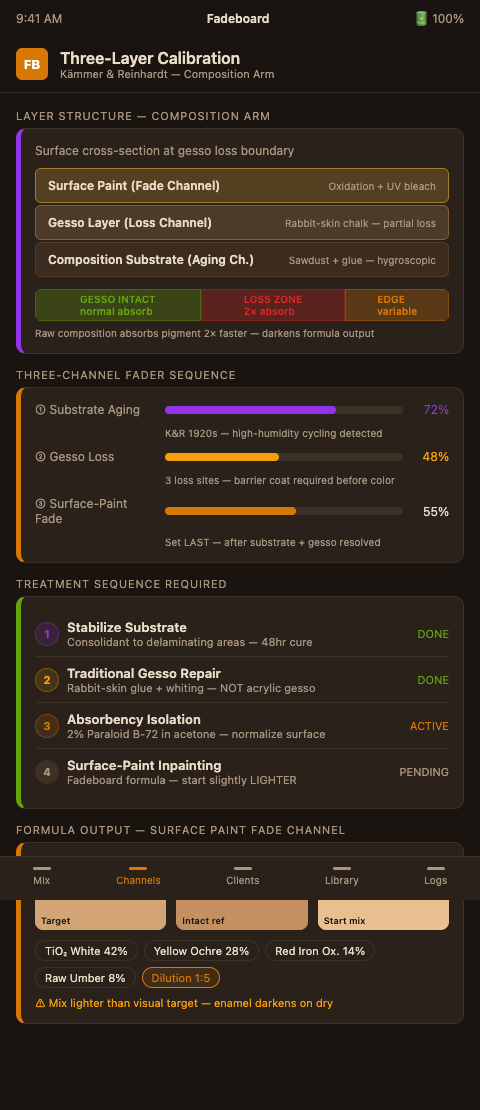
Fadeboard's contribution to composition arm work is the explicit separation of three aging channels that most restorers conflate. The substrate-aging channel models how much the composition body has deteriorated — relevant to absorbency and surface stability predictions. The gesso-loss channel tracks how much of the factory-applied gesso coating has failed, which is directly tied to the patchiness of the surface color. The surface-paint-fade channel represents the color shift of the decorative paint layer itself — oxidation, UV bleaching, and moisture-cycling, independent of the substrate condition.
Picture these as three independent faders on a soundboard. Moving the substrate channel doesn't change what the surface paint has done — it changes your prediction of how the repair material will behave on that substrate. Moving the gesso-loss channel adjusts your assessment of how much barrier coat needs to go down before any inpainting is possible. The surface-paint-fade channel, set last against reference photographs of comparable examples, gives you the color formula adjusted for the actual aging that occurred. For complex cases where identifying the original factory paint chemistry requires working from fragmentary evidence alone, the Effanbee composition pigment forensics methodology addresses how to reconstruct a formula when no reliable period reference photograph exists.
Traditional gesso preparation — rabbit-skin glue and whiting at specific ratios, applied at temperature — is the historically correct repair medium for composition gesso loss. Modern acrylic gesso is chemically incompatible with antique composition surfaces, as Wikipedia's gesso entry documents: traditional gesso uses chalk plus hide glue binder, and modern acrylic gesso's different expansion coefficient will cause delamination as the composition substrate moves. Using acrylic gesso as a quick fill for a Kämmer & Reinhardt arm effectively sets a timer on the repair.
Once the gesso repair layer has been applied, allowed to cure fully (minimum 48 hours at ambient humidity), and lightly sanded to blend with the surrounding surface profile, you can begin the color calibration phase. This is where the Fadeboard session for the surface-paint-fade channel becomes useful — the other two channels (substrate and gesso) are now resolved.
NPS Museum Handbook Chapter 8 policy on stabilization and restoration requires that all treatment categories be documented with material names and application sequences. For a composition arm with gesso loss, the treatment record has three sections: substrate stabilization (any consolidant applied to stabilize delaminating areas), gesso repair (the traditional gesso mixture, application temperature, and cure time), and surface paint inpainting (the Fadeboard formula, dilution ratio, and pass count).
Matching the Composition Surface Color
The surface color formula for 1920s-1930s Effanbee or American composition is structurally different from German bisque. According to Doll Kingdom's composition restoration documentation, restorers match pigment slightly lighter than the original formula for composition, because the enamel base with added pigment used in composition factory painting dried darker than the original batch mixture. This counter-intuitive adjustment — start slightly lighter — is one of the settings built into Fadeboard's composition surface-paint-fade channel: the channel output compensates for the factory paint's original darkening bias.
Webexhibits' documentation of Renaissance and Baroque pigment palettes establishes that lead white, ochre, and bone black formed the standard flesh-tone palettes foundational to later industrial doll paints. For early 20th-century composition arms, the factory palette was a descendant of this tradition: titanium or zinc white, yellow ochre, a small addition of red iron oxide, and in some cases a trace of raw umber to push the tone toward the cooler, slightly grey flesh characteristic of pressed composition. The Fadeboard formula output for a composition arm typically contains exactly these components in ratios calibrated to the current aged state.
Polychrome surface conservation practice at Bernacki & Associates confirms that polychrome surface conservation uses inpainting and pigment matching to address losses on painted three-dimensional objects — the composition arm case is a textbook example of this, and the professional approach described there aligns exactly with the three-layer thinking Fadeboard supports.
Avoiding the Second-Pass Problem
The most common failure point on composition arm restoration is the second pass — applying a correction layer over an initial application that dried wrong. Each correction layer adds film thickness, changes the surface sheen, and, on a mobile composition substrate, increases the risk of cracking at the repair boundary.
The way to avoid needing a second pass: pre-treat the gesso repair area with a dilute isolating medium — 2% Paraloid B-72 in acetone, or a thin PVA solution — before any color application. This normalizes the absorbency differential between the repaired zone and the surrounding surface, so the first wash of the Fadeboard formula dries at the same rate and opacity across the entire treatment area. Without this step, the repaired zone absorbs more and dries darker; with it, the surface behaves uniformly and the formula performs as calibrated.
When the question shifts from matching an existing surface to predicting long-term stability of the repair materials — whether a traditional gesso repair will hold on a piece with active humidity cycling — the modern pigments and antique gesso stability post covers accelerated-aging testing protocols relevant to composition and gesso compatibility.
Ecclesiastical conservators working with fragmentary orphrey strips and partial paint losses on vestment grounds face a parallel three-layer problem — fabric substrate, ground coat, and decorative paint layer — all with different degradation rates. The orphrey fragmentary loss pigment matching approach documents the channel-separation logic for that material type with useful crossover to composition arm work.
Substrate First, Color Second
The lesson that distinguishes professional composition restoration from amateur attempts: you cannot correct a color problem created by a substrate problem with more color. Every extra correction wash that goes down over an untreated absorbency differential makes the problem worse and adds irreversible film thickness to the surface.
If you have a Kämmer & Reinhardt, Effanbee, or American composition doll with gesso loss on the arms, run the Fadeboard three-channel calibration after the substrate and gesso steps are complete — not before. Let the gesso cure for 48 hours. Apply the isolating coat. Then calibrate the surface-paint-fade fader against the intact surrounding areas, swatch the formula on Bristol card, and apply the first wash. One correct pass, isolating coat in, gesso cured underneath. That is the sequence that avoids the three-sitting correction cycle.