Advanced Pigment Forensics on Composition Effanbee Dolls
The Composition Surface Is Not a Stable Reference Point
A restorer working on a 1932 Effanbee "Patsy" with significant facial pigment wear faces a problem that doesn't arise with German bisque: the surface beneath the paint is actively changing color. Composition — the sawdust, glue, resin, and wood flour compound used in Effanbee and similar American mass-market dolls starting around 1920 — is hygroscopic and continues oxidizing throughout its life. Composition Doll details from Wikipedia trace the material chemistry: hot-press manufacturing began around 1920 and altered surface chemistry compared to earlier papier-mâché constructions, creating a compound that responds differently to moisture and oxidation than either bisque or hardened gesso.
The practical implication: when an area of original pigment is missing due to flaking or wear, the exposed composition body reads as a warm mid-brown — not the skin tone the doll originally had. A restorer who matches their color wash to the surrounding intact pigment may find the repair reading correctly immediately after application but shifting warmer within 48 hours as the composition substrate's oxidation continues to read through the translucent pigment layer.
Restoring Collectable Composition Dolls at Doll Kingdom identifies the standard practitioner knowledge: composition restoration requires working lighter than the target tone because the surface darkens during sealing and priming. The mechanism is exactly this substrate oxidation bleed-through.
At peak production in the 1930s, Effanbee produced millions of composition dolls with varying facial pigment applications, according to Effanbee 1930s doll data from Doll Reference. The sheer number of pieces in circulation means Effanbee forensics is a recurring challenge for any studio that takes American doll commissions.
Reading the Pigment Stratigraphy Before Mixing
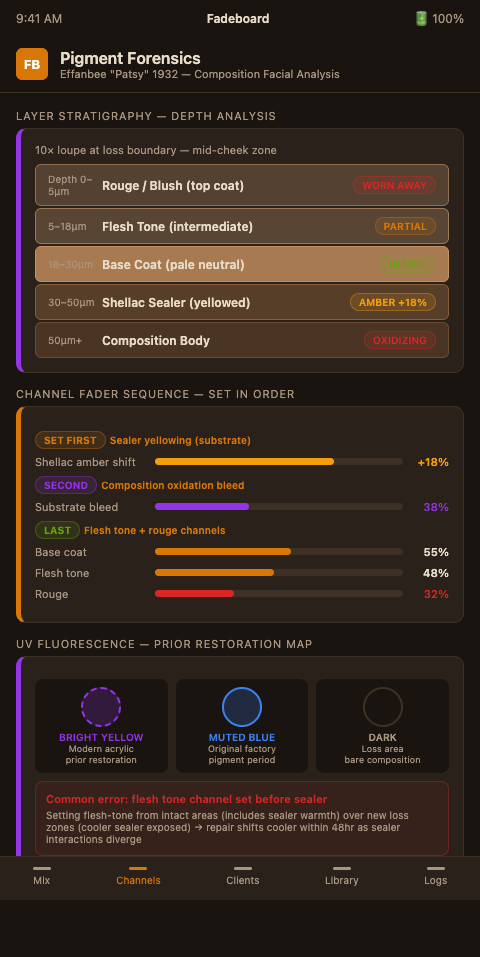
Forensic work on Effanbee composition begins with identifying how many distinct paint layers are present and which layers are still intact in different zones of the face. A 10x loupe or desktop magnifier at the boundary between an intact cheek area and a loss area typically reveals the layer structure: a pale base coat (usually a warm neutral applied directly to the sealed composition), an intermediate flesh tone, and a top blush or rouge layer applied in the studio's house style.
Effanbee 1920s doll documentation from Doll Reference describes identifiable composition batches with characteristic pigment layers that allow forensic dating — meaning the layer structure itself is diagnostic evidence about when the doll was made and what its original paint program looked like.
The forensic channel analysis in Fadeboard treats each surviving layer as an independent variable. The base-coat channel is set by sampling an intact section of the base coat at a boundary loss area — where the top layers have worn away but the base coat remains. The flesh-tone channel is set from a mid-face area showing full intact pigment. The blush or rouge channel comes from cheek areas where original top-coat rouge is still visible.
Once those three reference points are established, the missing areas can be reconstructed in sequence: base coat first at the correct base-coat channel setting, flesh tone second at intermediate opacity, rouge last. Working layer by layer rather than attempting a single-pass match eliminates the bleed-through problem because each layer is allowed to cure before the next introduces additional pigment over it. For restorers building a long-term reference archive on Effanbee composition, the microscope crazing analysis details how stereomicroscopy at loss boundaries clarifies layer structure decisions that are ambiguous at loupe magnification — the layer edges visible at 10x loupe reveal their full depth and crack infiltration at 30x stereomicroscope, which changes the sequence of fill steps.
For cases involving significant face painting wear rather than just loss areas, XRF pigment analysis from npj Heritage Science offers a non-destructive approach: X-ray fluorescence identifies the elemental composition of remaining paint, distinguishing period-authentic lead-based pigments from later restoration-added zinc or titanium whites. On a kitchen workbench without XRF equipment, the same information can be approximated by examining the color temperature of intact areas under tungsten versus daylight lighting — lead-based flesh tones shift warmer under tungsten more than titanium-white-based paints do.
Advanced Tactics for Composition-Specific Challenges
Two issues specific to composition restoration require separate channel consideration beyond the basic layer stratigraphy.
The first is crazing and cracking at loss boundaries. Composition surfaces frequently show a network of hairline cracks radiating from loss areas, caused by the material's dimensional instability under humidity cycles. In-situ pigment analysis from npj Heritage Science notes that Raman spectroscopy and FTIR allow compositional analysis of historical paint layers without sampling — but at the workbench level, UV light is the practical tool. Under UV illumination, restored areas from previous (non-original) interventions fluoresce differently than original factory pigment, mapping the extent of prior work before any new pigment is applied. This UV mapping step should precede every Effanbee forensic session to avoid matching to a previously restored section rather than to the original factory application.
The second issue is surface sealer interaction. Composition dolls were factory-sealed before painting, and the sealer layer often yellows with age at a different rate than the pigment layers above it. When a loss area exposes the sealer rather than bare composition, the target for the base-coat channel shifts: the sealer's yellowing needs to be incorporated into the base-coat mix rather than treated as neutral.
Effanbee used a shellac-based sealer on most 1920s–1930s production runs, and aged shellac yellows at a rate that correlates with UV exposure — a piece stored in a south-facing room for 90 years may show a sealer that reads 15–20% warmer and more amber than one kept in archival storage. That yellowing is a Fadeboard channel setting, not a formula component — you account for the sealer's contribution by adjusting the warm-shift channel before mixing the base coat, rather than adding extra raw umber to the paint itself.
Identifying mold-period production variants. Effanbee reformulated its composition compound multiple times between 1920 and 1940 in response to material shortages and manufacturing changes. The 1927–1932 run of the Patsy family used a higher-glue-content compound that is more prone to surface checking (fine surface cracks distinct from craze lines) than the lower-glue compound used in the 1935–1939 runs. These surface-checking patterns are visible at 10x magnification as irregular micro-fractures that run with the grain of the compressed sawdust, rather than the more uniform craze networks found in bisque. When the loss area you're reconstructing includes surface-checking, the Fadeboard base-coat channel needs an additional roughness adjustment — the formula concentration must be elevated slightly to account for the micro-fracture absorption that smooth surface areas don't present.
Common pitfall: applying the flesh-tone channel settings before the sealer yellowing is accounted for. The most frequent sequencing error on Effanbee forensic work is setting the flesh-tone channel from intact surface areas that include the sealer's warm contribution, then applying that formula over a loss area where the sealer has been newly exposed and reads cooler because the original paint layers that masked the sealer's warming are now gone. The result is a repair that reads correctly in tone next to intact areas but shifts cooler over the loss zone as the two sealer exposure conditions interact with the overlying pigment differently. Setting the sealer-yellowing channel first — as a substrate adjustment, independent of the flesh-tone and rouge channels — prevents this mismatch from developing.
The complementary 50-year fade prediction approach is directly applicable to choosing which modern pigments to use in the reconstructed layers, given that composition surfaces continue aging after restoration.
The broader forensic methodology for composition stage costumes — where layer stratigraphy under UV reveals similar period-specific coating programs — is covered in the Broadway chorus pigment forensics post, which offers transferable thinking on UV mapping and layer sequencing.
The Forensics Are the Restoration Plan
On Effanbee composition, the temptation is to start mixing toward the visible tone of the intact areas and adjust from there. This produces inconsistent results because "the visible tone of the intact areas" is a composite of base coat, intermediate layer, top coat, yellowed sealer, and ongoing composition oxidation — all simultaneously visible as a single surface color.
Fadeboard's channel structure forces the forensic analysis to happen before the mixing begins, because you cannot set independent channels without first identifying what each channel represents on this specific piece. That analysis step is not additional work; it replaces the iterative mixing-and-testing cycles that composition's unpredictability otherwise demands.
If you have an Effanbee commission on the bench that's defeated two or three previous color attempts, the issue is almost certainly undiagnosed substrate channels rather than wrong pigment choices. The channel read takes 20 minutes. What it replaces typically takes several sessions.
Open a Fadeboard session for your current Patsy, Dy-Dee, or Bubbles piece before mixing anything further. Run the sealer-yellowing channel first, then the substrate-bleed and flesh-tone channels in sequence, and compare the generated base-coat target against whatever formula your previous attempts converged on. The gap between those two numbers is almost always where the lost hours went — and it is exactly the diagnosis a color-matching approach structurally cannot produce.