Predicting 50-Year Fade on Freshly Mixed Restoration Pigments
The Matching Problem That Extends Past the Client Handoff
Most restoration color disputes happen at handoff — the client sees the finished piece under home lighting conditions and disagrees with the result. But a more insidious version of the problem plays out over years: a restoration that matched correctly at delivery begins diverging from the surrounding original surface as the new pigments and the antique bisque age at different rates.
Early Degradation Mechanisms at Acrylic/Oil Paint Interface from npj Heritage Science documents that instability between modern acrylic pigment layers and historic grounds begins before any visible color change — meaning the first signs of divergence are typically invisible to the naked eye but already in progress within the first year of application. By the time the divergence becomes visible, the restoration has been in place long enough that the original session notes may be unavailable.
For antique dolls destined for glass case display or long-term storage, this is not a hypothetical. A Jumeau bisque head restored in 2025 and stored in a collection will be examined by an appraiser or future restorer in 2050, 2060, or beyond. If the cheek rouge applied in 2025 has faded faster than the surrounding original surface, the result is a doll that looks partially restored even decades after the work was done — and a condition report that notes prior restoration pigment incompatibility.
The choice of pigment today is a commitment to how the piece will age.
Lightfastness Ratings as Channel Inputs
The established framework for predicting long-term color stability is the lightfastness rating system. The Blue Wool Scale from Wikipedia grades materials 1 through 8, where 1 fades within weeks of UV exposure and 8 maintains color over centuries. Most artist-quality pigments sold today carry a lightfastness rating in their technical data sheets; the critical step is checking those ratings before mixing rather than after.
ISO 105-B02 from Q-Lab specifies the xenon arc lamp protocol used to simulate accelerated daylight degradation. A pigment rated I or II on the ASTM scale under this protocol can be projected to maintain color stability under museum-storage conditions for 50 years or more. A pigment rated III or lower is a poor choice for any restoration intended to hold its color over generational timescales.
Lightfastness coverage from Wikipedia makes the mechanism explicit: chemical stability of pigment under sustained light exposure defines lightfastness, and photosensitive organic colorants fade fastest. This is directly relevant to the pigments commonly reached for in doll restoration: quinacridone reds, phthalo blues, and certain earth tones are rated differently, and the differences matter across a 50-year horizon.
Aspects of Longevity in Oil and Acrylic Artist Paints from Just Paint adds the binder dimension: acrylic polymers resist UV degradation and qualify as Feller Class A, while organic azo and quinone dyes degrade fastest regardless of binder. A warm red mixed from an azo dye carrier will not hold its hue as long as the same apparent color mixed from iron oxide pigment — even if they appear identical at application.
Translating Lightfastness into Fadeboard Channel Settings
In Fadeboard's channel framework, lightfastness projections operate as a forward-looking offset on the current mix. Rather than mixing to match today's target exactly, the approach accounts for how far the restoration pigment will drift relative to the surrounding original surface over the projection horizon.
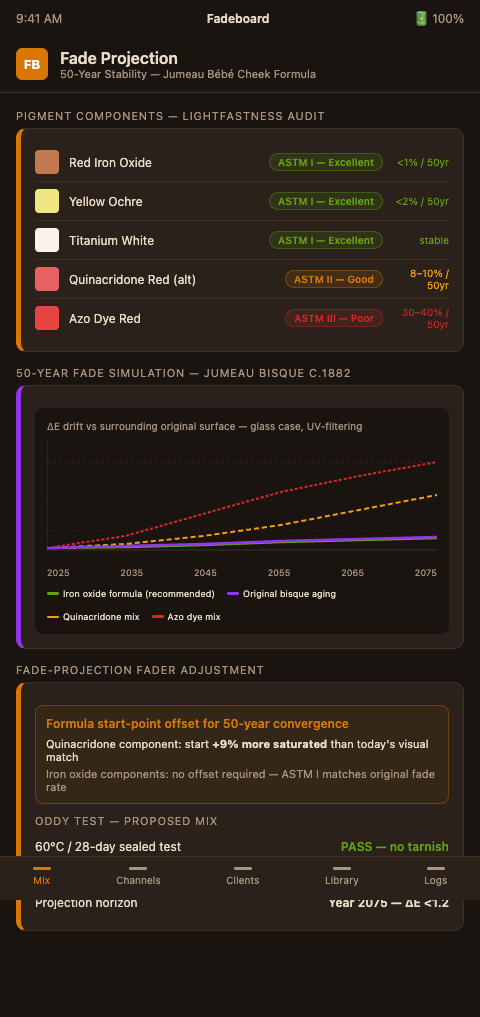
In practice: if the target cheek tone requires a medium quinacridone red component, and that pigment carries a lightfastness rating that projects 8–10% hue shift over 50 years, the restoration mix should be adjusted to start slightly more saturated than today's visible target. The original bisque around it will continue fading on its own trajectory — typically slower, since fired iron oxide pigments embedded in bisque are more lightfast than surface-applied organics — so the restoration pigment needs a head start to maintain correspondence over time.
This is the fade-projection fader on the Fadeboard soundboard: a forward channel that offsets the current mix toward where it needs to start in order to land in the right place after aging. The setting depends on: the specific pigment's lightfastness rating, the projected storage conditions (glass case with UV-filtering glass vs. open shelf near a south window), and the estimated aging rate of the surrounding original surface.
For Jumeau bisque from the 1880s already showing significant original iron oxide fade, the surrounding surface is aging slowly — most of the fastest-fading components have already gone. A restoration pigment with moderate lightfastness ratings may still match over a 50-year horizon because the rate differential between aging restoration pigment and near-stable antique surface is manageable. For a 1930s Effanbee composition piece where the original surface is still actively changing, the horizon calculation is harder and errs toward higher-rated pigments exclusively.
The modern-pigment gesso stability work and the microscope crazing adjustments both affect the fade-projection calculation: a surface with active micro-crazing transmits more UV into the pigment layer beneath it, accelerating degradation relative to intact surfaces.
Advanced Tactics: Accelerated Aging Tests Before Committing
For high-value pieces where the 50-year stability question is consequential — a Bru Jeune or Kestner at appraisal value — the Oddy test provides a practical bench-level check before committing a pigment mix to the actual doll surface.
The Oddy Test from Conservation Wiki specifies an accelerated 28-day aging protocol at 60°C that detects off-gassing incompatible with pigment stability in enclosed environments. Running an Oddy test on the proposed mix does not require institutional equipment — a small sealed glass container, the pigment sample, and a piece of polished copper or silver serve as the test coupon. Visible tarnishing or corrosion on the coupon within 28 days indicates off-gassing from the binder or pigment carrier that would compromise long-term stability in a glass case.
Met Museum Oddy test standardization work improved reproducibility of the protocol for predicting material-level risk. The bench-level version is less rigorous but still informative: if a proposed pigment-and-binder combination shows aggressive off-gassing behavior at 60°C, it will produce the same chemistry at lower temperatures over longer timescales.
The parallel challenge in historic theater costume archives — where restored pigments on silk and linen must also hold over decades under exhibit lighting — is covered in color shift under LED versus incandescent stage lighting, which uses a similar fade-projection framework adapted for textile substrates.
The Mix You Make Today Will Be Examined in 2075
The restorer who handed back that Jumeau in 1975 didn't have lightfastness testing frameworks on their workbench. The person examining that same doll today has to reverse-engineer what they did. The restorer working today has all the projection tools needed to make sure the 2075 examiner finds a restoration that still reads correctly.
Fadeboard's forward-looking fade channel is the mechanism for making that commitment explicit rather than implicit. Set the lightfastness rating of each pigment component into the projection fader before mixing, account for the storage condition estimate from the client's intake notes, and the output is a mix formula that starts in the right place for today's match and ages toward the same horizon as the surrounding original surface.
If a Jumeau or Kestner commission is on the bench and long-term stability is a client priority, start with the fade-projection channel before the color channels. The five minutes spent on the projection calculation will determine whether the match you achieve today still reads as a match in 2050.