Chemical Stability of Modern Pigments on Antique Gesso Grounds
The Gesso Ground Is Not Inert
A late 19th-century composition doll body with original gesso paint layers presents a restoration surface that is actively responding to its environment. Traditional gesso — chalk particles suspended in rabbit-skin glue — is hygroscopic: it absorbs and releases moisture with ambient humidity changes, expanding slightly in humid conditions and contracting in dry ones. Gesso from Wikipedia identifies the core material distinction: traditional gesso uses chalk in rabbit-skin glue, which behaves fundamentally differently from modern acrylic grounds.
Rabbit-skin glue behavior from Wikipedia makes the movement consequence explicit: the glue swells with humidity and shrinks in dry conditions. This cyclical dimensional movement is not a problem for the original gesso layers, which were applied and cured together as a compatible system. It is a significant problem for modern acrylic pigments applied over that ground, because acrylic films don't flex in the same way and the differential movement concentrates stress at the acrylic-gesso interface.
Early Degradation Mechanisms at Acrylic/Oil Paint Interface from npj Heritage Science documents that this interface instability begins before any visible color change. A restorer who applies modern acrylic pigment to an antique gesso surface and sees a perfect result at day 10 may not see visible delamination until month 8 — after the piece has been through two or three seasonal humidity cycles. At that point, lifting or cupping at the restoration edges becomes visible, and the piece needs intervention again.
This is not a theoretical risk for kitchen-workbench restorers. Composition doll bodies from Effanbee, Ideal, and American Character all used gesso-over-composition constructions through the 1920s and 1930s. Any commission involving a composition body with original gesso paint layers faces this compatibility question.
Compatibility Assessment Before the First Mix
The assessment protocol before applying any modern pigment over an antique gesso ground involves two parallel checks.
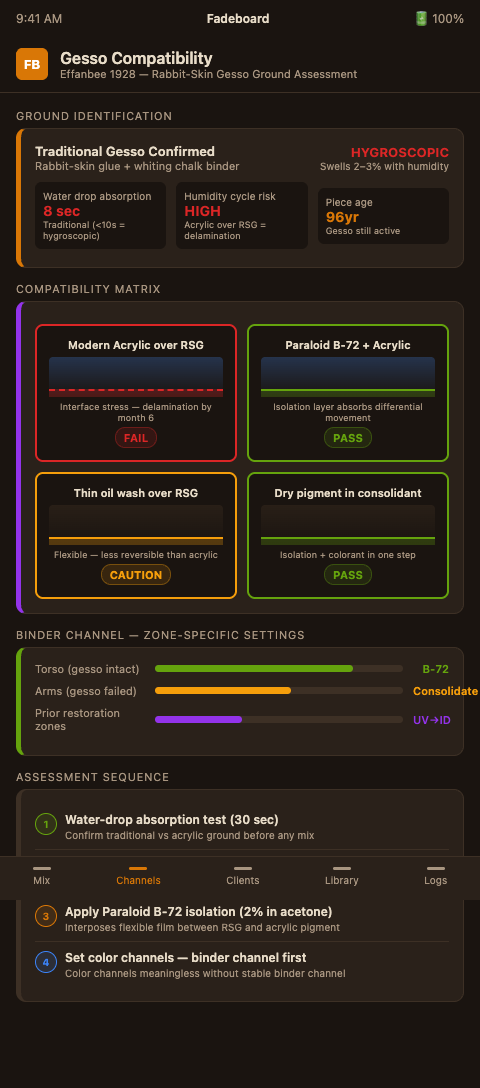
Differentiating Acrylic Gesso and Oil Ground from Just Paint identifies the first diagnostic: determine whether the existing ground is traditional (rabbit-skin glue based) or modern acrylic. The visual and tactile test is water absorption — traditional gesso absorbs a small water droplet within 5–10 seconds, while acrylic ground beads or absorbs much more slowly. If the ground is traditional, the compatibility risk is active.
Size, Primer, Gesso and Ground Explained from Jackson's Art Blog notes that rabbit-skin glue should not be used under acrylic layers precisely because mismatched sizing causes tension and cracking over time. The recommended isolation approach is an intermediate layer of diluted conservation-grade acrylic consolidant — Paraloid B-72 in acetone or a similar reversible acrylic — applied to the gesso surface before any pigment is introduced. This isolation layer interposes a flexible film between the moving gesso and the acrylic pigment above it, reducing the stress concentration at the interface.
The second check is the Oddy test on the proposed pigment and binder combination. Oddy Test Protocols from Conservation Wiki specifies that testing compatibility of new materials with historic grounds via accelerated aging prevents long-term adhesion failures. Running the test at 60°C for 28 days with the proposed pigment mix and a sample of the gesso material (scraped from a non-visible area) reveals off-gassing and corrosion risk before any material is committed to the doll surface.
In Fadeboard's channel framework, the gesso ground compatibility assessment feeds directly into the binder-selection channel — an often-overlooked channel that operates in parallel with color channels. The binder channel setting determines which vehicle is used to carry the pigment: pure acrylic medium over isolated gesso, conservation wax over non-isolated gesso, or dry pigment in a diluted consolidant where the isolation function and the colorant function are combined in a single application. The insurance appraisal documentation is directly relevant here: gesso compatibility assessment results and isolation treatment records are material information for any formal appraisal of a restored composition piece — a documented treatment record that notes "Paraloid B-72 isolation layer applied before pigment" is meaningfully different from one that simply notes "color restored."
Advanced Tactics for Long-Term Gesso Stability
Acrylic and oil paint longevity research from ResearchGate distinguishes the degradation profiles of different paint types over the same ground type. Acrylic paints over traditional gesso show earlier interface stress than oil paints over the same ground, because oil films have more elasticity and are more tolerant of the gesso's dimensional cycling. For restorers with a choice of binder system, this suggests that oil-based pigments — applied as thin washes with full drying between passes — may be a more chemically stable choice for traditional gesso surfaces than acrylic paints, despite acrylic's superior lightfastness.
The tradeoff is reversibility: acrylic films in acetone are more reversible than dry oil films, which matters for pieces with provenance significance. The choice between lightfast-but-brittle acrylic and flexible-but-less-reversible oil is not resolvable by a single rule — it depends on the expected humidity range of the piece's storage environment and the priority of long-term stability versus future reversibility.
For composition doll bodies with mixed surfaces — areas of original gesso, areas of bare composition, and areas of prior restoration using unknown materials — the channel approach separates each zone's binder requirements. The gesso zone gets isolation treatment before pigment. The bare composition zone gets a different consolidation step. The prior-restoration zone gets UV examination first to determine what material is already there before any new layer is introduced.
Common pitfall: performing the Oddy test only once at intake. Restorers who run the Oddy test at the beginning of a multi-session restoration and assume the results apply throughout the project may encounter a problem if the gesso's moisture content changes significantly between sessions — a piece stored in a humid environment between sessions can present a different absorption behavior than it showed during the initial test. For Effanbee and Ideal composition bodies from the 1920s–1930s, which have gesso layers that are especially hygroscopic after 90 years, the compatibility assessment should be re-verified at the start of each session that introduces a new binder material. The Oddy test itself only needs to run once for each material pairing, but the visual absorption test — water droplet on a non-visible gesso area — takes 30 seconds and confirms that the surface moisture state is consistent with what the Oddy test predicted.
Setting the binder channel for partial-gesso surfaces. Many composition bodies arrive with original gesso surviving on the torso but missing or compromised on the arms and shoulders. The binder channel settings for the torso and arms are not interchangeable: the intact torso gesso supports acrylic isolation, while the arm surfaces with bare or failed gesso need a different consolidation approach. Fadeboard's binder channel allows zone-specific settings within the same session — you log the torso binder protocol separately from the arm binder protocol, even if the target pigment color is the same for both zones.
The 50-year fade projection approach compounds with gesso stability: a lightfast pigment applied over an incompatible gesso ground may maintain its color chemistry while failing physically, which produces the same visible problem as a fugitive pigment over a stable ground. Both failure modes need independent channel consideration.
The aniline silk stability research documented in aniline chemical stability on silk bodices offers a parallel case where binder-substrate compatibility overrides colorant selection in restoration planning — useful reading for any restorer thinking about the interface problem in substrate-specific terms.
The Substrate Is Half the Mix
The most technically accurate pigment formula applied over an incompatible gesso ground is not a stable restoration — it is a timed failure. The color channel settings in Fadeboard are meaningless if the binder channel hasn't been set correctly for the substrate.
The assessment process described here takes one additional session before the color work begins: ground identification, water-absorption test, Oddy test on the proposed combination, and isolation layer if indicated. For a piece with genuine provenance and appraisal significance, that additional session is not overhead — it is the difference between a restoration that holds and one that returns to the workbench in 18 months with lifting edges and a disappointed client.
If a composition doll body with original gesso layers is on the bench now, the first question is not "what color is the ground?" but "will the pigment I'm planning to use adhere to this ground in five years?" Answer that first, and the color channel work proceeds on a stable foundation.
Restorers working with Effanbee, Ideal, or American Character composition bodies can book a Fadeboard demo session to walk through the gesso compatibility protocol on your next intake — contact us with the doll's maker and approximate decade and we'll set up the right binder-channel configuration before you touch the surface.