Building a Pigment Portfolio for Insurance Appraisal Work
The Documentation Gap That Costs Clients Money
A private collector submitting an insurance claim for a water-damaged 1890s Simon & Halbig bisque head discovered a problem after the adjuster reviewed the file: the pre-loss photographs were taken under incandescent home lighting with no color reference card, and the condition report from the original restoration was a handwritten note describing the cheek blush as "warm peach-pink." Neither the photographs nor the note gave the adjuster enough objective information to approve a replacement or restoration cost consistent with what the piece was actually worth.
The claim settled for 60% of the restorer's estimate because the baseline evidence was insufficient to support the full amount.
Fine Art Insurance Claims Documentation from Stella Art Conservation confirms the mechanism: insurers require documented condition reports and color photography before and after events to process claims accurately. "Documented" in this context means photographed under controlled, calibrated lighting with a color reference card visible in frame — not a snapshot under the display cabinet's warm LED.
A Collector's Guide to Appraisals from Chubb notes that insurers require Retail Replacement Value appraisals with full color and condition documentation for collectibles. For antique dolls, RRV appraisal depends on authenticated, documented condition — which requires the restorer's session records as one of the supporting inputs.
A Guide to Condition Reports from MyArtBroker establishes the standard: dated photographic condition reports provide the color and surface baseline that supports insurance claim adjudication. The key words are "dated" and "photographic" — the documentation is only useful if it was created before the loss event and can demonstrate the pre-loss state objectively.
What a Pigment Portfolio Contains
The pigment portfolio is the collection of session records that, together, constitute a verifiable color history for every piece the studio has worked on. For insurance purposes, it needs to contain three elements for each piece: pre-treatment photographs, session channel logs, and post-treatment photographs — all with consistent metadata.
Pre-treatment photographs should be taken under two light sources: the studio's calibrated daylight reference (5000K with a ColorChecker or equivalent card in frame) and a second source that approximates the piece's display environment. The two images together show both the objective color data and how that data reads in context.
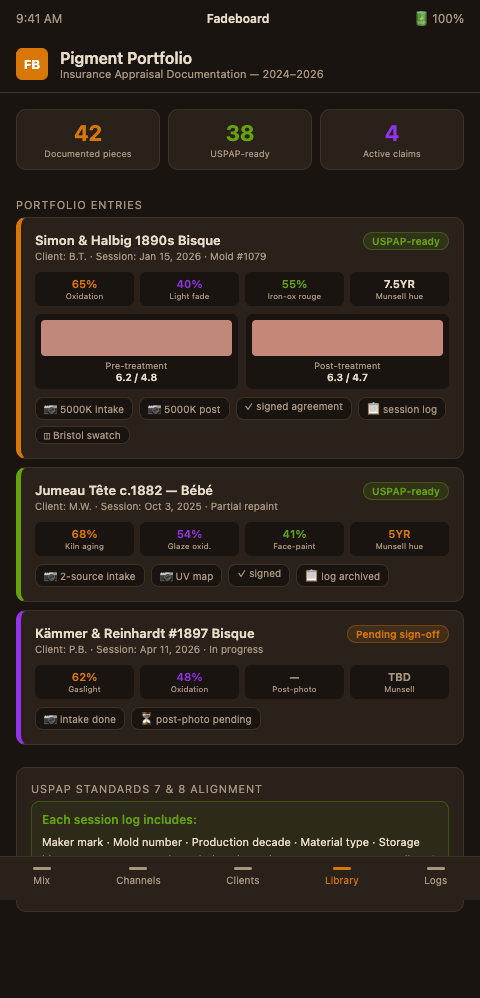
Session channel logs from Fadeboard serve as the technical record of what the pre-treatment surface condition was and how the restoration approached it. The oxidation channel setting, light-fade channel setting, and any damage-specific adjustments are all evidence of the pre-treatment state — because those settings are derived from the documented degradation profile of the piece before restoration began. A log entry that shows "oxidation channel at 65%, light fade at 40%, iron-oxide cheek rouge remaining 55% of original saturation" describes the pre-treatment condition more precisely than any prose condition note.
Post-treatment photographs under the same calibrated conditions close the documentation loop: they show what the restored surface looks like, and paired with the pre-treatment photographs, they establish that the restoration was targeted correctly. For a studio building this portfolio across multiple commission windows, solo studio scaling workflows describes the intake and session-log architecture in relation to multi-piece workflow management — the same portfolio structure that satisfies insurance documentation also accelerates setup time for the next similar commission.
Harvard's Forbes Pigment Collection demonstrates the principle at institutional scale: systematic color documentation built over decades underpins authentication and forensics. A private studio pigment portfolio is the same thing at a smaller scale — a searchable, cross-referenced record that serves authentication, dispute resolution, and insurance purposes simultaneously.
CAMEO's Forbes Pigment Database models the structured, searchable approach: a pigment directory organized to be retrievable by maker, period, material, and color characteristics. A studio pigment portfolio should follow the same organizational logic — searchable by doll maker, decade, material type, and degradation profile — so that a query for "Kämmer & Reinhardt 1895 bisque oxidation profile" returns the relevant session logs directly.
Advanced Tactics for Appraisal-Grade Documentation
USPAP from The Appraisal Foundation Standards 7 and 8 govern personal property appraisal development and reporting, including for antique collectibles. Restorer documentation that aligns with USPAP standards — dated, signed, with consistent methodology and calibrated reference photography — can be used directly by ISA or AAA appraisers to support formal valuation rather than requiring a separate condition assessment.
International Society of Appraisers Certified and Accredited members qualify under The Appraisal Foundation's definition. When a restorer's documentation package meets the evidence standards these appraisers require, the appraiser's work is faster and the resulting appraisal is more defensible — which directly benefits the collector client.
The practical tactics for building appraisal-grade documentation: standardize the lighting setup for every intake and post-treatment photograph (same fixture, same distance, same ColorChecker position); log every Fadeboard session with the piece's maker mark, date, and session purpose; and maintain a physical swatch archive — Bristol cards with dated pigment swatches from each session — as a tangible analog backup to the digital log.
The physical swatch archive is particularly important because digital files can be lost, corrupted, or disputed as to creation date. A physical Bristol card dated in the studio log and signed at creation provides an independent corroboration of the digital record that survives hard drive failures.
Common pitfall: inconsistent lighting across intake photographs. The most common documentation failure that undermines insurance appraisal work is a studio that changes its intake lighting setup — replacing one lamp model with another, shifting the workbench position, or switching from daylight to incandescent as the primary reference — without recalibrating the ColorChecker reference. An insurance adjuster or ISA appraiser comparing two photographs from the same studio taken two years apart under different (but undocumented) lighting conditions cannot reliably establish whether the apparent color difference represents a condition change or a photography artifact. Log the lamp model, color temperature, CRI, distance, and height for every intake photograph setup. When any element changes, document the change and include a calibration comparison image showing both setups with the same reference object.
Building the portfolio to USPAP structure from the first commission. USPAP Standards 7 and 8 require that personal property appraisal records include a property description, effective date, value, and the data and reasoning supporting that value. When a restorer's session log provides the pre-restoration color and condition data — including Fadeboard channel settings showing which degradation factors were active and at what level — the appraiser's description section is already substantially complete. A studio that structures its logs to USPAP-compatible format from the first session is building a portfolio that appraisers can use directly rather than requiring translation into their format. The practical fields to include in every session log: maker mark, mold number, production decade, material type, storage history (from client intake notes), pre-treatment degradation channel readings, and post-treatment Munsell coordinates for each treated zone.
For a studio building this portfolio over time, the compounding value described in future of solo doll studios is directly applicable: a portfolio spanning 50 or 100 completed sessions becomes a proprietary reference database with genuine authentication value beyond its insurance function — and the sessions logged to USPAP-compatible format become the training data that future AI diagnostic tools will be able to ingest directly.
The opera archive evidence documentation described in costume evidence for opera archives follows identical pre/post-treatment photographic logic and USPAP-aligned condition reporting — useful comparison for studios serving clients whose collections may include both textile and ceramic antiques.
Documentation Is Not Done When the Piece Ships
The common failure point in private studio documentation is treating the condition report as a delivery-day checklist rather than a permanent record. A Fadeboard session log filed and forgotten does nothing for an insurance claim three years from now when the client's storage unit floods.
The portfolio structure works because it is maintained continuously: every intake, every session, every post-treatment photograph is filed in a consistent, retrievable format. The insurance claim that comes in three years from now is answered by a 15-minute file retrieval rather than a reconstruction from memory.
If the studio currently has completed commissions without calibrated post-treatment photographs and session logs, the portfolio can still be built retroactively for pieces currently in active storage with the client. A calibrated pre-loss photograph taken today is better than no pre-loss record at all — even if the restoration session log wasn't kept at the time of original work.
Independent restorers ready to turn their session work into appraisal-grade documentation can visit the Fadeboard waitlist and sign up now — early-access members will receive the USPAP-aligned session log template along with the calibration package, so the first intake you run creates a portfolio-ready record from day one.