The Future of Pigment Restoration in Private Doll Studios
The Demand Curve Is Outpacing the Infrastructure
Antique doll collecting has been accelerating. Dolls Collectibles Market data from PR Newswire documents 42% year-over-year growth in 2023, with an 8.2% CAGR projected through 2033. The collectibles sector overall is projected at $484.6 billion according to Grand View Research, with antique dolls benefiting from authenticated, well-documented restorations.
That demand increase does not automatically translate into more qualified restorers. The pipeline for skilled bisque and composition restoration work is long — years of accumulated experience with maker-specific degradation chemistry, pigment behavior on different substrates, and the documentation standards that make restoration work defensible to appraisers and insurers. A 42% demand increase cannot be met by a 42% increase in available qualified studios within a two-year window.
The practical consequence for current studios: they're facing booking windows that stretch 6–10 weeks, with clients willing to wait but expecting correspondingly higher quality and documentation when the work is delivered. Faster tools are not the solution to this problem — more systematic tools are. A restorer who completes six commissions per month with consistent documentation is more competitive in this environment than one who completes eight per month with informal records.
Heritage Conservation Future from PMC identifies the critical gap: the heritage sector faces a structural mismatch between institutional technology adoption and independent studio capacity. Independent studios are not going to acquire $18,000 spectrophotometers, institutional XRF rigs, or institutional climate-controlled storage. But they are going to benefit from the downstream tools that make institutional-grade precision accessible at kitchen-workbench scale.
AI-Assisted Diagnostics and What They Change
Computer vision in art and cultural heritage conservation from Ultralytics describes the near-term trajectory: computer vision identifies damaged areas and models restoration options, automating tasks that previously required manual inspection. For doll restoration, the immediate application is intake assessment — a calibrated photograph of a bisque head fed into an analysis model that identifies crazing zones, loss areas, previous restoration regions, and probable original pigment channels based on maker-decade reference data.
This is not science fiction for private studios. The same type of photogrammetry that currently requires institutional scanning budgets is accessible via smartphone and low-cost photogrammetry software. Heritage Recording and 3D Modeling with Photogrammetry from MDPI Remote Sensing identifies photogrammetry as a low-cost 3D documentation path accessible to solo studios without institutional scanning resources. A solo restorer using photogrammetry for intake documentation creates a 3D surface record of the piece before any restoration begins — which is the highest-resolution condition baseline achievable and the most defensible pre-treatment evidence for insurance and appraisal purposes.
AI trend analysis from Journal of Computer Applications in Archaeology documents that predictive modeling is extending from large institutions toward smaller conservation practices. The trajectory from institutional AI to practice-level AI tools follows the same path as other professional technology adoption: 5–10 years after institutional deployment, tools arrive at accessible consumer price points.
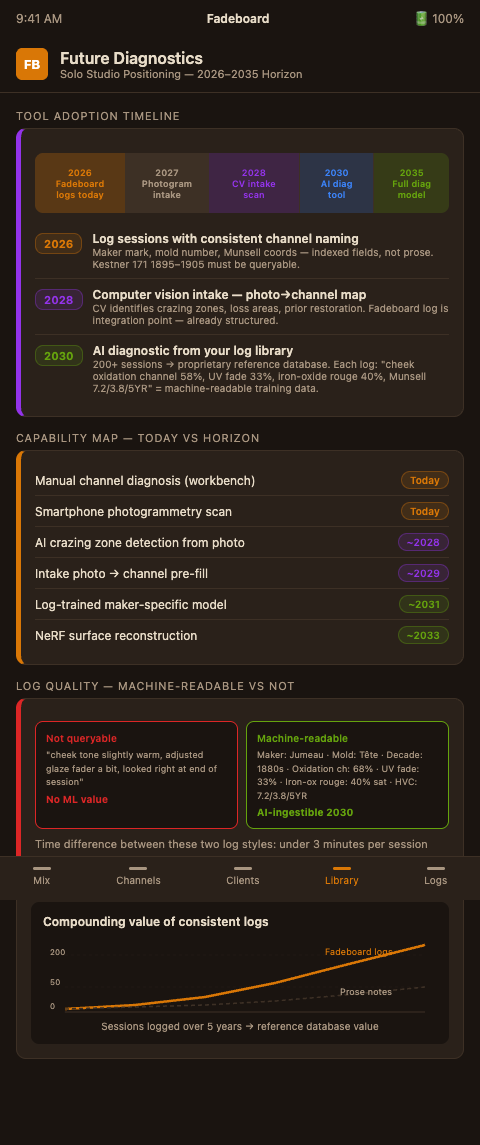
For Fadeboard users, the implication is that the channel-log architecture created today will be the training data and the integration point for those tools when they arrive. A studio with 200 logged sessions organized by maker, decade, material type, and degradation channel is positioned to use an AI diagnostic tool the moment it becomes available — because the log structure is already compatible with how those tools ingest and interpret color and condition data. The solo studio scaling workflow architecture is the specific foundation that makes future tool adoption seamless — a systematized intake, session-log, and post-treatment record structure enables new diagnostic capability integration without requiring workflow reconstruction from scratch.
Advanced Tactics for Positioning a Studio for the Next Decade
The studios that will benefit most from new diagnostic tools are the ones whose existing documentation is structured and searchable. Three practical steps build that positioning now.
First, standardize the intake photograph protocol today — calibrated 5000K lighting, ColorChecker in frame, consistent distance and angle. Every photograph taken under this protocol is immediately usable by any color-analysis tool, current or future. Photographs taken under inconsistent conditions require manual normalization before any quantitative tool can use them, which negates much of the efficiency gain. For bisque work, document the head both axially and at 45-degree raking angles: the raking image captures crazing relief and glaze-surface texture that the axial photograph flattens out, and AI intake tools calibrated on institutional collections will require that angular coverage to generate accurate surface-condition maps.
Second, use Fadeboard channel logs with consistent field naming. A log entry that consistently names the oxidation channel, the light-fade channel, the damage channels, and the bisque-body baseline channel in the same terminology across all sessions is queryable. A log with inconsistent naming requires manual interpretation before cross-session comparison is possible. The minor discipline of consistent terminology in every session log is the investment that makes the portfolio searchable at scale. For maker-specific work, add the mold number and production decade as separate log fields rather than embedding them in a free-text notes field — a query for "Kestner 171 1895–1905 oxidation channel" needs those values to be indexed fields, not buried in prose.
Third, build a physical swatch archive as a parallel record. Digital log files are searchable but can be lost, corrupted, or disputed as to creation date. Bristol cards with dated pigment swatches, stapled to session logs and cross-referenced by maker and mold number, provide an independent corroboration of the digital record that survives a hard drive failure. A studio that logs 50 Jumeau Tête sessions over three years with matching physical swatches has a reference library that neither software migration nor storage loss can erase.
Common pitfall: structuring logs for current workflow rather than future retrieval. The most frequent documentation error that undermines future tool adoption is a log designed to answer today's questions rather than the questions a diagnostic tool will ask in five years. A restorer who logs "cheek tone slightly warm, adjusted" has documented a decision for their own memory — that entry is not queryable by maker, not sortable by degradation profile, and not usable by any color-analysis model as training data. A log that instead records "cheek oxidation channel 58%, UV light-fade channel 33%, iron-oxide rouge remaining 40% of reference saturation, Munsell value 7.2 / chroma 3.8 / hue 5YR" documents the same session in a format that is both auditable today and machine-readable in 2030. The time difference between these two log styles is under three minutes per session. The retrieval and tool-adoption difference compounds across every session logged.
NeRF and diffusion-based inpainting from ScienceDirect reconstructs degraded artifact surfaces with color in 3D for reference — a tool that, when applied to a photogrammetry scan of a bisque head, could generate a reference model of the undamaged surface for any loss area. Private studios are not using this today, but the reference model concept is already implemented in Fadeboard's channel framework: the channel settings for a piece's intact areas are already a working model of the undamaged surface from which loss-area targets are derived.
The pigment portfolio for insurance appraisal is the most immediate form of that compounding value: the portfolio built over the next three years is simultaneously the foundation for AI tool integration in year four.
The parallel trajectory in theater costume conservation — where new spectral imaging tools are arriving at archive-accessible price points — is described in the future of stage costume pigment recovery, with directly applicable thinking about how documentation architecture positions a practice for new tool adoption.
The Studio Built on Logs Is the Studio Ready for What Comes Next
Private doll restoration is not going to be automated. The manual skills of bisque-surface preparation, tinted-wash application, and layer sequencing require the kind of physical dexterity and material judgment that no current or near-future tool replaces. What is going to be automated — or at minimum dramatically accelerated — is the diagnostic and documentation work that currently takes as much time as the restoration itself.
A studio that spends 30 minutes on intake photography and channel diagnosis today is preparing to spend 5 minutes on the same work in 2030, when the diagnostic tools are better. The restoration itself will still take the same skilled hands and careful attention. The log-based infrastructure means that efficiency gain accrues to the studio rather than requiring a workflow rebuild when the new tools arrive.
Fadeboard's channel structure is designed to be that infrastructure: not a tool that gets replaced, but a framework that new tools plug into as they become accessible.
Solo restorers who want their studio positioned for the next decade of diagnostic tools can subscribe to Fadeboard's early-access program now. Start logging sessions today with consistent channel naming, and your first 50 sessions become the reference library that makes every future tool adoption a five-minute integration rather than a workflow rebuild.