The Future of Stage Costume Pigment Recovery in Archives
What Has Changed in the Last Decade
Ten years ago, a theater archivist assessing a faded gaslight-era operetta bodice had access to good dye identification chemistry, reasonable conservation treatment options, and photographic documentation. What was largely absent was the ability to separate multi-cause degradation into quantified independent channels, translate a restoration target across historical light source eras, and generate color evidence documentation that met the colorimetric standards that institutional loan partners were beginning to require.
Those capabilities now exist in tools like Fadeboard, and their adoption across theater archives — slow at first, accelerating as peer institutions began requesting colorimetric loan documentation — has changed what archivists expect from their color workflows. The question now is not whether quantitative color analysis belongs in theater archives, but where the field is going next.
Preventive conservation's evolving approach to light management points to one trajectory: sensor-driven systems that monitor cumulative lux-hours in real time and alert archivists when a displayed object approaches its documented light budget. This is a monitoring capability that integrates naturally with Fadeboard session-based light budget tracking, where the session file records the object's projected fade threshold and the monitoring system records actual exposure against that threshold.
Nanomaterial Consolidation Agents
The most significant near-term development for stage costume pigment recovery is the maturation of nanomaterial-based consolidants. Research on nanoparticle and gel systems for heritage conservation documents consolidation agents — nanolime, hydroxyl apatite nanoparticles, silica gels — that penetrate degraded silk fiber at the molecular scale and stabilize the substrate without altering optical properties at the surface.
For aniline-dyed silk bodices where the substrate is fragile but the desired restoration color is achievable, traditional consolidation approaches (cellulose tissue backing, stitched supports) address structural stability but leave the degraded dye chemistry untouched. Nanomaterial consolidants address both: they stabilize the fiber while also blocking the photolysis pathways that continue to degrade aniline chromophores in stored and displayed objects.
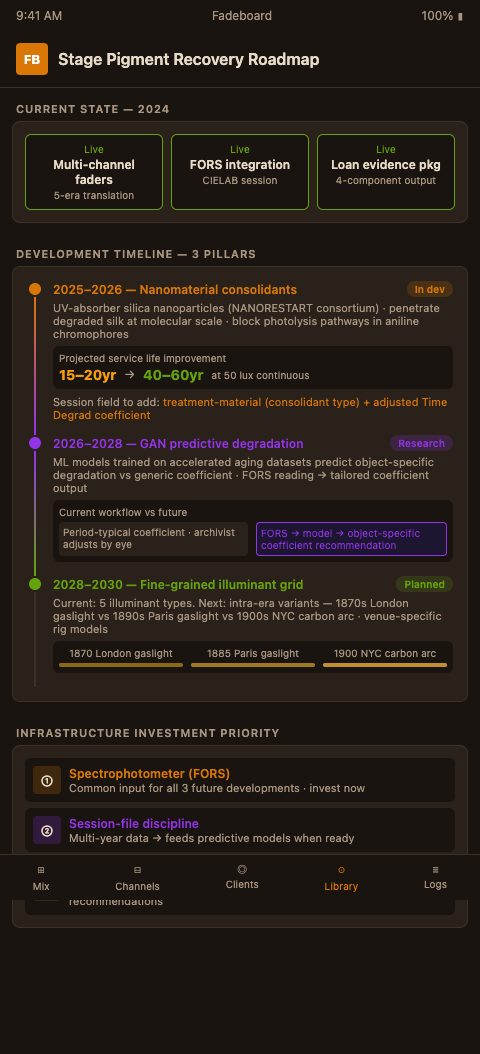
The NANORESTART research consortium's nanomaterial toolkit for artwork and textile restoration has produced UV-absorber-functionalized silica nanoparticles that demonstrate significant photostabilization in treated silk samples. Applied to aniline-dyed areas before exhibition loans, these materials could extend the effective service life of a restoration from 15–20 years under museum display conditions to 40–60 years — a change that would materially alter the monitoring and retreatment schedules that archives currently plan for.
Fadeboard's session architecture will need to accommodate this development by adding a treatment-material field that records not just the dye analog used but the consolidation system applied, and adjusts the Time Degradation fader coefficient accordingly. A session that records "fiber-reactive magenta analog plus UV-absorber silica nanoparticle treatment" should project a substantially different degradation curve than one using a dye analog alone.
Advanced analytical techniques for heritage textiles reviews how spectroscopic methods are being adapted for real-time monitoring of these nanomaterial treatments — work that will eventually feed directly into the re-measurement workflows that theater archives use to maintain their Fadeboard session records.
Predictive Degradation Modeling
The current generation of Fadeboard's Time Degradation fader operates on period-typical degradation coefficients derived from dye family lightfastness data. This is a significant improvement over visual estimation, but it does not account for object-specific factors: the microchemical environment within a particular storage box, the interaction between a mordant compound and the silk substrate's amino acid profile, or the secondary photodegradation products that accumulate in stored aniline textiles and accelerate ongoing decay.
Machine learning-based approaches to predicting visual textile degradation demonstrate that GAN models trained on accelerated aging datasets can predict object-specific degradation at accuracy levels substantially above generic coefficient models. For theater archives, this means that within the next five to eight years, a Fadeboard session will potentially incorporate spectral input from the object's current state and generate a degradation prediction calibrated to that specific object's measured response curve — not just to the average behavior of its dye family.
That capability would change the session intake workflow: instead of setting the Time Degradation fader based on period-typical coefficients and then adjusting based on visual assessment, the archivist would take a FORS reading, input it into the predictive model, and receive a coefficient tailored to the measured object. The fader would still be set manually — the model provides a recommended value, not an automatic one — but the recommendation would be substantially more accurate.
Lighting-Era Translation Sophistication
Current Fadeboard lighting-era translation channels represent five historical illuminant types: gaslight footlights, limelight, carbon arc, tungsten Fresnel, and modern LED. These cover the major eras of theatrical lighting history and handle the most common translation scenarios that theater archives encounter.
The next generation of translation tools will model a wider range of historical variants within each era. Gaslight footlights in 1870s London had a different spectral output than those in 1880s Paris or 1890s New York, due to differences in gas composition, fixture design, and maintenance practice. Early carbon arc rigs varied significantly between European houses and American touring houses based on electrode type and power supply. These intra-era variations matter for pieces with well-documented production histories, where the archive can establish not just the lighting era but the specific venue and rig configuration.
Photodegradation pathways in historic silk and stabilization interventions documents how different spectral components of historical illuminants drove different degradation pathways — findings that will eventually support finer-grained lighting-era models that distinguish not just gaslight from carbon arc but early-period gaslight from late-period gaslight.
For theater archive pipeline management, this increasing model sophistication means that session archives built today will need periodic recalibration as the translation models improve — a form of maintenance that archives should plan for as infrastructure, not as episodic revision.
Infrastructure Investments That Age Well
For theater archives planning capital investments in color documentation infrastructure over the next five to ten years, three investment categories will hold their value as the field evolves.
First, spectrophotometer infrastructure. FORS or contact spectrophotometer capability is the common input layer for every new development in predictive modeling, nanomaterial monitoring, and illuminant-specific translation. Archives that have this capability established will be positioned to adopt each successive tool generation without re-building their measurement workflow.
Second, session-file discipline. Fadeboard's value compounds as session histories accumulate across the collection. An archive that maintains complete, well-structured session files for every significant object will have a multi-year data record that feeds directly into predictive models as they mature. Archives that have maintained photographic-only documentation will face a data gap that takes years to close.
Third, staff training in color science fundamentals. As translation models and predictive tools become more sophisticated, the archivist's interpretive role does not diminish — it shifts from manual calibration to intelligent oversight of model recommendations. Staff who understand CIELAB geometry, spectral power distributions, and dye photochemistry will be better positioned to catch model errors and apply professional judgment at the points where algorithmic recommendations encounter object-specific complexity.
The LED vs incandescent color shift prediction work represents the current state of the art in lighting-era translation — archives that have adopted this methodology are already ahead of where the field average will be in three to five years.
Liturgical pigment conservation's future trajectory maps closely to this analysis — the same infrastructure investments (spectrophotometer, session discipline, color science training) apply across niche contexts where long-term collection stewardship drives the investment case.
If you are currently building or expanding your archive's color documentation infrastructure, Fadeboard's architecture is designed to absorb the tool improvements coming in nanomaterial treatment recording, predictive degradation modeling, and fine-grained illuminant translation without requiring workflow rebuilds. Build toward spectrophotometer-informed sessions now, maintain rigorous session-file discipline, and train staff in the underlying color science. The archives that do this work today will be the ones whose collections are best served by the next generation of tools.