The Future of Liturgical Pigment Work in Parish Conservation
The Parish Conservation Problem Has Always Been Scale
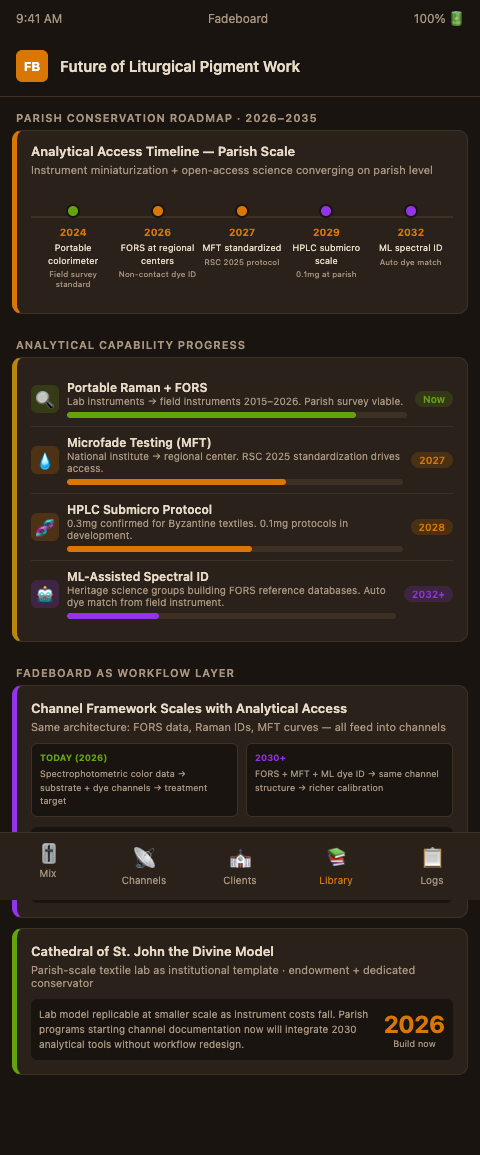
The Cathedral of Saint John the Divine in New York maintains one of the few active parish-cathedral textile conservation labs in North America. The lab's existence reflects an institutional scale — an endowment, a dedicated conservator position, purpose-built workspace — that the vast majority of parishes cannot replicate. For the typical parish with a nineteenth-century chasuble, a worn dalmatic, and an orphrey cope last treated by an unknown hand in the 1960s, the path to rigorous conservation has required outsourcing to a specialist studio with a multi-month turnaround and costs that can exceed the vestment's insurance value.
That structural constraint has shaped what "parish conservation" means in practice for most congregations. It has meant stabilization rather than restoration, storage rather than active liturgical use, and decisions made by the sacristan or the parish administrator rather than a trained conservator — people making the best choices they can with no framework for understanding what they are seeing when a cope's orphrey band has faded toward brown.
Two converging shifts are beginning to change this. The first is instrument miniaturization: portable Raman units, handheld FORS devices, and compact colorimeters that were laboratory instruments in 2015 are now field instruments routinely used for initial surveys at small institutions. The second is open-access scientific publishing: the heritage textile conservation literature is increasingly available through open-access repositories, which means the analytical foundation for liturgical pigment decisions is accessible to conservators at any scale.
Cathedral of Saint John the Divine Textile Conservation Lab provides the institutional model — an active parish-scale lab integrating conservation science into ongoing liturgical textile stewardship — that lower-barrier analytical tools may eventually make replicable at smaller scale.
Where the Analytical Methods Are Going
The analytical landscape for heritage textiles in 2026 is meaningfully different from what it was in 2015, and the changes are not yet fully reflected in standard parish conservation practice.
Microfade testing — the non-contact method for measuring a material's light sensitivity at a specific point — was for most of the 2010s a service available only from national conservation institutes. By 2025, published standardization work and instrument cost reductions have made MFT accessible at the regional conservation center level, meaning that liturgical silk lightfastness assessment is no longer a service requiring referral to a national laboratory. RSC Analytical Methods 2025 microfade testing standardization review documents the methodological maturing that is driving this accessibility shift — a signal that MFT will become a standard pre-display assessment tool for parish collections holding significant textiles.
HPLC dye identification, which required milligram-scale samples for most of its history, has been pushed toward submicro-scale extraction protocols by the analytical work on archaeological textiles. The 14th-century Byzantine textile studies have demonstrated that 0.1–0.3 milligram samples are sufficient for reliable dye identification when combined with appropriate preparation protocols. For parish vestments where sample extraction from a visible loss area is ethically and practically manageable, HPLC dye identification is no longer categorically out of reach.
Machine learning-assisted spectral interpretation is the frontier development with the longest runway but potentially the largest practical impact. Several heritage science groups are developing reference databases of textile spectral signatures that would allow FORS or portable Raman data to be automatically compared against confirmed dye identifications — effectively bringing laboratory-quality dye identification to a field instrument. The Future of Heritage Science and Technologies — Springer Nature Florence Heri-Tech 2022 papers previews several of these directions in enough detail to indicate the likely pace of development.
For vestment conservators, the implication is clear: the analytical tools that currently support rigorous channel calibration in specialist studios are moving toward the scale at which regional and parish-based conservation programs can incorporate them into routine practice.
What Fadeboard's Role Becomes
As analytical capability moves toward parish scale, the workflow architecture that connects analytical data to treatment decisions becomes more rather than less important. More capability without more structure produces inconsistency at scale — individual conservators making better-informed decisions in locally variable ways, without the institutional record that allows those decisions to compound into collective knowledge.
Fadeboard's position in the emerging landscape is as the channel framework that makes analytical input actionable and recordable at whatever scale the analytical work is conducted. A parish conservator with access to a regional FORS survey can enter that data into the substrate and dye channels and produce a treatment target and stability record that meets the same documentation standard as a specialist studio session. The channel architecture does not change with scale — it provides the same documented structure for a solo conservator working on a single parish chasuble as for a large metropolitan studio working through a diocesan collection.
Advanced analytical techniques for heritage textiles — SpringerOpen open-access collection maps the emerging instrumental methods that are reshaping the field — a reference landscape for understanding which analytical developments will reach standard conservation practice first.
Vestment studio soundboard pipeline expansion covers how the Fadeboard workflow scales within a growing specialist studio — the infrastructure model that parish and regional programs can adapt as their capacity grows.
Predicting lightfastness on restored ecclesiastical silks addresses one of the most consequential questions parish conservators will face as they take on more rigorous work: how to ensure that restoration treatments hold under the specific light conditions of sanctuary use.
The transition from natural to synthetic dyes in ecclesiastical collections adds a layer of complexity that emerging analysis methods are beginning to address: npj Heritage Science LC study on the transition from natural to synthetic dyes traces how dye choices shifted in the 19th century, directly informing conservation decisions for the large class of vestments that fall in that transitional period.
Future of natural-dye restoration in quilt conservation workshops provides a parallel track: quilt conservators face the same scaling question for analytical tools, and their experience with regional studio networks adopting portable spectroscopy offers a model for how vestment conservation programs might organize collective analytical access.
Building the Capacity Now
The conservators who will be positioned to use the analytical tools of 2030 effectively are the ones building structured workflow practices now. Adopting Fadeboard as the session architecture before portable FORS or MFT becomes accessible at your practice scale means that when the analytical tools arrive, the workflow infrastructure to use them productively is already in place.
The channel framework that currently receives spectrophotometric color data can receive FORS spectral data, Raman identifications, or MFT lightfastness curves with the same structural logic. The record that currently documents a conservator's informed judgment will document instrument-validated channel settings when the instruments become available — without requiring a workflow redesign.
The next decade will also see the liturgical conservation community building shared analytical databases that individual practices can query — reference spectral libraries for period and regional vestment production, machine-learning-assisted dye identification from portable Raman output, and collaborative lightfastness datasets for natural-dye restoration media applied to ecclesiastical silk. Studios that have been documenting their commissions in a structured channel format will have the most to contribute to and benefit from those shared resources. A Fadeboard session file from a 2026 Marian feast stole treatment, structured with substrate, dye-loss, and stability channels, becomes a data point in the collective analytical record — not just a service record for a single vestment.
For parish and diocesan programs that want to begin building this capacity today, the first step is to treat documentation rigor as a conservation value on the same level as technical skill. The vestment that receives a channel-documented treatment in 2026 will serve the conservators of 2050 and 2075 with a precision that an undocumented treatment never can.
If your practice serves parish or diocesan collections and you are thinking about how to position it for the analytical developments ahead, Fadeboard offers a session architecture that is designed to grow with your access to analytical capability. Join the Fadeboard waitlist and contact the team to discuss how to configure your initial sessions in ways that will integrate naturally with the analytical tools your practice will have access to in three to five years.