The Future of Natural-Dye Restoration in Quilt Workshops
The Current Ceiling and Why It Exists
Most quilt restoration workshops today work with natural dye systems that have not changed substantially in thirty years: madder, weld, indigo, cochineal, walnut, and logwood, applied with alum, iron, or tin mordants, adjusted by pH and temperature. The dye chemistry is well understood, the outcomes are reasonably predictable on healthy cotton fiber, and the long-term behavior has been observed across decades of restoration work.
The ceiling this approach hits is threefold. First, lightfastness: most natural dyes applied with traditional mordants fall in the Blue Wool 2–4 range, which means restored patches will show visible change within a decade under moderate display conditions. Second, mordant uptake inconsistency on aged fiber: the bonding chemistry that works on new cotton is less reliable on 19th-century cotton with depleted surface sites, producing color depth that falls short of the target even when the formula is technically correct. Third, stability matching: achieving a restored patch whose aging trajectory matches the surrounding original fabric requires precise knowledge of the original dye's degradation rate — knowledge that often doesn't exist.
Advancements in Sustainable Natural Dyes for Textile Applications — PubMed / MDPI surveys enzyme, plasma, and nanotechnology approaches developed between 2015 and 2023 that address all three of these ceilings. Enzyme pre-treatments can restore mordant bonding sites on degraded cellulose more effectively than traditional mordant re-treatment. Plasma surface activation improves dye uptake consistency without the fiber stress associated with wet pre-treatment. Some of these approaches are already in use at conservation laboratories and will reach workshop practice within a few years.
A Recent Perspective on Sustainable Color Using Natural Plant Resources — PMC synthesizes the 2009–2021 literature on biomordants — plant-based mordant substitutes for alum and metal salts — which have the potential to produce dye bonds that are more compatible with aged cellulose chemistry and that introduce no additional metal ion load to an already chemically stressed fiber.
The Fadeboard Framework as an Absorptive Layer
The argument for channel-based documentation as a future investment is not that the fader metaphor is the final word in restoration methodology — it is that the channel structure is methodology-agnostic. As dye chemistry evolves, what changes is the translation between fader settings and bath formulas, not the channel structure itself.
Today, a sun-exposure fader reading of 0.6 on an alum-mordanted madder zone translates to a specific concentration using a water-extract madder bath with standard alum pre-treatment. In five years, the same fader reading on the same zone might translate to an enzyme pre-treated cotton followed by a concentrated madder extract with a tannin biomordant — a different chemistry, but the same channel structure capturing the same degradation history.
This means that workshops investing in Fadeboard session file discipline today are building an archive that will remain interpretable as the dye chemistry evolves. The channel settings are the stable record; the bath formulas are the variable record. When a restorer is working on a companion piece ten years from now, the archived channel settings from the original project still correctly represent the degradation history of the textile, even if the restoration chemistry has changed entirely.
Micro Fading Test for Textile Single Yarns — npj Heritage Science describes a 2023 methodology for non-destructive real-time light sensitivity tracking of individual restored yarns — a technique that will enable direct measurement of whether a new dye-bath formula is matching the aging trajectory of the surrounding original fabric at the yarn level, rather than estimating it from formula chemistry alone.
Microfade Testing in Cultural Heritage — RSC Analytical Methods provides a 2025 state-of-field review confirming that microfading is moving toward standard practice for quilt conservation workshops, particularly for high-value pieces destined for institutional display. The Fadeboard forward-looking fader settings — which currently encode aging trajectory estimates — will eventually be calibrated against direct microfade measurements rather than formula-based predictions.
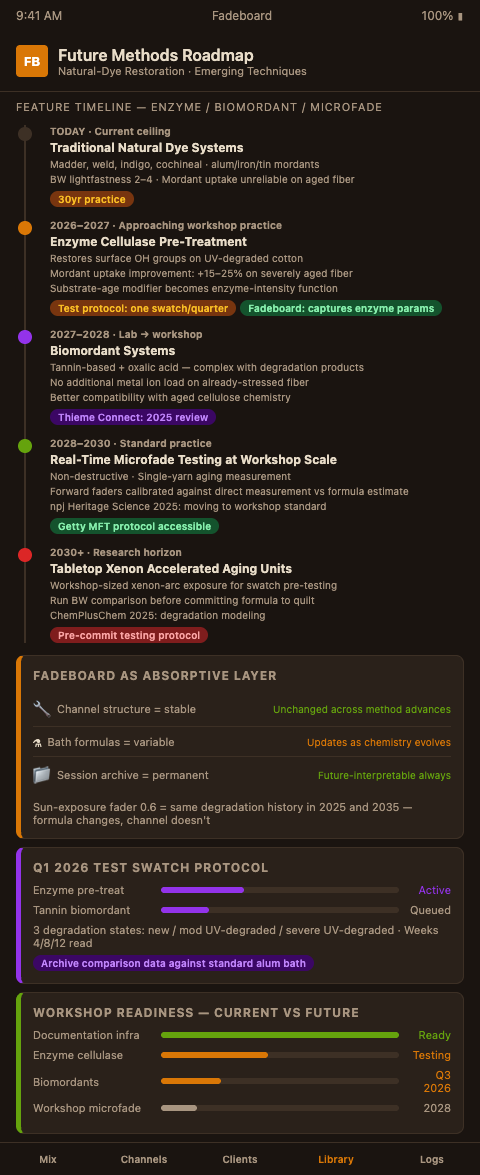
Emerging Methods Workshops Should Monitor
Three specific advances are close enough to workshop application to warrant attention now.
Enzyme cellulase pre-treatments for mordant site restoration. Research demonstrates that mild cellulase treatment can partially restore surface hydroxyl groups on UV-degraded cotton without significant fiber damage, improving mordant uptake on historic fiber by 15–25%. The practical implication for Fadeboard users is that the substrate-age modifier in the dye concentration calculation — currently applied as a flat discount for degraded fiber — could become a function of enzyme pre-treatment intensity, enabling more precise color depth targeting on severely aged cotton.
Biomordant systems. Tannin-based and oxalic acid-based biomordants offer an alternative to aluminum sulfate that may produce better dye stability on aged cellulose because they complex with existing degradation products rather than competing with them. Innovations in Natural Dyes and Biomordants — Thieme Connect reviews the current state of biomordant chemistry applicable to restoration contexts. Workshops that begin testing these systems now — and documenting the results in Fadeboard session files — will have comparative data when the methods become mainstream.
Accelerated aging protocols for workshop use. Investigating Degradation of Historical Cellulose-Derived Textiles — ChemPlusChem 2025 describes current accelerated aging research with direct implications for predicting restored patch longevity. Tabletop xenon-arc exposure units sized for workshop use are increasingly available, enabling workshops to run controlled aging tests on dye swatches before committing a formula to an irreplaceable quilt.
The workshop growth documentation systems that support scaling operations today are the same infrastructure that will capture and transmit these new methods to apprentices — the documentation framework does not change when the chemistry evolves.
Advanced Tactics: Building a Future-Methods Testing Protocol
Workshops that wait for new methods to be fully established before testing them will always be following rather than contributing. The practical alternative is a structured testing protocol that runs alongside routine work: one new method per quarter, applied to workshop-generated test swatches rather than client quilts, with results documented in a designated section of the Fadeboard archive.
The test swatch protocol is straightforward: prepare matched cotton samples in three degradation states (new, moderately UV-degraded, severely UV-degraded), apply the new method alongside the current standard method, expose both to controlled light, and compare after four, eight, and twelve weeks. The Fadeboard session file records the method parameters, the baseline readings, and the periodic measurements. Over three years, the workshop accumulates a comparative data set that directly informs which new methods are ready for quilt work.
Textiles Conservation — National Gallery of Art signals the institutional research agenda for natural dye work — workshops that align their testing protocol with NGA's research priorities are more likely to produce results that institutional clients and historical societies will credit.
The Baltimore Album quilt accent border restoration cases that represent some of the highest-value workshop projects are also the natural proving ground for new methods — the precise color matching required for Baltimore Album appliqué borders rewards any incremental improvement in dye chemistry.
The doll studio future methods discussion in adjacent disciplines covers parallel advances in synthetic substrate pigment stability — the analytical tools and the documentation frameworks are converging across restoration disciplines even as the specific materials diverge.
Workshops that are thinking now about the methods and documentation infrastructure they will need in five years are in the best position to absorb the coming advances. Fadeboard's channel-based session architecture is designed to remain the stable layer as the restoration chemistry evolves — schedule a consultation to map your current methodology against the emerging landscape.