Restoring Accent Borders on Antique Baltimore Album Quilts
Why Baltimore Album Borders Are a Separate Problem
A Baltimore Album quilt made in the 1840–1855 peak period is a textile of extraordinary complexity: twenty to thirty appliquéd blocks, each with its own fabric selection and color palette, surrounded by accent borders that were designed to frame and unify the composition. The border fabrics were chosen deliberately to complement the block palette — typically a deep green, a rich red, or a combination of both, against white or cream ground cotton.
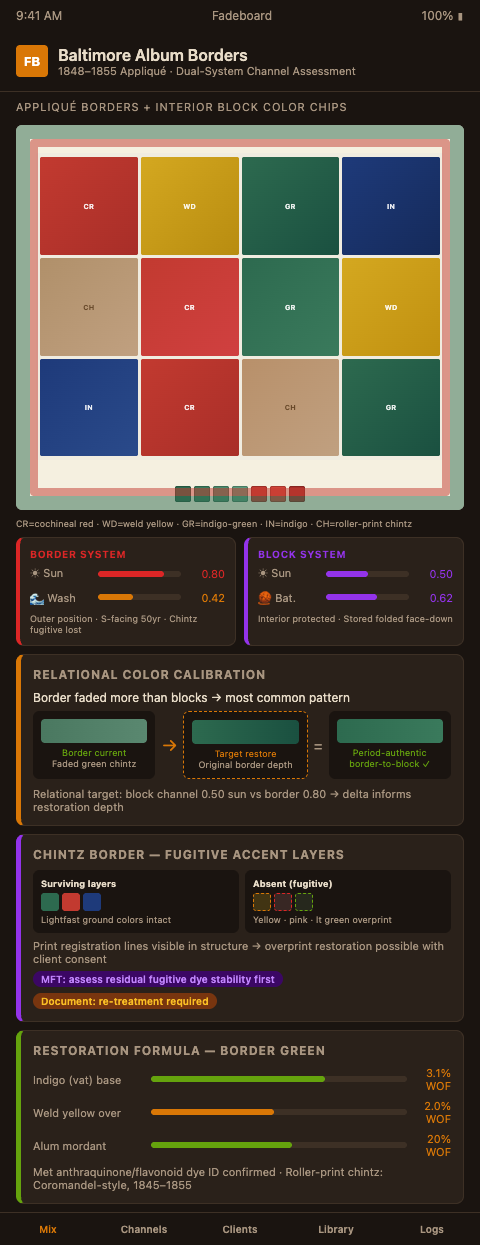
A century and a half later, the fading history of the borders and the blocks is rarely synchronous. The borders, by virtue of their outer position, often received more direct light exposure than the interior blocks during display. The interior blocks, by contrast, may have accumulated more batting-contact damage from prolonged storage if the quilt was folded with the center face-down. The result is a quilt where the blocks and the borders have faded at different rates along different channels — and where restoring the borders to their original relationship with the blocks requires modeling both histories independently before combining them.
Baltimore Album Quilts — Wikipedia provides the encyclopedic foundation for the 1840s–1855 tradition, including the specific fabric choices and border conventions that distinguish authentic period work from later interpretations. The typical accent border palette — roller-printed chintz green, cochineal or madder red, and occasionally an indigo blue accent — was not arbitrary; it was coordinated with the block appliqué fabrics at the point of construction.
Baltimore Album Quilt — Maryland Center for History and Culture documents the Maryland institution's holdings and the condition issues characteristic of the collection, which confirm that border fabric degradation is consistently more severe than center block degradation in stored pieces — a pattern directly explained by orientation-dependent UV exposure.
The restoration challenge is therefore not to match the border to its own faded state or to a hypothetical original, but to restore the border's original chromatic relationship to the blocks — a relational color problem that requires Fadeboard's channel model applied in parallel to two distinct textile systems. Workshops that have completed the 1862 sampler quilt restoration case and similar Civil War-era work will recognize this dual-channel logic immediately — it applies the same panel-indexed framework to a more precisely documented historical palette.
Channel Assessment: Borders and Blocks as Parallel Systems
The Fadeboard session for a Baltimore Album quilt begins with two separate channel assessments: one for the border system and one for the block system. They share the same session file but maintain independent fader settings.
For the border system, the dominant channel is almost always sun-exposure. Baltimore Album quilts were frequently display pieces — hung on walls or draped over furniture — and the outer border received the full brunt of whatever light the display environment provided. The sun-exposure fader for a border that was south-facing for fifty years will read considerably higher than for the interior blocks that were partially protected by the quilt's own layering.
The wash-cycle fader for the border fabrics requires separate attention because chintz-ground border fabrics often contain fugitive dyes in the printed motifs that bleed before the structural ground dye. A border that appears to have an even deep green ground may have lost printed accent colors within the green — a detail that is visible only when comparing the border to a period reference sample.
Baltimore Album Quilts Archives — Maryland Center for History and Culture provides institutional collection records that include photographic documentation of border condition across multiple quilts — a comparative reference that helps calibrate the channel assessment for a specific piece against the broader population of similar objects.
For the block system, the channel assessment prioritizes batting-contact and wash-cycle faders more heavily. The elaborate appliqué blocks in Baltimore Album quilts often used fugitive dyes — particularly in the printed chintz fabrics that were a hallmark of the style — and those dyes are vulnerable to migration under both heat and humidity. A wash-cycle fader reading that accounts for any laundering history is essential for understanding why specific appliqué colors have shifted.
Matching the Relational Color: Border to Block
Once both channel assessments are complete, the restoration goal becomes explicit: find the dye formula for each border fabric zone that, applied at the depth indicated by the border's fader readings, produces a color that stands in the correct relationship to the current state of the adjacent blocks.
This is a more complex calculation than straightforward chromatic matching because "correct relationship" requires modeling the original intent. The Baltimore Quilt Tradition — Antiques and the Arts Weekly provides trade press context on the historical palette conventions and restoration expectations for high-value Baltimore Album quilts — confirming that connoisseurs and institutional buyers are attuned to whether the border-to-block relationship reads as period-authentic or as a modern approximation.
The practical calculation runs as follows. The block system's channel readings indicate how far the blocks have moved from their original state. The border system's readings indicate how far the border has moved from its original state. If the blocks have faded more than the border — which is less common but does occur in pieces stored in specific orientations — the restoration dye for the border needs to be lighter than the border's current apparent color suggests, because the original border was calibrated against a brighter block palette. If the border has faded more than the blocks — the more common case — the restoration dye needs to achieve the depth that would have been the original relationship.
Identifying Natural Dyes to Understand a Tapestry's Origin — Metropolitan Museum describes the Met's dye identification methodology using anthraquinone and flavonoid analysis, which is the analytical tool for confirming whether a border's current apparent color represents a madder, cochineal, or combination-dye original before committing to a restoration formula.
Advanced Tactics: Chintz and Fugitive Dye Management
The roller-printed chintz fabrics characteristic of Baltimore Album borders present a restoration challenge that goes beyond the structural ground dye. Chintz from the 1840s–1855 period frequently combined a lightfast ground color — typically indigo, madder, or a combination — with overprinted fugitive accent colors in yellow, pink, and light green. After a century and a half, the fugitive accent colors may be entirely gone, leaving a monochromatic version of a fabric that was originally polychromatic.
Microfade Testing — AIC Conservation Wiki describes the non-invasive tool for assessing light sensitivity of specific border dye zones — critical for determining whether any residual fugitive dye remains in the printed motifs and whether it is stable enough to preserve.
The decision about whether to attempt restoration of fugitive accent layers requires careful consideration of what evidence remains. If the print registration lines are still visible in the fabric structure but the color is entirely gone, an overprinted restoration using a period-appropriate fugitive dye system can recover the visual effect — but this requires documented client consent and a clear record in the Fadeboard session file noting that this layer will require periodic re-treatment.
Climate and Textiles Storage — Smithsonian Museum Conservation Institute recommends 45% RH and 70°F for textile storage — conditions that are directly relevant to post-restoration care recommendations for chintz border fabrics, which are susceptible to both high-humidity dye migration and low-humidity fiber embrittlement.
The museum quilt loan coordination records built from Fadeboard session files are particularly important for Baltimore Album quilts because they are among the most frequently requested pieces for institutional loan — the documentation built during restoration becomes the loan package.
The Parisian accent color methods from doll restoration cover the same relational color challenge in miniature — the logic of calibrating accent colors against a primary palette is identical regardless of the medium.
Baltimore Album quilt restoration at this level of precision — dual-system channel assessment, relational color calibration, chintz fugitive dye management — is the workshop capability that institutional clients and serious collectors seek. If you are ready to build that capability with the documentation infrastructure it requires, schedule a Fadeboard session focused on a Baltimore Album piece from your current intake and we will walk through the dual channel assessment together.