Case Study: Restoring a Sun-Damaged 1862 Sampler Quilt
The Intake Problem: Twenty-Three Blocks, Twenty-Three Fade Profiles
The quilt came in rolled inside an acid-free tube, donated by a grandniece who had kept it folded on a south-facing window seat for most of her adult life. Before unrolling it, the workshop already knew two things: the donor's description placed construction around 1862, and the storage location explained the damage. What no one anticipated was the degree to which individual block fabrics had diverged from one another.
Unrolled on the examination table, the sampler told a complicated story. The outer border blocks — a parade of nine-patch and flying-geese units cut from madder-dyed cotton — had retained most of their warm rust tone. The center medallion, worked in weld yellow and indigo with touches of turkey red appliqué, had shifted dramatically: the weld had gone near-white in the exposed quadrant, the indigo deepened by oxidation in the protected corner, and the turkey red had split into two distinctly different hues across a single diagonal seam.
The calico strips between blocks had fared worst of all. Cut from roller-printed chintz in what was once a deep brick-red ground with cream reserves, the calico now presented a washed-out salmon on the sun-facing yardage and a truer original hue only in the tucked-under seam allowances — the one place light had never reached. Civil War Quilts: Support from the Homefront — World Quilts / Quilt Study documents the range of fabrics and dyes in use for quilts made during this period, confirming that mixed-dye sampler construction was common and that no two blocks should be assumed to share the same chemical history.
That observation set the entire restoration framework. This was not a quilt with one fade problem — it was a quilt with twenty-three distinct piecework fade problems that happened to share a border. For cochineal piecework forensics — including blocks that blend alum-mordanted and tin-mordanted carminic acid in ways invisible to the naked eye — the same block-by-block isolation framework applies at every scale of piecework complexity.
Building the Soundboard: One Channel Per Degradation Agent
The workshop's approach with Fadeboard treats each textile like a multi-track recording: the damage is not a single blended signal but a sum of independent inputs that can be isolated and addressed one at a time.
For this sampler, the first step was identifying which degradation channels had actually been active. The south-facing window exposure made the sun-exposure fader the obvious lead channel. UV photodegradation attacks the chromophore bonds in organic dyes — madder and weld lose color through irreversible oxidation of their anthraquinone and flavonoid structures respectively — and the pattern of that loss is predictable once you know the angle and duration of exposure. Effect of UV Light and Heat on Cotton Cellulose (Springer) documents the photochemical mechanisms that yellow and weaken cotton under UV, confirming that the substrate itself degrades in parallel with the dye, which matters when planning how much mechanical stress the fabric can bear during wet treatment.
The second active channel was the wash-cycle fader. The donor remembered the quilt being "freshened" occasionally over the decades — no formal laundering, but surface sponging and at least two full washings she could recall. Fugitive dyes respond to water differently than to light: they migrate outward along fibers and bleed across weave intersections rather than simply disappearing. The calico ground showed bleeding halos around the printed motifs that were consistent with water exposure, not UV alone.
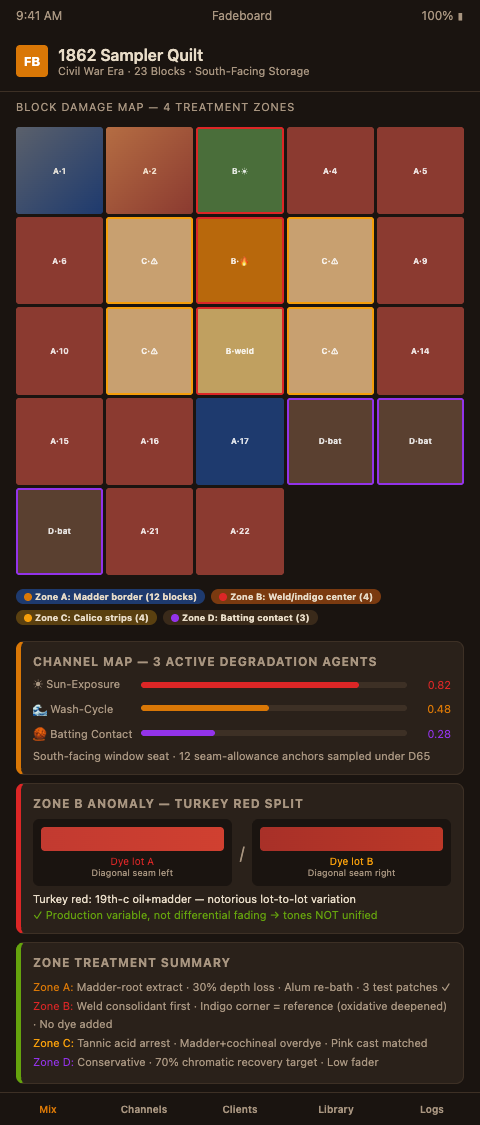
The third channel required closer inspection. In three blocks along the bottom edge, the batting contact fader was clearly in play: a characteristic yellowing and surface dye transfer pattern visible only where the cotton wadding had been pressed against the face fabric during storage. This is a slow, low-intensity channel but it concentrates in specific geometry — always parallel to the fold lines.
With all three channels identified and isolated, the Fadeboard session for this quilt became a structured calibration exercise rather than a guessing game. The sun-exposure fader was set high for the exposed quadrant blocks, tapered toward zero for the corner blocks. The wash-cycle fader was held at a moderate reading for the calico strips and zeroed for the appliqué turkey red, which showed no water-migration signature. The batting-contact fader was applied only to the bottom-edge blocks at its documented geometry.
General Effects of Ageing on Textiles — Conservation OnLine (COOL) confirms that cumulative photodegradation in textile cellulose is irreversible — the goal is not reversal but compensation, which is exactly what the channel model supports. Each fader reading translated directly into a dye-concentration adjustment for the corresponding block group.
Dye Decisions by Block Group
With the channel map established, the workshop divided the sampler into four treatment zones based on dominant degradation channel and fabric type.
Zone A — Outer border, madder blocks: The sun-exposure fader reading for these blocks was moderate rather than severe. The madder had lost approximately 30% of its original depth based on comparison with the seam-allowance samples. The restoration dye bath used a madder-root extract at reduced concentration, applied with a weak alum mordant re-bath to reactivate the fiber bonding sites. Three test patches on matching period cotton confirmed the depth before the actual blocks were treated.
Zone B — Center medallion, weld and indigo: Weld yellow on fully bleached cotton is one of the most demanding restoration targets because the fiber itself has been weakened by UV exposure. A Treatment to Reduce Fading and Degradation of Textiles (UNL Digital Commons) provides evidence-based interventions that slow UV-driven deterioration; the workshop applied the recommended consolidant treatment to the weld blocks before attempting any dye replenishment. The indigo corner received no dye addition — the oxidative deepening actually matched the intended blue more closely than the faded facing blocks, so the indigo channel fader was set to read that corner as the reference state.
Zone C — Calico strips, wash-damaged: The bleeding pattern in these strips required a two-step approach: first, a mild tannic acid bath to arrest further migration potential, then a dilute brick-red overdye using madder and a touch of cochineal to recover the warm ground tone. The cochineal component addressed a slight pink cast in the original calico print that plain madder would not replicate.
Zone D — Bottom-edge blocks, batting contact: These blocks received the most conservative treatment. Batting-contact yellowing in cotton is partially mechanical — the wadding fibers have physically abraded the outer surface — and aggressive dye application risks saturating a weakened substrate. The fader reading for this zone was set deliberately low, targeting 70% chromatic recovery rather than full match.
The panel-indexed recipe that emerged from the Fadeboard session meant that each apprentice working on the project could execute their assigned zone without needing to observe the full quilt. The channel readings were the shared language.
Advanced Tactics: Seam Allowance Sampling and Color Reference Anchors
The most reliable color reference for any antique quilt is the fabric it contains that has never seen light. Seam allowances, tuck-under margins on appliqué, and the reverse of patchwork blocks that were quilted face-down onto batting all preserve something close to the original chromatic state. The same principle governs museum loan documentation — institutional curators rely on the seam-allowance reference readings captured in a Fadeboard session file to establish the original-state reconstruction required for loan condition reports.
For the 1862 sampler, the workshop systematically sampled twelve seam allowances under controlled color-temperature lighting, recording them as reference anchors in the Fadeboard session file. These anchors functioned like the reference track in a recording session — they established the target state that each fader reading was calibrated against.
The Materials and Techniques of American Quilts and Coverlets — Metropolitan Museum provides authoritative documentation of 19th-century cotton fabrics and dye practices, which helped the workshop verify that the madder and weld choices were period-appropriate and that the calico ground was consistent with roller-printed chintz production of the 1855–1870 window.
One advanced refinement came from the turkey red appliqué anomaly. The two distinctly different hues across a single diagonal seam turned out to have a logical explanation: one side of that seam was cut from a different dye lot than the other. Turkey red — produced through a multi-step oil and madder process — was notorious for subtle lot-to-lot variation in the 19th century. Recognizing this as a production variable rather than differential fading prevented the workshop from attempting to unify the two tones, which would have been historically incorrect. The National Quilt Collection — National Museum of American History collection includes documented examples of this kind of lot variation in Civil War-era red-and-white quilts.
The final inspection compared each zone against its seam-allowance reference anchor under three lighting conditions. The Fadeboard session file was appended with post-treatment readings and archived alongside the quilt's condition report. The cross-material parallel for this kind of post-treatment channel archiving is documented in the 1865 Bru Jeune case study, where water-damaged bisque pigments required the same zone-by-zone reference anchor methodology — seam allowances replaced by glaze crevices, but the channel logic identical.
The workshop returned the quilt in a flat storage configuration with a Caring for Textiles and Costumes — Canada Conservation Institute compliant acid-free interleaving protocol, and the donor received a written summary of every dye decision tied to its corresponding channel reading — a document she said she would pass on with the quilt.
If your workshop is ready to move beyond visual approximation and treat antique piecework fade as the multi-channel problem it actually is, Fadeboard's block-indexed session files are built for exactly that complexity. Contact us to schedule a demonstration with a sampler quilt from your current intake — bring the block count, the exposure history, and the fabric types, and we'll build the channel map together.